

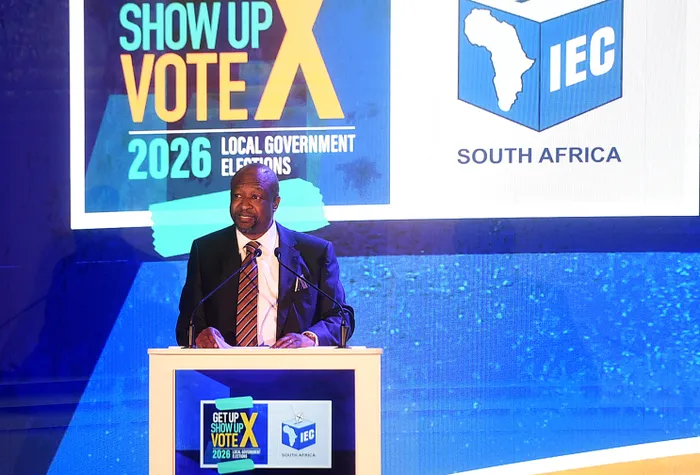
IEC CEO Sy Mamabolo. The IEC is not just announcing another voting cycle — it is activating one of the only national moments where political power is temporarily redistributed equally.
Image: Itumeleng English | Independent Newspapers
THIS past week, the Independent Electoral Commission of South Africa (IEC) officially launched the 2026 local government election season, and that matters more than some people are treating it right now.
Because the IEC is not just announcing another voting cycle — it is activating one of the only national moments where political power is temporarily redistributed equally. It is the only institution that still forces the country into a shared moment, where the rich, the poor, the powerful, and the forgotten all carry one equal voice.
And in a country like South Africa, that moment matters more than words can describe.
But you cannot talk about elections without talking about the reality they are happening inside of.
South Africans are entering this period carrying exhaustion on their backs. Across the country, communities are dealing with unemployment, deepening inequality, collapsing public trust, corruption fatigue, gender-based violence, crime, hunger, failing infrastructure, and the emotional weight of simply struggling to survive. For millions, democracy has not translated into dignity in any meaningful sense — even three decades into our democracy.
And yet, despite living in what is often described as one of the world’s most progressive constitutional democracies, many people still experience daily life through struggle, exclusion, and sheer abandonment.
That contradiction matters. Because the truth is that political freedom without economic justice has — and continues to — feel incomplete. A democracy that cannot meaningfully touch the conditions of ordinary people will always leave frustration simmering beneath the surface.
South Africa continues to wrestle with the unfinished business of colonialism and apartheid — systems that were never only political but deeply socioeconomic too. And in reality, these systems continue to ravage our post-apartheid society.
The structures may have changed, but the patterns of extraction remain painfully familiar. Neocolonialism continues to shape how wealth moves, who owns it, who benefits, and who remains disposable.
We see it in global economic systems that continue to profit from African labour, African minerals and African vulnerability while inequality deepens on the ground. We see it in the concentration of wealth among a tiny white minority while entire black communities remain trapped in generational poverty.
And when people are denied dignity long enough, anger eventually looks for somewhere to land. That is part of why South Africa continues to experience waves of violence, including Afrophobia and xenophobic attacks against fellow Africans. Economic desperation, political failure, and social fragmentation create dangerous conditions where vulnerable people become targets instead of systems becoming accountable.
Poor Black communities are forced into competition with one another while the structures producing inequality remain largely untouched. None of this exists in isolation.
This is where the responsibility of the election moment becomes unavoidable. Because, if this is the lived reality, then disengagement is not neutral. It is a political decision that leaves the existing power structures untouched. And in a country where inequality is already so deeply embedded, silence always benefits those who already hold power.
This is why voting matters. Not because elections are magical solutions. Not because one ballot paper suddenly erases centuries of inequality. But because disengagement creates even more room for unaccountable power.
The IEC spends every election cycle urging South Africans to vote for a reason. In a country where so many people feel overburdened, disappointed, and completely gatvol with the system, choosing not to participate can slowly deepen political hopelessness. And hopelessness is very dangerous — particularly for young people.
In recent years, South Africa has seen a growing wave of youth political consciousness, youth activism, and youth frustration. Young people are no longer quietly accepting the idea that they must inherit unemployment, inequality, and social instability as though it is normal.
Across campuses, communities, online spaces, and protest movements, there is an entire generation demanding accountability, justice, and a future worth believing in. This election season must become part of that pressure.
Because this is one of the few moments where everybody — rich or poor, powerful or ordinary, educated or not — stands equal at the ballot box. For a brief moment, the domestic worker, the unemployed graduate, the street vendor, the president, and the billionaire each carry equal power. That matters.
Nearly a century ago, Sol Plaatje warned: “We were turned into strangers in our own land.” That is still painfully obvious in how exclusion operates today. From neo-colonial extraction, exploitation, and calls for basic reparations, our society has long been under attack.
Decades later, Chris Hani insisted: “The struggle is not over until the basic needs of the people are met.” And truly, the struggle is still active, still unfinished, and still present — and elections are one of the few structured ways to influence how that struggle is shaped going forward.
Voting is one of the highest forms of activism. But at the same time, communities still need organising. Civil society still needs strengthening. Protests still matters. Journalism is still critical. Grassroots movements are still impactful. Holding leaders accountable between elections matters now more than ever.
Voting is still one of the only moments where the system is forced to treat everyone the same way, at the same time. One person. One vote. No shortcuts. No privilege. No excuses. And in a country like SA, that matters more than words can describe.
One thing must be made clear: When people don’t show up, nothing resets. The same problems stay. The same decisions get made. The same conditions continue, just with less resistance in the room.
And we already know what that looks like at home. It looks like inequality is getting worse and worse. It looks like corruption becoming shockingly rampant. It looks like communities are being told to wait — once again — while daily life grows more unbearable by the day. It looks like decisions are being made further and further away from the people they actually affect.
So the question is not whether voting fixes everything. It’s whether we are willing to remove ourselves completely from the one moment where we still have collective power. Because if you’re not there, you’re not shaping anything.
You’re invisible — wholly removed from the conversation. And considering how much we have to complain about as a society, absence cannot be an option.
Don’t make this an election you ignore, because the truth is, you’re still going to live under the consequences of the outcome — just like everyone else. As one of our prolific freedom fighters, Robert Sobukwe, once said: “It is in our hands to build the South Africa we want.”
* Tswelopele Makoe is a gender and social justice activist and editor at Global South Media Network. She is a researcher, columnist, and an Andrew W Mellon scholar at the Desmond Tutu Centre for Religion and Social Justice, UWC.
** The views expressed here do not reflect those of the Sunday Independent, IOL, or Independent Media.