

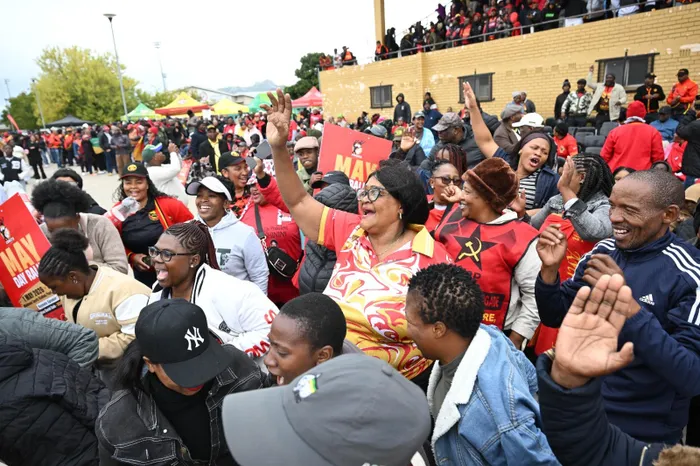
People sing and dance during COSATU's May Day rally at Mbekweni Sports Field in Paarl while artist Rhayi Zandisile performs. Workers in South Africa are not forgotten in some accidental way. It is intentional, systemic imperialism.
Image: Henk Kruger | Independent Media
“A nation that forgets its workers forgets how it was built.” And honestly, I believe that’s exactly where we are.
EVERY year, Workers’ Day comes around — another coveted long-weekend — and suddenly the same script gets regurgitated! The speeches get louder, the promises get bigger, the history gets quoted like scripture.
But for the people who actually keep this country running, nothing really shifts. The same workers we celebrate today are the ones going back to stagnant wages, uncertainty, and a system that keeps asking them to make magic out of peanuts.
To keep it completely real, workers in South Africa are not forgotten by accident. It is intentional, systemic imperialism. There is nothing accidental about how hard it has become just to live off an honest day’s work. There is nothing accidental about the gap between what workers give and what they get back.
And this past week, we saw it again; after reveling in the bliss of the past long weekend — Human Rights Day — workers are being suffocated under the thumb of a system that persistently dismisses the realities of the working class.
This past week’s strike at the Department of Communication in Pretoria by hundreds of South Africa’s postal workers is nothing to sweep under the rug. Innumerable working class members of our society — many of them hanging on by a thread — took to the streets to demand what should never even have been up for debate: fair wages, job security, and a future.
The crisis at the South African Post Office is not new. It has been building, slowly and then all at once. Years of mismanagement, hollow restructuring plans, and political indifference have pushed workers into a corner. And now, when they speak, when they march, when they refuse to quietly accept collapse — they are ‘conveniently’ treated like a disruption.
But what we saw this week was not disruption. It was desperation. It was workers saying: "We cannot keep living like this." Because, beyond SAPO, this is the story of millions of workers across the country.
The cost of living is rising at a pace that wages and salaries simply cannot keep up with. Food prices skyrocket. Transport costs soar. Education, healthcare, and electricity (amongst so many more) have absolutely stratified.
Not only have everyday expenses become more expensive, but also more unreliable. And somehow, workers are expected to absorb all of it. To budget better. To stretch less into even less. To survive what is very clearly becoming unsurvivable.
We are living in a country where having a job no longer guarantees stability. And this is particularly disheartening considering our extreme unemployment rates that — over three decades into democracy — still stagger at 41%. This doesn’t even include the youth, who comprise the majority of South Africans and hold an unemployment rate exceeding 58%.
Ultimately, full-time workers are still trapped in poverty. Where the distance between effort and reward has become so wide that it almost feels insulting to even call it a gap — it’s a gulf. And that’s the part we don’t talk about enough on Workers’ Day.
We don’t talk about the fact that poverty in South Africa is not just high—it is deep, it is structural, and it is incessantly stubborn. It is the kind of poverty that doesn’t just limit income, it limits possibility. It shapes what kind of healthcare you can access, what kind of education you & your children receive, and what kind of future you are even allowed to imagine.
What does dignity even look like when public healthcare systems are overburdened and under-resourced? When clinics are overcrowded, understaffed, and stretched beyond capacity? What does it mean to be a worker in a country where getting sick can so easily become a financial crisis? What does dignity look like when housing remains out of reach for so many?
When people spend hours commuting from the margins of cities into economic centres that still refuse to fully include them? When informal settlements continue to grow, not because people want to live there, but because they have run out of options?
And through all of this, we are told to be patient. To trust the process. To believe that reform is coming — that the justice that near-millions died for during the liberation struggle is actually existing in the SA of today.
But patience does not pay rent. Process does not put food on the table. And belief, on its own, does not build a future.
That is why the anger we are seeing — from postal workers, from public sector workers, from young people trying to enter a shrinking job market — is not simply irrational. It is not dramatic or excessive. It is the natural, human response to a system that feels infuriatingly indifferent to the realities of those it depends on most.
Because at its core, this is the contradiction South Africa has yet to confront: we celebrate workers symbolically, but we fail them materially. In real life, our people are suffering under a system that continues to protect minority elites while driving the rest of us to starvation.
And this is even more maddening when we consider the incumbent local elections. Just last weekend, we celebrated the commemoration of our first democratic elections. Soon, we’ll be once more voting to shape our governance system, to elect the leaders that preside over our communities.
However, it seems as if we invoke the legacy of struggle, but we hesitate to extend that legacy into the present in any meaningful way. We speak about dignity, but we tolerate conditions that strip people of it every single day.
Workers’ Day was never meant to be comfortable. It was never meant to be a neat, once-a-year reminder of a past we are proud of. It was meant to be disruptive. It was meant to force us to ask difficult questions about power, about value, about who this economy is really working for. And right now, the answers are not flattering.
Because if we are honest, this economy is not working for the majority of its workers. It is extracting from them, exhausting them, and then demanding that they be grateful for the opportunity.
So maybe this Workers’ Day should not be about celebration at all. Maybe it should be about confrontation. About refusing to accept a reality where work does not equal security.
Where effort does not translate into stability. Where the people who hold this country together are the ones most at risk of falling through its cracks.
Because a nation cannot claim to honour its workers while systematically failing them.
And until that changes, Workers’ Day will remain what it is becoming for more and more people: not a celebration, but a reminder of just how much is still broken.
As the leaders of the Federation of South African Trade Unions (COSATU) once powerfully said: “What we do now, shapes what we get tomorrow.”
* Tswelopele Makoe is a gender and social justice activist and editor at Global South Media Network. She is a researcher, columnist, and an Andrew W Mellon scholar at the Desmond Tutu Centre for Religion and Social Justice, UWC.
** The views expressed here do not reflect those of the Sunday Independent, IOL, or Independent Media.