

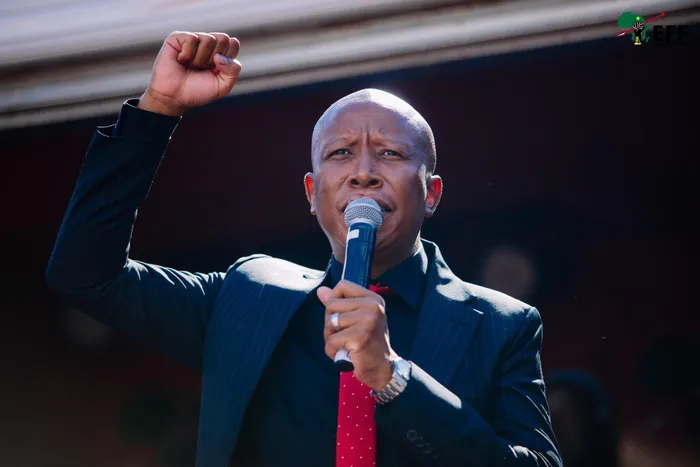
EFF leader Julius Malema has described his five-year direct prison sentence for unlawful possession of a firearm as a politically motivated attempt to silence him and his party.
Image: EFF | Supplied
THERE is something about timing in South African politics that never quite feels accidental.
On Thursday, EFF’s Julius Malema was officially convicted for discharging a firearm in public during a rally, and sentenced to an effective five years’ imprisonment. And just like that, our country has once again been fractured into familiar camps, with national attention locking sharply onto a moment that is already being read in completely opposite ways.
On one hand, the official story is clean and almost comforting in its certainty: No one is above the law. Not politicians, not movement leaders, not people who sit at the centre of public emotion and influence in this country.
And in that reading, this is exactly what accountability is supposed to look like in a democracy. The justice system, at its core, should always punish the contravention of law — especially where public safety is concerned.
But on the other hand, South Africans do not live inside that clean version of the story. We live inside a country where the law has always been experienced through extreme inequality, through selective urgency, through a long memory of who gets pursued quickly and who moves through official processes that look identically equal from the outside, but play out very differently inside, depending on who you are.
So, even when the legal facts are clear, the public interpretation is never neutral.
This story is particularly sensational because it does not arrive in a neutral political climate. Election season is not approaching. It is already here, already shaping how every institution behaves, already moulding every major decision into something that carries political weight — whether it admits it or not.
So when Malema is convicted and sentenced now, it cannot avoid being read through that lens. Timing becomes part of the story, whether the courts acknowledge it or not.
What’s worse is that Malema is not just another accused public figure moving through the system. He is the rambunctious Juju Malema — a political force who has spent more than a decade disrupting the comfort of South Africa’s post-apartheid consensus, refusing to soften his language, refusing to dilute his confrontation, and refusing to become the kind of politician the system finds easy to manage.
Whether people support him or despise him, he is impossible to ignore. From grassroots politics to global platforms, even into the orbit of the Trump administration’s White House, Juju has never been one to fade into the background — he’s always unapologetically provoked reaction, one way or another.
Figures like that do not simply get judged. They are continuously contested, fought over, defined, and disputed in the public arena. And that is why this moment already feels politically charged, far beyond the courtroom.
Especially when placed alongside uncomfortable comparisons that are already circulating. One such example is that, in the same case from the same incident, Juju’s white counterpart in the case, Adriaan Snyman, was swiftly acquitted, while Malema was convicted.
Add to that the role of AfriForum. They didn’t just participate in this trial — they were the engine behind it. Their role as the primary complainant is what pulled this case out of a simple legal docket and thrust it directly into South Africa’s unresolved political fault lines.
Afriforum, the pro-white (Afrikaner) supremacist group, have always found figures like Juju to be the bane of their existence. Afriforum, as the primary complainant, certainly ensured that this case became a lightning rod for racial and political tensions across the nation.
Now, none of this proves conspiracy. But South African politics does not require proof to generate meaning. It runs on perception, memory, and more importantly, patterns that people feel even when they cannot always formally prove them.
And then there is the actual incident itself — the thing at the centre of it all: a rally. A political gathering. A firearm was discharged into the air amid a convivial atmosphere of EFF’s 5th anniversary celebrations. No injuries recorded. No immediate escalation into physical harm.
And throughout the process, Malema has not disappeared or evaded scrutiny — he has engaged the system, appeared in court, and remained visible through the legal process that has now culminated in conviction and sentencing.
The legal seriousness of that act is not in dispute. A firearm discharged in a public space is not symbolic politics — it is conduct with real risk attached to it. The law treats it as such, and rightly so. But even that does not remotely settle the public contestation of the moment.
Because Malema is not only an individual before the court. He is also the leader of the Economic Freedom Fighters — a political formation rooted in a very specific social reality in South Africa: a generation of young, educated people who entered the post-apartheid economy with expectations of mobility and instead encountered exclusion, unemployment, and stagnation.
A generation who are being suffocated under the weight of an imperialist post-apartheid system.
This is why the EFF is not just a party in the traditional sense. It is a political expression of accumulated frustration. It is the literal face of millions of modern-day South Africans. It is extremely central in student bodies of universities, in student and youth politics, in national youth culture, and in spaces where formal opportunity has not matched formal qualification.
Mind you, the youth constitutes over half of the entire national population, and around 80% of our nation’s unemployed demographic. It speaks to a constituency that is already politically awake, already critical of institutions, and already sceptical of the repeatedly broken promises of the system.
So when Malema is sentenced, it does not land as an isolated legal outcome. It lands across an entire political formation and a generation that already feels that the system does not distribute justice or opportunity evenly.
As seen following his sentencing, EFF supporters took to the streets of South Africa to express their outrage. And rightfully so. Our justice system has been extremely flawed for decades now. The average murderer and rapist in South Africa almost never receive a sentence this harsh.
However, the hammer of the law coming down on Juju seemed like something we could all safely bet on. Particularly because rampant corruption in South Africa so often goes unpunished.
From former President Jacob Zuma’s brushed-off sentencing, to the VBS bank heist, to President Cyril Ramaphosa’s Phala Phala dramas, to the Zondo and Madlanga commissions, and beyond! Yet, this impropriety wasn’t born yesterday!
From the scandals around Eskom, SAA, the Covid-19 PPE fraud, SAPS incompetence, BEE misappropriation, and so much more, our nation has been embroiled in debauchery for much too long now. And what is often left-out of the conversation is our brutal history under the barbaric apartheid system.
Here, there was no real law, nor was there any real humanity. Black people were tortured, slaughtered, and disappeared with zero accountability. Oppressors representing the heinous minority regime enjoyed impunity. There was no justice system, just a “whites vs everybody” structure of governance.
So how then can we expect our post-apartheid government to move earnestly and morally when those same apartheid loggerheads are still at the helm of power? How can there be change when the same figures still contribute to running our economy, institutions, and government?
And that is where the real tension sits. Because what is unfolding here is not a single story with a single meaning. It is a collision of two readings of the same moment.
On the one hand, a democracy insists that the law applies without exception, even to its most contentious political figures. On the other hand, a society that has lived long enough with inequality and inconsistency to ask whether that application is always as even as it claims to be — or whether timing, power, and political pressure still shape how justice is experienced.
What must be made clear is that Malema is not just an individual moving through a courtroom moment — he is both a product of deep political frustration in this country and a target of its institutions, shaped by the very anger he continues to channel, and at the same time constantly pushed into the path of systems that are designed to contain that kind of disruption.
Juju has always represented both mobilisation and institutional confrontation at once, and that contradiction is exactly why moments like this never settle cleanly, because they are never just about what has been decided in court, but about what that decision means in a country still struggling to agree on how power, consequence, and accountability should actually look in practice.
That gap between legality and legitimacy is where South African politics now lives. The fragility of our public institutions — judiciary, in this case — is at a very critical precipice. This is not just about a court case; it is a sharper indication of the heightened lack of trust across our nation. And figures like Juju have always loudly called out these kinds of hypocrisy, double-standards, and injustices.
And in the end, let’s make it clear: This is not about one man or one verdict. It is about a country once again split open over whether justice is ever truly equal, or whether it will forever remain selective.
* Tswelopele Makoe is a gender and social justice activist and editor at Global South Media Network. She is a researcher, columnist, and an Andrew W Mellon scholar at the Desmond Tutu Centre for Religion and Social Justice, UWC.
** The views expressed here do not reflect those of the Sunday Independent, IOL, or Independent Media.