

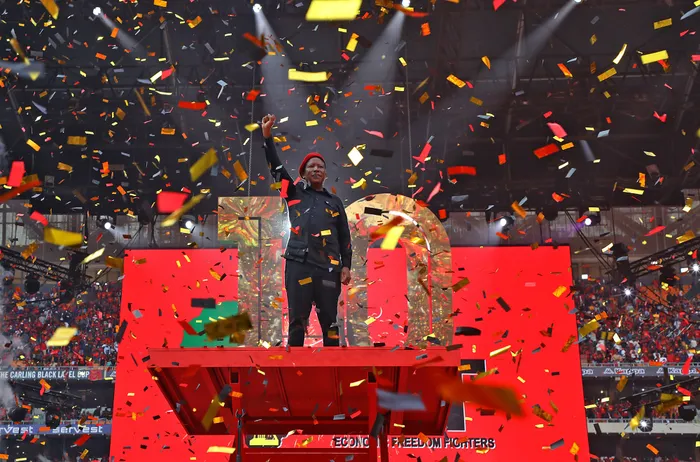
EFF leader Julius Malema is appealing a five year prison sentence handed to him. The writer says he is undoubtedly the most militant Black youth leader in this country and, in fact, in the entire history of this country.
Image: Oupa Mokoena / African News Agency
I HAVE no reservations whatsoever in asserting that I support Julius Malema, leader of the Economic Freedom Fighters (EFF), in his battle against the five-year jail sentence handed to him last week for unlawfully firing a rifle at his party’s fifth anniversary celebration in 2018.
Why I present this argument is a question that is very important to both pose and answer. I know all about Malema’s history, much of which has been surrounded by several allegations of corruption.
I first met Malema in 2010, when he was still president of the African National Congress Youth League (ANCYL). The purpose was an interview I requested with him for the authorised biography of the then deputy president of the ANC and South Africa, Kgalema Motlanthe, which I wrote.
Then already, as we have so often seen, he was a youth leader who was fearless and courageous and, as often, aggressive, volatile, cavalier and even somewhat narcissistic. But he was undoubtedly also the most militant Black youth leader in this country and, in fact, in the entire history of this country.
Probably predictably, the ANC dismissed him as president of the ANCYL in 2012. I believe the grounds for the dismissal were spurious, to say the least. His crimes, according to the ANC, were that he was guilty of sowing divisions, bringing the party into disrepute, and criticising how the ANC government handled a foreign relations matter with Botswana.
Malema should, in the first place, never have been dismissed, and the ANC set a terrible precedent by doing so. Hence, several leaders of the ANC did not support his dismissal, including Motlanthe. Malema, defiant of the ANC leadership to the end, went on, with Floyd Shivambu and others, to form the EFF in 2013.
That is how he is, as he has been since he faced charges related to having fired a rifle at the EFF’s 2018 fifth anniversary celebrations. Perhaps some might argue with some justification that such tenacious and defiant conduct, even when he is facing trouble, is further evidence of a gung-ho and cavalier attitude on his part.
Over the past decade, there have been many media stories about corruption allegations against Malema, some of which appeared substantial and credible, but he was not actually charged. No doubt, he is a very controversial, combustible and strong Black youth leader, probably the most radical we have ever seen in this country.
But few people, including the media and the ANC itself, have ever really thought carefully about the conditions that produced the likes of Malema. How did it happen that we have had a black youth leader like Malema, with all his virtues and warts?
That is how Malema must be seen. I argue that if you listen very carefully to what Malema and the EFF believe in and the radical ideas and policies, such as nationalisation without compensation, they have and why, we will probably understand better their roots and aims.
A logical extension of my argument will include why it was extremely excessive and severe for him to be sentenced to five years last week. I called it a case of judicial onslaught when I heard this sentence, though many might argue that his firing a rifle in public was unlawful and that, as the leader of the EFF, he should have known better.
However, I argued in an SABC panel interview last week that the circumstantial context of this dramatic event was not seriously considered by the presiding magistrate, Twanet Olivier, as a major mitigating factor, which should have led to a suspended sentence.
A key and critical question in this matter is: Why was this approach not adopted? Why could he not have received a stern warning, a suspended sentence or even correctional supervision under the Criminal Procedure Act, which is a community-based sentence which avoids a prison sentence?
Now, the fact that what I have said thus far was not seriously considered by Olivier is itself a stark revelation of a very punitive mindset and even that there was perhaps a political element deep down in her legal reasoning. So much so that some might argue, as they have on social media, that she did what Afriforum desired to see.
It must also be said that Afriforum is certainly not always motivated by a conservative and right-wing agenda. In fact, like some of the issues the Democratic Alliance (DA) has taken up in our courts, which were very important, such as their fight against the ANC’s cadre deployment policy, which was successfully prosecuted and declared unlawful.
Our approach to both Afriforum and the DA requires a much more sophisticated and nuanced approach, certainly not a knee-jerk reaction. But there is no doubt that, as much as Malema’s radicalism, some of which has no doubt been opportunistic and even reckless, struck such fear in the hearts and minds of white people in general, especially white Afrikaners, that many or most of them would have been elated with the very disproportionately severe five-year jail sentence Olivier imposed on him.
But there is no doubt whatsoever that many of Malema's and the EFF’s radical sentiments and policies are themselves a reflection of the seriously limited “transformation” we have had in this country since we had our Uhuru elections in 1994.
Who can deny that the Black working-class majority, including the ANC’s own historical support base in townships, are poorer today than they were under apartheid?
The townships are a total mess today, if the frank truth be told. I was there in 1972 when others and I joined the South African Student Movement (SASM). The black townships were, in fact, in material and socioeconomic terms, better off than they are today. Often, raw sewage running down streets and children playing alongside are common sights today in Black townships.
What this approach means is that the judiciary, the political establishment, the white-dominated corporate sector and the elite beneficiaries of Black economic empowerment must take full responsibility, but to varying degrees, for creating the likes of Malema and the EFF, with all their virtues and vices, strengths and weaknesses.
Finally, Olivier paid no attention at all to the political consequences that Malema and the EFF would have to face if he were indeed sentenced to five years in prison. No regard whatsoever to what it would mean to the EFF in Parliament.
As I argued last week on the SABC, such a very severe sentence would have devastating political consequences for Malema, the EFF and indeed to an extent even the political establishment, bearing in mind the earlier exodus of Floyd Shivambu and Mbuyiseni Ndlozi, which has seriously affected its leadership and intellectual resources.
Malema, whatever we think of him, kept the entire political establishment on its toes. He is a fierce, vibrant and very vocal voice in our deeply troubled and crisis-ridden politics, which I believe will be worsened if Malema is sent to jail for five years.
Besides, I think that were he to succeed in his pending appeal against the sentence, it would have a positive effect on Malema, the EFF and our general politics. Malema himself will be much more careful in his conduct in the years ahead.
I am making no apologies at all for Malema, whom I have strongly criticised many times over the years in columns and articles, but a punitive, vindictive and politically biased approach to his sentencing in this matter is, I fear, going to worsen our political crisis and bedevil further relations between an embittered and embattled EFF without him, especially in parliament.
* Dr Ebrahim Harvey is a political writer, analyst and commentator.
** The views expressed here do not reflect those of the Sunday Independent, Independent Media, or IOL.