

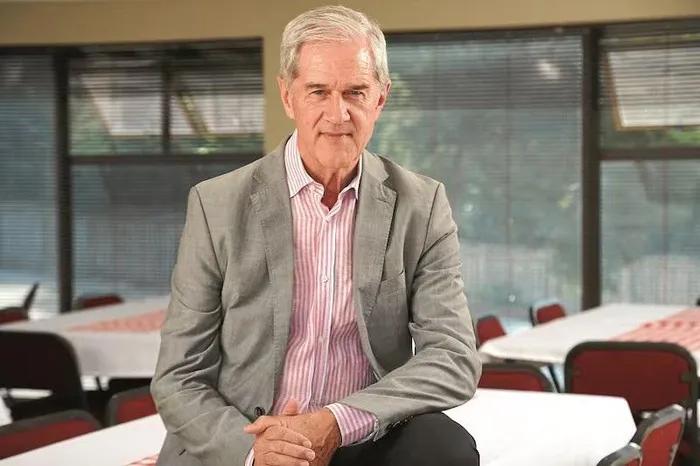
Former apartheid minister Roelf Meyer’s appointment as South Africa's ambassador to the US has sparked debate over his suitability for the role.
Image: Facebook
SOUTH Africa’s President Cyril Ramaphosa has appointed Roelf Meyer, a white Afrikaner who served in the final government of the apartheid era, as his new ambassador to the United States.
Presidential spokesperson Vincent Magwenya confirmed the nomination last week, stating that it would take “immediate” effect. “I can confirm that President Cyril Ramaphosa has appointed Meyer as South Africa’s ambassador to the US,” Magwenya told media reporters.
The appointment fills a post that has been vacant since early 2025, when South Africa's previous envoy, Ebrahim Rasool, was expelled from Washington after he publicly accused President Donald Trump of using claims of white victimhood in South Africa as a “dog whistle” to mobilise his voter base.
Those claims, which Trump used to justify pausing US aid to South Africa and to introduce a policy welcoming Afrikaners as refugees, have since been widely discredited by independent analysts and human rights organisations.
Ramaphosa himself has called them “completely false”, stating there is no evidence that “people of a certain race or culture are being targeted for persecution” in South Africa.
Rasool’s expulsion deepened an already deteriorating relationship between the two countries, one that had been on a downward spiral since Trump returned to office.
Ramaphosa's choice of Meyer is, by any political measure, a calculated and intelligent decision. Meyer is not simply a diplomat. He is a white Afrikaner who lived through and actively participated in the dismantling of apartheid, a living witness to the complexity of South Africa's post-racial transition and direct evidence that the country's democratic order is not hostile to its white population.
Analysts in South Africa have broadly recognised this. Dr Oscar van Heerden, a senior research fellow at the University of Johannesburg, described the appointment as a “clever, tactical decision”, noting that sending a white male Afrikaner to Washington flies “in the face of the lie that there is a white genocide” in South Africa.
Van Heerden also pointed to Meyer’s long experience as a negotiator: “He still has his wits about him, a set of skills, both in terms of negotiations but also dealing with difficult, intransigent individuals.”
On the question of whether Washington would accept Meyer’s credentials, Van Heerden was direct: “I think that’s why they chose someone that Trump and Marco Rubio are going to find difficult to say no to.”
Meyer, 78, played a central role as one of the chief mediators in the negotiations that ended white-minority rule in South Africa in the 1990s.
He was the chief representative of the National Party, the same party that had introduced and enforced the apartheid system, while Ramaphosa sat across the table representing the African National Congress, then led by Nelson Mandela.
The two men forged more than a working relationship during those talks. They went on a fishing trip together during that period and went on to build a lifelong friendship that continues to this day.
After the historic 1994 elections that brought Mandela to the presidency, Meyer served as constitutional affairs minister in the last apartheid government before joining the government of national unity.
He left two years later and co-founded the United Democratic Movement, eventually becoming a member of the ANC. Within his own Afrikaner community, his role in the peace process earned him the label of traitor from right-wing groups, a characterisation that speaks precisely to how seriously he engaged with transformation.
Meyer was also part of a group of 32 prominent South Africans Ramaphosa selected in 2024 to guide the country’s national dialogue process, aimed at addressing the country’s persistent social and economic challenges.
Reaction to the appointment inside South Africa has been mixed. The ANC’s Secretary-General Fikile Mbalula welcomed it. Julius Malema’s Economic Freedom Fighters dismissed it as “politically tone deaf” and “a deliberate insult to our democratic struggle”.
Criticism from the right-wing Afrikaner groups like AfriForum leader, Kallie Kriel, described Meyer on X as an “ANC cadre” whose record shows “he is someone who is willing to dramatically reposition himself to suit his own personal interests”.
The Solidarity Movement, which the South African government has accused of spreading misinformation in the US, called the appointment disappointing, with spokesperson Jaco Kleynhans warning that it risked “deepening existing concerns” within the Afrikaner community.
Meyer himself had once said he did not think someone of his age should take on a role demanding “everyday, hard work” and “youthful energy” in Washington. Ramaphosa overruled that reservation, saying Meyer would “represent South Africa very well”.
The broader context of this appointment is one of serious concern. The Trump administration's approach to South Africa has been shaped not by a careful reading of the country's history or political landscape, but by domestic political imperatives.
Amplifying claims of white persecution in a country that only three decades ago freed itself from white-minority domination through negotiation, not violence, reflects a refusal to engage with the actual and documented record.
This is not an isolated failure. Washington's aggressive unilateral trade and tariff policies have disrupted international markets, strained alliances, and imposed costs not only on targeted countries but on the global economy at large.
Partners of the US across Africa and beyond have found themselves absorbing the consequences of decisions made with no reference to their realities.
Ramaphosa’s appointment of Meyer is a response built on fact, intelligence and history. It forces Washington to confront, in the person of a single ambassador, the evidence that contradicts its own narrative. Whether the Trump administration chooses to engage with that evidence is another question.
What is certain is that South Africa has placed its strongest available argument directly in front of those who have chosen, until now, not to see it.
* Sizwe Dlamini is editor of the Sunday Independent.
** The views expressed here do not reflect those of the Sunday Independent, Independent Media, or IOL.