

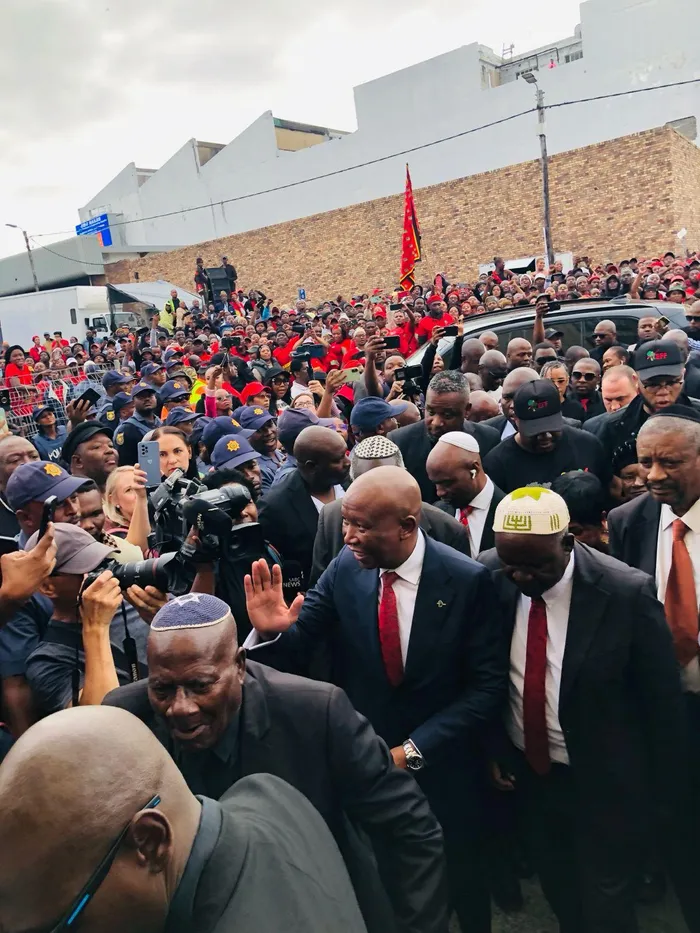
Julius Malema at court for his sentencing
Image: Abongile Ginya
ON April 16, 2026, Magistrate Twanet Olivier, sitting in the East London Regional Court in KuGompo City, handed down a five-year direct prison sentence to Julius Malema, the leader of the Economic Freedom Fighters (EFF).
This was for illegally possessing a firearm and firing it at a party rally back in 2018. The court also fined him R20 000 for each of three other charges: firing a gun in public, not taking proper precautions, and recklessly endangering others.
If he couldn’t pay these fines, he would face an extra six months in prison for each. The sentence for unlawfully possessing ammunition, along with the fines, would run at the same time as the five-year term.
While the state wanted him to get up to 15 years, the court gave less, but it’s still a sentence we should look at very closely.
There’s no argument about what happened. During the EFF’s fifth-anniversary celebration at the Sisa Dukashe Stadium in Mdantsane, Malema was filmed shooting a semi-automatic rifle into the air. Nobody got hurt. Nothing was damaged.
There’s no proof anyone actually feared for their safety. That day, the only danger was a potential risk, which thankfully didn’t turn into real harm. Malema’s legal team, led by Advocate Tembeka Ngcukaitobi SC and Laurence Hodes SC, rightly highlighted these points for the court: It was one continuous event, lasting no more than two minutes, with no injuries, no property damage, and the state didn’t present any evidence to make the crime seem worse.
Given these facts, we need to judge the sentence. Firing a gun unlawfully is definitely a serious crime, and the court was right to treat it that way. But the real question is whether sending him to prison for five years is fair and balanced. I don't think so.
The sentence is too harsh. A suspended prison term, combined with a significant fine, would have served justice just as well, maybe even better.
South African sentencing laws follow what’s called the “Zinn Triad”, a principle from the 1969 case of S v Zinn. It means the court has to consider three things: the crime itself, the person who committed it, and what’s best for society.
The punishment should fit both the crime and the criminal. It needs to be fair to society but also show some mercy. These aren’t just empty words; they’re the rules set out by our Constitution for every sentence.
When we apply these rules to Malema's case, the outcome is concerning. Yes, the crime is serious, but it was reckless, not an act of intentional violence. There was no plan to hurt anyone, no attack, no property destroyed, and no actual victim.
The Constitutional Court, in the 2001 S v Dodo case, said a sentence shouldn’t be “so out of proportion to the crime as to shock the conscience”. A five-year prison term for something that hurt no one and damaged nothing comes dangerously close to being just that.
Take S v Mkhize (2014) as an example. The Supreme Court of Appeal reduced a prison sentence for someone who negligently fired a gun at what they thought were intruders, but didn't hurt anyone. The court stressed that it’s usually better not to send someone to prison if they acted recklessly rather than with direct intent to harm.
Similarly, in S v Ndlovu (2017), a person who fired a rifle in public but caused no injuries didn't go straight to jail. There’s nothing to suggest these people got lighter sentences because they weren’t famous like Malema. Instead, the key factor was that no one was actually harmed.
The state tried to argue that the incident was “planned” and “calculated”. But with all due respect, simply planning an act doesn’t make a reckless event deserving of five years in prison. Planning is something that can make a crime worse, but it has to be weighed against the complete lack of physical injury.
The court even agreed with the state that it was the “main event of the evening”. Even so, the legal question remains: What is the right sentence for a planned but ultimately harmless firing of a gun? Based on previous cases, the answer isn’t necessarily immediate imprisonment, and certainly not for this long.
There was no evidence that anyone was hurt. No property was damaged. The state didn't call any witnesses who said Malema's actions put them in fear. The defence clearly pointed out that no evidence was presented to make the sentence harsher.
Usually, in sentencing, the fact that no one was actually harmed is a strong reason to be more lenient. It doesn’t excuse the act, but it’s a fact that should be given proper consideration.
However, the court seemed to treat the possibility of harm as if it were actual harm. Magistrate Olivier mentioned: “We hear daily, or weekly, of children playing in the front yards, in the street, who are caught in crossfire, random shots fired, killing people.”
With respect, that line of thinking mixes up a general societal problem with the very specific details of this case. There was no crossfire here. No one was randomly shot at. It was a single act of celebratory gunfire into the air, inside a stadium, in a somewhat controlled setting. Sentencing Malema as if he’s to blame for every gun-related death in the country is simply wrong.
The R20 000 fines for the other three charges don’t seem to have a clear purpose. No one asked for compensation. No restitution was ordered. The fines just feel like extra punishment, piled on top of an already harsh prison sentence.
In a case where a suspended sentence plus a big fine could have deterred others and condemned the act, giving him immediate prison time and fines feels like overkill.
Jessi-Ann Thompson, a social worker for the defence, suggested a sentence that didn’t involve prison. She noted that Malema is a first-time offender, didn’t intend to cause harm, and that there are no similar cases where someone got a prison sentence under these circumstances.
The court rejected her advice, partly because public figures are held to a higher standard. While that’s a valid point, it doesn’t erase the fact that no actual harm was done or ignore his personal situation.
Being held to a higher standard doesn’t mean you automatically get a harsher sentence, no matter the facts. It means the sentence should reflect the seriousness of breaking that trust, but still be fair and proportional.
A suspended sentence would have served justice better. Given Malema’s prominent role as the leader of a major political party, just getting convicted and a suspended sentence would have sent a very clear message to everyone.
The simple fact that such a well-known person was found guilty, that he had to stand in court and be declared a criminal, is a powerful deterrent in itself. It shows every citizen and every politician that the law applies to everyone equally.
A suspended sentence, along with a substantial fine, would have achieved this without the destructive consequences of sending him straight to prison.
People now understand that illegally firing a gun is serious. This understanding comes from the conviction itself, not from how long he’ll be in prison. In fact, all the media coverage of the trial and conviction has already taught the public about why celebratory gunfire is against the law.
Adding direct imprisonment doesn’t really add anything to that public education, but it does come with a huge personal and political cost that simply doesn’t match the harm caused.
In the 2007 case of S v M (Centre for Child Law), the Constitutional Court ruled that a child's best interests must be considered when sentencing a primary caregiver. While Malema’s situation is different, the core idea is the same: a court needs to think about the broader impact a prison sentence will have.
In his case, the impact goes beyond him to his family, his political party, and the millions of South Africans who voted for him. These wider consequences aren’t reasons to avoid prison altogether, but they are factors that should be properly considered. Here, they weren’t given enough weight.
It’s hard to ignore the politics surrounding this. The case was brought by AfriForum, a lobbying group that has a long-standing antagonistic relationship with Malema and the EFF. The state pushed for a 15-year sentence, which always seemed excessive for the facts.
While the court did reduce that to five years, suggesting it didn’t completely give in to political pressure, the feeling persists that the sentence is tougher than what an average person would get. The defence argued that “deviating from (a non-prison) approach would simply show the accused is being singled out for unduly harsh punishment”. That argument definitely has merit.
To sum up, the five-year prison sentence given to Julius Malema is too much. It doesn’t properly consider that no one was actually hurt or that nothing was damaged. It ignores that no evidence was presented to make the crime worse.
It mistakenly treats the potential for harm as if it were actual harm, which is legally unsound. And it hands down a prison term that’s out of proportion when you look at the established rules from cases like S v Zinn, S v Dodo, and other rulings about negligently firing a gun.
A conviction with a suspended sentence, along with a significant fine, would have been the fair and balanced outcome. It would have held Malema accountable, sent a clear warning to the public, and avoided the harsh and unnecessary consequences of immediate imprisonment.
Just because the court chose a different path doesn't mean it was the right one. Hopefully, the appeal court will review this matter and impose a sentence that is fair, well-thought-out, and in line with the Constitution.
* Vincent Seloane is an attorney in Johannesburg and a former Treasurer and Secretary of the Black Lawyers Association (Gauteng). He writes this in his personal capacity.
** The views expressed here do not reflect those of the Sunday Independent, IOL, or Independent Media.