


Despite growing conversations around mental health, many people still struggle to understand how personality disorders differ from acute mental health illnesses.
Image: AI ChatGPT
When people hear the words “personality disorder”, they often think of someone manipulative, dramatic, dangerous or impossible to deal with.
Mental illnesses such as depression or anxiety, on the other hand, are generally met with more empathy and understanding.
But according to clinical psychologist Sinqobile Elevia Aderinoye, the reality is far more complex, and the public misunderstanding surrounding personality disorders continues to fuel harmful stigma.
Conditions such as borderline personality disorder, narcissistic personality disorder, antisocial personality disorder and obsessive-compulsive personality disorder are among the most widely recognised personality disorders.
Yet despite growing conversations around mental health, many people still struggle to understand how personality disorders differ from acute mental health illnesses like depression, bipolar disorder, PTSD or anxiety disorders.
Aderinoye explains that the distinction is not always clear-cut, even within psychology itself.
“In lay terms, a mental illness like major depression, panic disorder, bipolar disorder or PTSD is usually understood as a condition that disrupts a person’s normal functioning compared with their usual baseline,” she said.
“A personality disorder involves long-standing patterns of thinking, feeling, relating and coping that become rigid and create problems across many areas of life.”

Despite growing conversations around mental health, many people still struggle to understand how personality disorders differ from acute mental health illnesses like depression, bipolar disorder, PTSD or anxiety disorders.
Image: Freepik
Unlike an acute mental health illness, which often appears in episodes, personality disorders are typically woven into the way a person experiences the world and interacts with others over many years.
For example, someone with major depression who is usually social and motivated may suddenly become withdrawn for several months, lose interest in activities, struggle with hopelessness and later return to something closer to their previous functioning once the depressive episode improves.
A personality disorder, however, tends to show up more consistently across different areas of life.
Aderinoye explained that a person with a personality disorder may repeatedly fear abandonment, interpret neutral interactions as rejection, struggle with emotional regulation and experience unstable relationships across friendships, work environments and romantic partnerships over many years.
“The pattern persists during good and bad times,” she said. “It is woven into the person’s habitual way of experiencing the world.”
Historically, psychology treated personality disorders and mental illnesses as entirely separate categories in diagnostic manuals.
However, modern psychology has moved away from that rigid separation because research has shown significant overlap between the two.
“Personality disorders are not truly separate from other psychiatric conditions biologically or psychologically,” Aderinoye explained.
She added that many illnesses once thought to be temporary can become chronic, while personality disorders themselves can fluctuate and improve more than experts previously believed. It is also extremely common for people to experience both conditions simultaneously.
This overlap, known as comorbidity, is one of the biggest reasons diagnosis can become complicated.
Patients with personality disorders frequently also experience depression, anxiety disorders, PTSD, eating disorders or substance misuse disorders.
During periods of acute mental illness, symptoms can sometimes mimic or exaggerate traits associated with personality disorders.
According to Aderinoye, clinicians try to determine whether behavioural patterns existed long before a crisis began.
“They ask questions such as: what was the person like before the crisis? Are these patterns lifelong or recent? Do symptoms persist when mood stabilises? Are the difficulties context-specific or pervasive?” she explained.
The issue becomes even more complicated in teenagers and children. While personality disorder traits may begin early in life, clinicians are often cautious about formally diagnosing personality disorders before adulthood.
Aderinoye said adolescence naturally involves emotional intensity, impulsivity, identity shifts and instability, all of which can resemble personality pathology.
“There are also considerations for trauma, family instability, neurodevelopmental conditions or mood disorders which can temporarily resemble personality pathology,” she said.
Clinicians, therefore, look for evidence that behavioural patterns are persistent, inflexible and present across multiple settings before making a diagnosis.
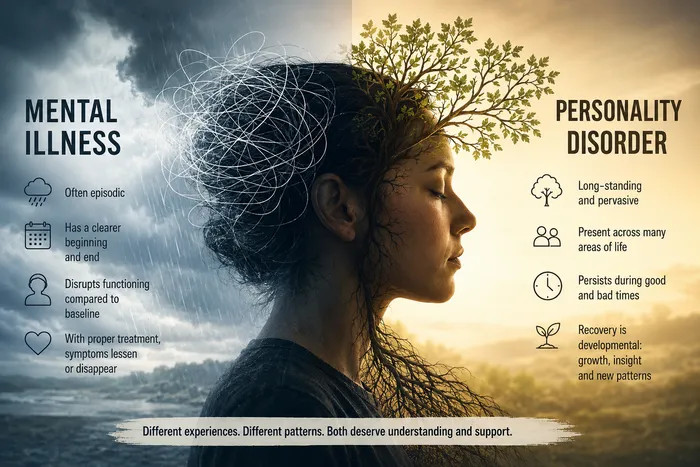
The difference between mental illness and personality disorder is often misunderstood.
Image: AI ChatGPT
One of the most damaging myths surrounding personality disorders is the long-standing belief that they are untreatable.
Aderinoye believes this misconception partly stems from older treatment models that were less specialised and from the fact that people with personality disorders often experience complex trauma, self-harm, interpersonal conflict and high dropout rates in therapy.
Today, however, specialised treatments have dramatically changed the outlook for many patients.
Approaches such as Dialectical Behaviour Therapy (DBT), which focuses on emotional regulation and coping skills, are now evidence-based treatments that help people build healthier ways of managing emotions and relationships.
Importantly, clinicians are also becoming more mindful of how diagnoses are communicated to patients.
“A good clinician avoids saying things like ‘This is just your personality’, ‘You’re manipulative’, or ‘You can’t change’,” Aderinoye said.
Instead, she explained, treatment focuses on helping patients understand their patterns while recognising that emotional systems can be retrained, relationships can improve, and flexibility can grow over time.
Medication also plays a very different role in treatment depending on the diagnosis.
While illnesses such as bipolar disorder or schizophrenia often rely heavily on medication management, personality disorders are primarily treated through psychotherapy.
“There is no medication that treats personality itself,” she explained, adding that medication is usually used in a supportive role to help manage symptoms such as anxiety, mood instability or depression.
One of the most damaging myths surrounding personality disorders is the long-standing belief that they are untreatable.
Image: Adriana Oliveira Correia / Pexels
Recovery also looks different.
With acute mental illnesses, recovery often means returning to a previous level of functioning once symptoms lessen or disappear. Personality disorder recovery, however, is more developmental and long-term.
“It involves developing healthier ways of processing emotions, engaging in relationships and managing stress,” said Aderinoye.
The stigma attached to personality disorders remains one of the biggest barriers to understanding and treatment.
Unlike depression or anxiety, which are often viewed as involuntary illnesses, personality disorders tend to affect the people around the patient more directly.
“Empathy becomes difficult because personality disorders appear in relationships,” Aderinoye explained.
Family members and loved ones may experience emotional instability, manipulation, conflict or unpredictability firsthand, making it harder to separate the person from the condition itself.
This can create deeply strained family dynamics. While mood disorders may temporarily disrupt relationships during episodes, personality disorders often shape relationship patterns over many years.
Aderinoye said families can sometimes become organised around crisis management, rescuing behaviours or over-accommodating the individual’s emotional needs.
For loved ones who suspect someone may have an undiagnosed personality disorder, she stresses the importance of offering support without trying to become the person’s therapist.
“Healthy support involves creating and maintaining boundaries, validating distress compassionately, avoiding rescuing patterns and not trying to fix the patient,” she said.
She also noted that the presence of a personality disorder can complicate treatment for other mental health conditions such as PTSD or depression.
“Personality disorders affect trust in the therapist, consistency in treatment, emotional regulation, medication adherence, crisis frequency and interpretation of interpersonal interactions,” she explained.
Ultimately, Aderinoye believes society needs to move beyond simplistic ideas that frame personality disorders as “bad behaviour” or character flaws.
The reality, she says, is that personality disorders are deeply rooted psychological conditions shaped by biology, environment, trauma, attachment and lived experiences.
And while treatment may look different from treating an acute mental illness, change, growth and recovery are absolutely possible.