

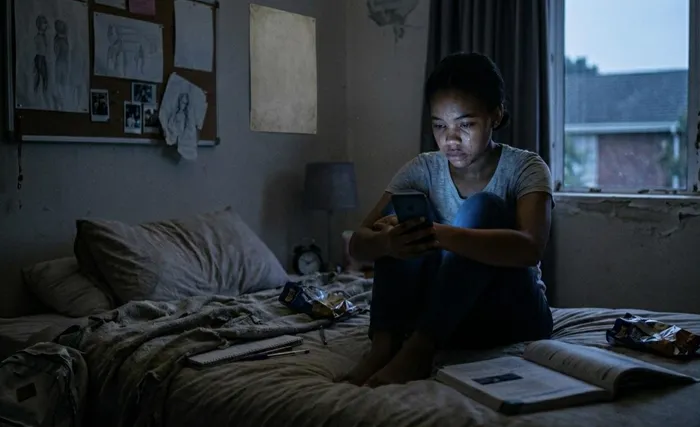
The teenagers slipping through the cracks are not invisible, they are sitting in classrooms, scrolling through phones late at night, carrying weight that adults too often mistake for moodiness.
Image: AI / Gemini
In bedrooms filled with half-finished homework, glowing phone screens and dreams that once stretched far beyond the horizon, a devastating reality is taking hold: more teenagers in South Africa are dying by suicide, often in silence that arrives too late.
Families are left clutching memories and unanswered questions, replaying ordinary moments that never felt like goodbyes.
A laugh at the dinner table. A closed door. A message left unread.
For many, the signs were there, hidden in plain sight, buried beneath pressure, loneliness and the weight of expectations too heavy for young shoulders.
Experts warn that youth suicide is no longer a distant concern but an urgent, escalating crisis demanding immediate attention.
At the South African Depression and Anxiety Group (SADAG), those warning signs are becoming heartbreakingly familiar.
"Living in a country where violence is so common can quietly sit in the background of people's lives and affect their mental health, especially for teens who are still developing emotionally and psychologically," said SADAG Education Project Manager Roshni Parbhoo-Seetha.
She stressed that trauma does not require direct exposure.
"Teens don't have to be directly involved in a violent incident for it to impact them. Just hearing about it, witnessing it, or constantly being aware that it could happen can leave them feeling unsafe and on edge."
Over time, she warned, the effects begin to surface in damaging ways.
"We see teens struggling with anxiety, feeling constantly on edge, or expecting something bad to happen. Others experience depression, where they feel numb, overwhelmed, or hopeless."
What makes the situation even more insidious, Parbhoo-Seetha noted, is how thoroughly normalised this distress has become. "It just becomes 'how things are.'"
Sociological factors are now under increasing scrutiny.
Cici Sebego, a master's candidate in sociology and community development facilitator, says the society in which a child is raised plays a significant role in shaping how they perceive the world and how they view themselves.
She emphasised how deeply children absorb their environments. "These experiences, whether positive or negative, are internalised and can have lasting effects on their emotional and psychological development."
"Children do not develop in isolation. They are influenced by families, schools, communities, and the wider society."
But when those systems fail, the consequences can be devastating.
"Children who grow up in environments characterised by neglect, conflict, violence, or lack of emotional support may begin to internalise feelings of worthlessness, fear, or rejection."
She warned that neglect can quietly escalate into crisis. "Over time, this emotional neglect can contribute to serious mental health challenges such as depression, anxiety, and, in extreme cases, suicidal thoughts."
In societies where mental health is stigmatised, she added, children may be unable to speak about their struggles, deepening their sense of isolation at the very moment they need connection most.
Counsellor and mental health advocate Candice Lambert brings a neuroscience lens to the conversation, cautioning against oversimplification.
"Teen suicide in South Africa cannot be explained by a single cause. It usually develops out of a painful mix of emotional distress, social pressure, loss of hope, and feeling alone with problems that seem too heavy to carry."
She pointed to broader social realities intensifying the risk, including community violence, child maltreatment, gender-based violence, inequality and uneven access to mental health care, and emphasised that adults have both the opportunity and the responsibility to intervene early.
"They can help most by being present before a crisis, not only during one. Teenagers need adults who listen without immediately lecturing, minimising, or panicking."
Registered counsellor Vanishaa Gordhan Narotam echoed this, highlighting the long-term and often invisible impact of childhood trauma.
"There is a major disconnect in how we view childhood trauma, specifically the dangerous assumption that children will simply grow out of difficult experiences."
"Instead, they often grow into the trauma, developing quiet or negative coping skills that stay with them as they mature."
The teenagers slipping through the cracks are not invisible. They are sitting in classrooms, scrolling through phones late at night, carrying weight that adults too often mistake for moodiness or teenage drama.
Every expert consulted arrived at the same conclusion: South Africa cannot afford to treat youth mental health as a secondary concern.
The stigma must be dismantled. The conversations must begin earlier, at kitchen tables, in school halls, in the spaces where young people already live.
Because the silence that precedes a tragedy is rarely sudden. It builds slowly, in the absence of someone willing to ask the right question and wait long enough to hear the answer.
If this country is to turn the tide, it will not be through grand policy gestures alone.
It will be through the ordinary, deliberate choice of adults to show up, before the closed door, before the unread message, before it is too late.
If you or someone you know is in crisis and has suicidal thoughts, call SADAG 0800 567 567 or SMS 31393.