

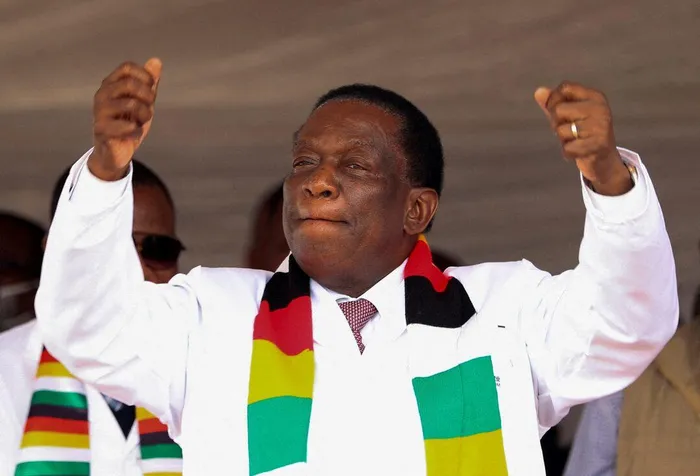
Zimbabwe's President Emmerson Mnangagwa.
Image: Reuters
ZIMBABWE stands at a pivotal constitutional crossroads. The proposed Constitution Amendment Bill No.3 has ignited the most passionate debate since the 2013 Constitution was adopted.
At its heart is a straightforward but transformative proposal: To replace the direct election of the president with an indirect system in which Parliament elects the head of state and the government.
Far too often, this discussion has been clouded by slogans and misinformation rather than reasoned analysis. Let us be clear: The claim that an indirect presidential election can only work under a system of pure proportional representation is simply untrue.
It is a myth that distorts the conversation and does a disservice to national discourse.
Consider Botswana — one of Africa’s most admired and stable democracies. Since independence in 1966, Botswana has used a first-past-the-post electoral system, yet its president is elected indirectly by Parliament.
The result? Decades of peaceful power transitions and an enviable absence of the bitter, violent disputes that have plagued so many African presidential systems.
Botswana’s Members of Parliament are elected from individual constituencies, yet they still choose the president from the majority party. If this model has delivered stability and legitimacy in Botswana, those who insist it cannot work in Zimbabwe carry the burden of proof.
Moreover, the assertion that Zimbabwe lacks any experience with proportional representation is factually incorrect.
The 2013 constitution already embeds proportional representation in several key areas: 60 women’s seats in the National Assembly are allocated according to provincial party votes, ten additional youth quota seats have been introduced, and the Senate itself is constituted through proportional representation.
These are not minor features — they are deliberate constitutional mechanisms. To pretend otherwise is not constitutional analysis; it is political rhetoric.
The deeper question, therefore, is not about electoral mechanics but about legitimacy and stability. Critics argue that only a direct nationwide vote can confer true democratic legitimacy on a president.
This concern is understandable, especially in a country with a painful history of authoritarian rule. Yet it reveals a profound inconsistency. Zimbabweans already directly elect 280 members of parliament and over 1 900 local councillors.
These representatives do not merely cast symbolic votes — they pass laws, approve multibillion-dollar national budgets, oversee the executive, ratify international treaties, and even possess the power to impeach a sitting president.
If these elected legislators are already trusted with such immense responsibilities on behalf of their constituents, why should they suddenly be deemed unfit to elect the president? To deny Parliament this role is to undermine the very foundation of representative democracy itself.
We must also confront Zimbabwe’s lived reality with honesty rather than emotion. Since independence in 1980, the country has endured a series of bitterly disputed presidential elections.
The 2008 crisis remains a scar on the national conscience: over 200 lives lost, thousands displaced, and a Government of National Unity (GNU) required only after regional mediation.
That tragedy was not merely the fault of individuals; it was the predictable outcome of a system that placed the entire fate of the nation on a single, high-stakes presidential contest.
In deeply polarised societies with fragile institutions, winner-takes-all presidential elections turn politics into an existential battle. Losing ceases to be a temporary setback and becomes total exclusion from power and resources.
The stakes become so high that democratic norms struggle to contain the resulting tensions. Political science has repeatedly shown that such hyper-presidential systems often breed instability rather than strengthen democracy.
An indirect presidential electoral system offers a wiser path. By shifting the choice of President into the parliamentary arena — where power is already distributed and negotiated — it lowers the temperature of national politics.
It reduces the catastrophic consequences of any single electoral defeat and encourages broader coalitions and compromise. This is no radical experiment. It is a proven constitutional principle embraced by respected democracies around the world: Germany, India, Botswana, and South Africa all employ variations of parliamentary or indirectly elected executives.
South Africa, in particular, elects its president through parliament and remains one of the continent’s most robust constitutional democracies.
The true measure of democracy is not whether a president is chosen directly by voters. It is whether institutions are credible, the rule of law is respected, and citizens retain trust in the system to foster stability.
A direct election administered through weak or distrusted institutions can produce violence and illegitimacy — just as Zimbabwe has experienced. An indirect system, operating through strong institutions, can engender stability and accountability.
Citizens would continue to elect their members of parliament directly. Those representatives would then exercise delegated authority — including the election of the president — on behalf of the people who voted for them.
The real constitutional choice before Zimbabwe is therefore this: Do we wish to concentrate national legitimacy in one polarising, all-or-nothing presidential contest, or do we choose to disperse it more broadly through representative institutions that better reflect our political diversity?
Reasonable people may differ in their conclusions. But genuine debate demands intellectual honesty, not fear or distortion. Constitutional design is not a matter of political theology. It is practical engineering — shaped by a nation’s history, its institutions, and its aspirations for the future.
Zimbabwe’s challenge is not merely deciding how a president is elected. It is deciding what kind of political stability, accountability, and democratic culture it wishes to bequeath to the next generation.
Let us choose wisely, guided by evidence, experience, and a clear-eyed commitment to a more stable and prosperous Zimbabwe.
* Glen Mpani is a political campaign strategist and Group Lead of the International Centre for Political Campaigns, His work spans campaign strategy, war-room operations, mobilisation, political communications, and institutional capacity-building for political parties, candidates, and political organisations across Africa and internationally.
** The views expressed here do not reflect those of the Sunday Independent, Independent Media, or IOL.