

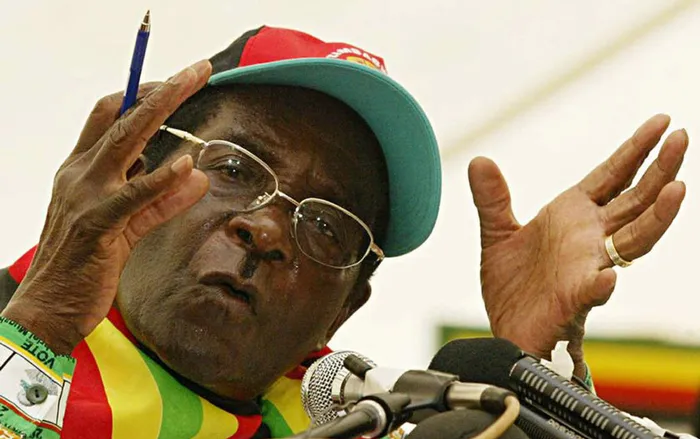
Former Zimbabwean president Robert Mugabe. Constitutional Amendment No 7 abolished the office of Prime Minister and replaced it with an executive presidency under Mugabe.
Image: File
FORTY years of election violence, institutional decay, and political polarisation did not emerge by accident in Zimbabwe. They are the product of a constitutional structure deliberately designed to concentrate power in one office.
The current debate around Constitutional Amendment Bill No. 3 (CA3), gazetted in February 2026 and proposing, among other reforms, the replacement of direct presidential elections with parliamentary elections of the head of state and government, is being framed in simplistic terms: An authoritarian executive trying to sidestep the will of the people versus civil society defending democracy.
That framing collapses under historical scrutiny.
The uncomfortable truth is that many of the loudest defenders of Zimbabwe’s current constitutional order are defending a political architecture originally designed for a one-party state, and inconsistent with the country’s 2013 Constitution.
And many of the same voices now condemning CA3 spent decades correctly identifying the executive presidency itself as the central threat to democratic accountability.
The contradiction could not be more glaring.
To understand Zimbabwe’s constitutional crisis, one has to return to 1987.
Constitutional Amendment No 7 abolished the office of Prime Minister and replaced it with an executive presidency under Robert Mugabe. The amendment consolidated sweeping powers into a single office, giving the president authority over Cabinet appointments, provincial administration, the judiciary, and the security establishment.
This followed the Unity Accord between Zanu and Zapu, which effectively collapsed Zimbabwe into a de facto one-party state.
There was no meaningful opposition inside Parliament at the time. No major constitutional resistance. No organised civil society campaign capable of stopping it. The imperial presidency was not an accident of governance. It was a deliberate constitutional project.
And crucially, it was designed for a political system where power would never genuinely rotate.
The presidency created in 1987 was not intended to coexist comfortably with competitive multiparty democracy. It was built to dominate Parliament, overshadow institutions, and centralise state power around one office and one political movement.
That architecture survived every constitutional era that followed.
It survived 19 amendments to the 1980 Lancaster House Constitution. It survived the failed constitutional referendum of 2000. And it survived the celebrated 2013 Constitution produced through the Copac process.
The 2013 Constitution introduced important reforms, including presidential term limits and expanded constitutional protections. But structurally, it left the executive presidency intact. Zimbabwe retained a constitutional system where one office still sits at the centre of political power, state patronage, and institutional control.
In other words, Zimbabwe attempted to build a multiparty democracy on top of a constitutional foundation originally designed to prevent it.
The current constitutional debate also requires honesty about the origins of Zimbabwe’s reform movement itself.
By the late 1990s, economic decline, labour unrest, and growing public anger had created fertile ground for opposition politics. The National Constitutional Assembly (NCA) emerged demanding constitutional reform.
Soon after, the Movement for Democratic Change was formed out of the NCA, labour movement, civic groups, academia, and white commercial farming interests.
But constitutional reform was never purely an abstract democratic mission. It was also a political strategy aimed at weakening Zanu-PF and removing Mugabe from power.
That reality became especially visible during the 2000 constitutional referendum.
Opposition groups argued, correctly, that the proposed constitution retained excessive executive power. But the referendum battle was also deeply tied to the land question. The proposed draft constitution included provisions allowing compulsory land acquisition without compensation from Britain.
For many white commercial farmers and their political allies, defeating the constitution became inseparable from resisting the land reform agenda.
This does not invalidate the democratic concerns raised at the time. But it does complicate the mythology that constitutional activism in Zimbabwe was always purely about institutional design and democratic principle.
The constitution became a battlefield for political power long before CA3 arrived.
And that same dynamic remains visible today.
If Zimbabwe’s executive presidency had delivered political stability, institutional accountability, and peaceful democratic transitions, there would be a strong argument for preserving it despite its origins.
But the historical record points in the opposite direction.
Zimbabwe has held seven presidential elections since 1990, under the current executive framework. Six of them were marred by allegations of violence, intimidation, irregularities, or state interference.
The 2008 election remains the clearest example.
After Morgan Tsvangirai won the first round but failed to secure an outright majority, the country descended into widespread political violence in the ensuing campaign for a runoff. Opposition supporters were assaulted and abducted, and over 200 were killed. Entire communities were subjected to intimidation campaigns and the destruction of their property.
The violence became so severe that Tsvangirai withdrew from the runoff election altogether.
The crisis eventually forced Sadc-mediated negotiations that produced the Government of National Unity between 2009 and 2013, effectively acknowledging that Zimbabwe’s presidential system had failed to produce a legitimate democratic outcome.
The problem was not simply the individuals involved. It was structural.
When one office controls state power, security influence, patronage networks, and executive authority, elections become existential contests. Losing no longer means spending time in opposition. It means losing access to the machinery of the state itself.
That winner-takes-all logic creates enormous incentives for political manipulation and coercion.
Zimbabwe’s constitutional architecture did not create every political crisis in the country. But it intensified nearly all of them. Critics of CA3 portray the parliamentary election of the executive as somehow anti-democratic or abnormal.
Comparative constitutional reality says otherwise.
Most Commonwealth democracies operate under parliamentary systems where the head of government is elected through Parliament and remains accountable to it.
In India, the world’s largest democracy, the prime minister governs through parliamentary support. In the United Kingdom, the Prime Minister remains in office only while commanding the confidence of Parliament.
The same principle exists in Canada, Australia, New Zealand, Malaysia, Botswana, and South Africa.
Justice Minister Ziyambi Ziyambi has pointed to this international precedent in defending CA3, noting that parliamentary election of leaders is common across the Commonwealth.
The South African example is particularly relevant.
South Africa’s president is elected by Parliament, not through a separate nationwide presidential vote. Despite the African National Congress (ANC) dominating politics for years, Parliament has still developed mechanisms capable of exerting pressure on executive authority.
Former President Jacob Zuma ultimately faced parliamentary pressure that contributed significantly to his removal from office.
More recently, South Africa’s Constitutional Court ruled that Parliament had acted unlawfully in setting aside the Section 89 report concerning President Cyril Ramaphosa and the Phala Phala matter. Parliament was compelled to revive the impeachment process.
That is institutional accountability functioning through parliamentary mechanisms.
Zimbabwe’s current presidential system has rarely demonstrated comparable institutional restraint.
The most striking aspect of the CA3 debate is not Zanu-PF’s position. It is the position of Zimbabwe’s civil society establishment.
For decades, civic organisations correctly argued that Zimbabwe’s executive presidency concentrated dangerous levels of power in one office. They warned that no democracy should permit a single individual to dominate state institutions, security structures, and patronage systems simultaneously.
Those arguments were correct then, and they are correct right now.
Yet many of those same voices are now mobilising to defend the continuation of the executive presidency because they distrust the current government’s motives.
That concern is understandable. Constitutional reform in Zimbabwe has often been pursued through politically expedient processes rather than a broad national consensus.
But there is also a deeper political reality at work. Both the ruling party and the opposition have historically wanted control of the executive presidency rather than its dismantling. The battle has often been less about reducing executive power than about who gets to wield it.
That is why Zimbabwe’s constitutional reform debates repeatedly become trapped in cycles of political self-interest.
The opposition’s position frequently reduces to this: the reforms may be structurally sound, but they should not happen while Zanu-PF benefits from them.
Yet this logic creates an impossible constitutional stalemate. If no governing party will willingly reduce executive power once it controls the presidency, then reform can never happen at all.
Zimbabwe’s constitutional history reveals a state built around concentration rather than distribution of power.
The country developed a multiparty political system without building genuinely multiparty constitutional institutions. Parliament remained weak. Executive authority remained dominant. Elections became high-stakes struggles over control of an imperial presidency.
The consequences have been visible for forty years: disputed elections, recurring violence, weakened institutions, and deep political distrust.
CA3 may not be perfect. Legitimate questions remain about implementation, safeguards, and process. Constitutional reform must be subjected to scrutiny, public participation, and rigorous debate.
But the core argument behind CA3 is fundamentally correct. Zimbabwe’s political crisis cannot be solved while preserving a constitutional structure designed to centralise overwhelming power in one office under a one-party state.
Democracy requires more than periodic elections. It requires institutions capable of dispersing power, lowering the stakes of political competition, and ensuring accountability between elections.
Zimbabwe’s executive presidency has repeatedly failed those tests. Until Zimbabweans stop fighting over who occupies the imperial presidency and begin dismantling the structure that created it, the cycle of instability will continue regardless of which party wins power.
* Karabo Ngoepe is a journalist with over 15 years of experience in political, investigative, and human interest journalism who specialises in pan-African politics with a particular interest in SADC and Global South news. He is a former CEO of Rubicon Media Group in Eswatini.
** The views expressed here do not reflect those of the Sunday Independent, Independent Media, or IOL.