

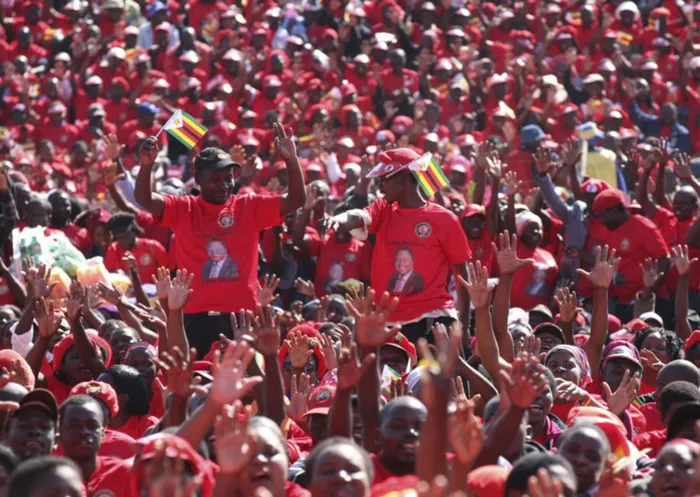
Crowds cheer Zimbabwe opposition Movement For Democratic Change leader Morgan Tsvangirai at the launch of his party's election campaign in Marondera about 70km east of Harare. Direct elections have long been treated as the gold standard of democracy. Citizens vote, a leader emerges, and legitimacy is assumed. Yet this assumption deserves scrutiny.
Image: File
I HAVE closely followed the debate around Constitution of Zimbabwe (Amendment No. 3) Bill with keen interest. Working in political campaigns, I have reflected deeply on what the Bill’s proposed changes mean, not just for governance, but for how campaigns are designed, executed, and won. That perspective has shaped my thinking in ways I did not initially anticipate.
There is a fundamental question at the heart of Zimbabwe's political future: how should a president be chosen?
Direct elections have long been treated as the gold standard of democracy. Citizens vote, a leader emerges, and legitimacy is assumed. Yet this assumption deserves scrutiny.
Across Africa, most presidential systems rely on direct elections. Yet this has not consistently translated into stability or public trust. According to Afrobarometer, trust in elections and electoral bodies across many African countries frequently falls below 50 percent. High participation does not automatically produce legitimate outcomes. In Zimbabwe specifically, direct elections have personalised politics to a damaging degree, intensified winner-takes-all dynamics, and consistently elevated tribal emotion over policy substance. The ballot paper feels empowering. The aftermath frequently is not.
An indirect system, where parliament elects the president, does not remove democracy. It restructures it around institutions rather than personalities. This is not a radical experiment. Germany elects its president through a federal convention. India uses an electoral college. South Africa's president is elected by parliament. These are not fringe arrangements. They are the architecture of some of the world's most stable democracies. Leadership in these systems emerges through coalition building and structured deliberation rather than purely national popularity contests driven by money, mobilisation and ethnic arithmetic.
Research by the Swedish-based electoral institute, IDEA, demonstrates that closely contested direct presidential elections are significantly more likely to trigger post-election disputes than those mediated through institutional processes. Zimbabwe has experienced this firsthand across multiple election cycles.
Zimbabwe's most enduring governance challenge has been the dominance of individuals over institutions. Presidents accumulate power. Institutions weaken around them. The cycle repeats. Indirect systems interrupt this cycle by shifting the locus of political power back to legislative institutions. World Bank governance indicators consistently show that countries with institutionalised executive selection processes perform better on political stability metrics over time. The goal is not to remove the people from power. It is to ensure that power flows through structures that outlast any individual.
From a campaigns perspective, this shift is profound and largely underappreciated in the current debate. Let me be direct about what it means for those of us who work in this field professionally.
In a direct presidential election, the campaign is essentially a war of reach. The candidate who can mobilise the most bodies, dominate the most airwaves, and ignite the most emotional loyalty wins. Campaign budgets flow overwhelmingly toward the presidential candidate. Legislative races are afterthoughts. Ground operations are built around a single personality. Data, where it exists at all, is used to target voters by region and ethnicity rather than by policy preference or persuadability. The result is campaigns that are expensive, tribal, and structurally incapable of building the broad coalitions that governance actually requires.
An indirect system changes every one of those calculations. Suddenly, every parliamentary seat matters enormously. The campaign practitioner's work shifts from manufacturing a presidential image to building a parliamentary majority, seat by seat, constituency by constituency. Voter research becomes more sophisticated because you are no longer just asking who people like but what policy positions can hold a coalition together across different regions and interest groups. Alliance negotiations become a core campaign function, not an afterthought. Internal party democracy strengthens because parliamentary candidates carry genuine weight in determining who ultimately leads the country.
For campaign professionals, this is a more demanding environment but a far more intellectually honest one. You cannot win through spectacle alone. You must win through strategy, substance, and the patient construction of governing alliances. The skills required, negotiation, policy development, legislative mapping, and coalition management, are precisely the skills that translate into effective governance once the campaign is over. In that sense, an indirect system does not just change how campaigns are run. It changes what campaigns are for.
This also has significant implications for political party development in Zimbabwe. Parties would be compelled to invest in their legislative wings, develop genuine policy platforms, and build organisational depth beyond a single leader's personal following. The era of the party as a personality vehicle becomes structurally unsustainable. That is not a loss for democracy. It is a maturation of it.
Intellectual honesty requires acknowledging the tension here. Indirect systems can create perceived distance between citizens and their leadership. When voters cannot directly remove a president through the ballot, accountability mechanisms must be robust and transparent to compensate. Parliamentary oversight, freedom of the press, and an independent judiciary become even more critical in such a system. These risks are real but manageable. They are also not unique to indirect systems. Direct elections in Zimbabwe have produced their own accountability deficits that remain unresolved.
Zimbabwe does not lack political participation. It lacks a system capable of converting that participation into stable, institutional governance. An indirect presidential system is a structural intervention, not a perfect one, but a serious one. It shifts focus from individuals to institutions, from electoral victory to the harder work of governing. It asks political parties to be more than vehicles for a single personality and demands that leaders earn power through deliberation rather than domination.
The time has come to debate not just who leads Zimbabwe but how we choose our leaders and whether the system we inherited is still fit for the country we are trying to build.
* Glen Mpani is a political campaign strategist and group lead of the International Centre for Political Campaigns. His work spans campaign strategy, war room operations, mobilisation, political communications, and institutional capacity-building for political parties, candidates, and political organisations across Africa and internationally.
** The views expressed here do not reflect those of the Sunday Independent, IOL, or Independent Media.