

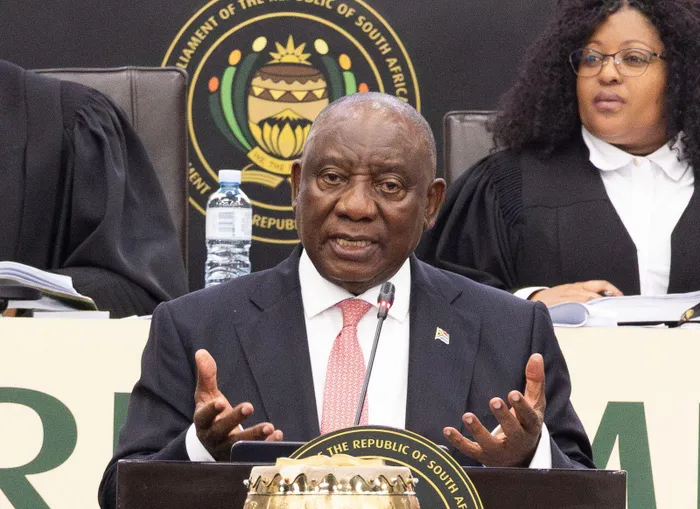
If President Cyril Ramaphosa had been open and honest when the scandal broke in 2020 about what happened on his farm and that he had perhaps made some grave and regretful mistakes, he would probably have received much sympathy from many people.
Image: GCIS
I FIRMLY believe that the only way to understand the current mindset of embattled President Cyril Ramaphosa is to look back briefly at his political history. I first met Ramaphosa in 1982 when the National Union of Mineworkers (NUM) was formed.
Together with James Matlatsi, then president of NUM, he played the leading role in the formation of NUM.
He was always a charming person, had a magnetic personality, a powerful determination to succeed, and a huge sense of himself. He is very strong-minded and has an incredible willpower to pursue and get his way.
We were thereafter together in the Congress of South African Trade Unions (Cosatu), which was formed in 1985. I was then an organiser/educator for the Paper, Printing, Wood, and Allied Workers Union and he was then still the leader of NUM.
I remember that Ramaphosa was a formidable leader and very confident and assertive in Cosatu Central Executive Committee (CEC) meetings, which I sometimes attended. He certainly seemed like a trade union leader who had bigger ambitions and was destined for a leading political role in the future of South Africa.
I believe that deep down it is these qualities that motivated his decision to not resign but to launch a challenge against the ruling by the Constitutional Court (ConCourt) ruling last week that Parliament acted unlawfully in 2022 by rejecting the Section 89 independent panel’s report on the Phala Phala scandal.
The court set aside the majority vote in 2022, when parliament was dominated by the African National Congress (ANC), because it had a majority of MPs. That ANC parliamentary majority ended when the ANC lost the 2024 national elections.
But a very important and interesting fact about Ramaphosa is that he cut his political teeth in the Black Consciousness movement and, specifically, its South African Students Organisation (Saso). But after he had travelled to Britain with Motlatsi in 1985 and had discussions with ANC leaders in exile, he could see ahead that the ANC was going to be the leading organisation of the broad national liberation movement.
As a result, it was since around 1985 that he began to shift politically from the BC movement to the ANC and played a leading role in NUM’s adoption of the Freedom Charter. He had made a politically very strategic decision to shift his focus to the ANC because he believed it was going to be the biggest and strongest force for change in South Africa in the future.
After his trip to Britain, together with Motlatsi, in 1985, there was also a distinct shift politically and ideologically towards socialism, and both supported the idea of a working-class party. Increasingly, they then made direct attacks against capitalism in South Africa.
But that was in the 1980s. After 1994 things fundamentally changed. Ramaphosa was elected general secretary of the ANC and led the constitution-making process and the negotiations with the white Nationalist Party (NP).
He was very smart politically and strategically. Not only did his political sentiments decisively shift towards the ANC from around 1985, but he was also the leader of NUM, arguably the most powerful trade union in the entire history of this country. It was his leadership of NUM during the tumultuous days of the mid-to-late 1980s that placed him in such a powerful position after the ANC and other parties were unbanned in 1990.
As a direct result of that situation and his very dynamic leadership he was elected the first secretary-general of the ANC in 1991 after it was unbanned in 1990. It was that same background he had which also led him to be elected chairperson of the Constitutional Assembly after the 1994 elections.
It was also an observation of many inside the ANC that Nelson Mandela, then president of the ANC, favoured Ramaphosa for being elected secretary-general of the ANC in 1991 and in fact preferred him to be his deputy, but he was outmaneuvered by Thabo Mbeki in the run-up to the 1994 Uhuru elections.
Alienated by the fact that Mbeki was elected deputy to Mandela and not him, Ramaphosa left politics for the business world in 1996. But still nursing his ambition to become the president of the ANC and SA he returned to politics at the ANC’s 53rd National Congress in 2012, where he was elected deputy president under President Jacob Zuma.
At the ANC’s 54th National Conference in 2017, Ramaphosa was elected president of the ANC and was elected president of South Africa after Zuma was forced to resign on the February 14, 2018. He thereafter finally ascended to the highest office in the land and the pinnacle of political power.
These achievements showed what incredible political survivalist skills he has, much of which I think resides in the very strong sense of himself he has and what a great political strategist he is. He came back from the business world to become the deputy president of the ANC and the country and, thereafter, the president of both.
But linked to these survivalist skills is the striking way in which he deals with and overcomes distinct adversity. Remember his ‘New Dawn’ speech of 2018? But we have today in this country arguably the worst multifaceted crisis ever. Where seven years later is the “New Dawn” he promised?
Furthermore, remember his complicitous role in the Marikana massacre when, as a director of Lonmin, he urged “concomitant action” against angry Black striking mineworkers? A few days later the massacre of miners took place. For me and many others that was the lowest point of his political career.
But even after Marikana, his blatantly unfavourable Phala Phala scandal, and the deplorable fate of his “New Dawn” promises, if a referendum were held tomorrow, I am quite confident that he would probably be favoured to retain his presidency of South Africa.
Such a possibility is not because voters and citizens are satisfied by his leadership, but what ANC leadership alternatives there would be if he was impeached.
However, it is not so much that he has incredible survivalist instincts, but it is how, despite all the fully justifiable criticisms of him in several respects, he would still prevail, I contend, if an appropriate referendum were held today.
Could Ramaphosa perhaps be replaced by his deputy, Paul Mashatile? Certainly not. Matshatile has been dogged by several serious allegations of malfeasance over several years, so much so that the Democratic Alliance wanted to take legal action against him not long ago.
Besides, Mashatile honestly leaves much to be desired as a political leader. I don’t even think he deserves to be the deputy president of the ANC and the country. The fact that he is is a sad reflection of the ANC.
I cannot even envisage an interim or caretaker ANC president if Ramaphosa is impeached. I cannot think who in the ANC that could be. I don’t think the ANC has the calibre of leaders who could play that role.
Besides, it is legally possible that his application for the panel’s report to be judicially reviewed could be successful. What then?
There would also be many adverse consequences for the ANC and the country if he were impeached. Those matters must be taken into account by those who believe he deserves to be impeached.
The latest news is that Ramaphosa has filed an urgent court interdict to block the parliamentary impeachment process from proceeding until his review is heard and decided. The big problem is that such a course of action might considerably delay the parliamentary process from beginning.
What exactly he hopes to achieve by this procedural delay is not very clear. It can also make his opposition in parliament more determined to interrogate him about his Phala Phala scandal. Judging from the response thus far from opposition parties, they are strongly critical of these delays, arguing that he is trying to run away from or delay accountability.
However, it would not go down well with many if Ramaphosa is seeking to delay the impeachment process, especially if he is confident that he has good grounds in calling for a review of the panel’s report.
He should have allowed the process to unfold because depending on the evidence and arguments produced, he will not necessarily be found guilty of violating the constitution regarding the events on his farm.
We don’t know and cannot anticipate the legal grounds upon which he is challenging the report and on what grounds exactly he is now making an urgent application to interdict the impeachment process in parliament.
The view of many is that it will be very demanding and difficult for him to successfully interdict the parliamentary impeachment process, especially after the ConCourt firmly ruled that his case must go back to parliament to face an impeachment process.
But about his review of the report, there are some leading constitutional legal minds who think that it was not well crafted and that it contained good grounds for justifiable criticisms and was in some respects vague.
In fact, I think that the better half of Ramaphosa would concur that many things he is reported to have done or not done are just blatantly wrong, farfetched, and unconstitutional for a head of state. He should long ago have admitted that he is deeply regretful about certain things that happened or did not happen on his farm. But it is obviously far too late to proceed along those grounds.
I also think that if Ramaphosa had been open and honest when the scandal broke in 2020 about what happened on his farm and that he had perhaps made some grave and regretful mistakes, he would probably have received much sympathy from many people, including in the media and even among MPs themselves.
But it is very important to realise and accept that irrespective of what position we occupy in society, we are fallible human beings. Instead, he chose to evade journalists who asked legitimate questions about what had happened on his farm.
However, I think that Ramaphosa knew that what had happened on his farm was of a very serious magnitude and that there was much evidence against him in that regard, which is why he was going to resign after the panel’s report came out in December 2022 but was persuaded not to do so.
But we also need to realise that this situation is much more complex than we imagine. This is also the first time that a president in this country is alleged to have committed such reprehensible conduct on his property. There is no precedence in SA for this case.
Politics can be extremely complex, as is the question of whether Ramaphosa will be impeached or not. Besides, there can be no doubt that his impeachment will certainly have serious and severe repercussions for SA, locally and globally. But we cannot in advance know what specific affects it will have.
However, there are many distinct possibilities that could still occur, even if the impeachment process unfolds in parliament. If the impeachment decision was taken by a simple majority, it would only require 201 votes of a National Assembly of 400 seats, which the ANC would support because then they would then need 42 votes from other parties.
But if the decision for impeachment requires a 2/3 majority of 238 votes, they would need 79 votes from other parties, which would be much harder for the ANC. But if the DA, with 86 votes, supports the ANC, it will seal victory for Ramaphosa because it will have a total of 245 votes, in excess of the 238 votes required.
However, a legitimate question is this: if there was no other ANC leader competent, experienced, and credible enough to replace Ramaphosa, does that mean that he should not be impeached?
If so, some would justifiably argue that such a stance would make a mockery of the constitution and set a terrible and indeed unconstitutional precedent. Hence, how Ramaphosa is going to survive the toughest battle of his entire political career is going to be virtually impossible.
Unless he and his legal advisers can succeed in persuading the parliamentary impeachment committee that the panel’s report was fatally flawed, which is possible, but unlikely. However, from legal commentary I have heard I don’t think he will succeed in his urgent application to interdict the impeachment proceedings in parliament.
* Dr Ebrahim Harvey is a political writer, analyst, and commentator.
** The views expressed here do not reflect those of the Sunday Independent, Independent Media, or IOL.