

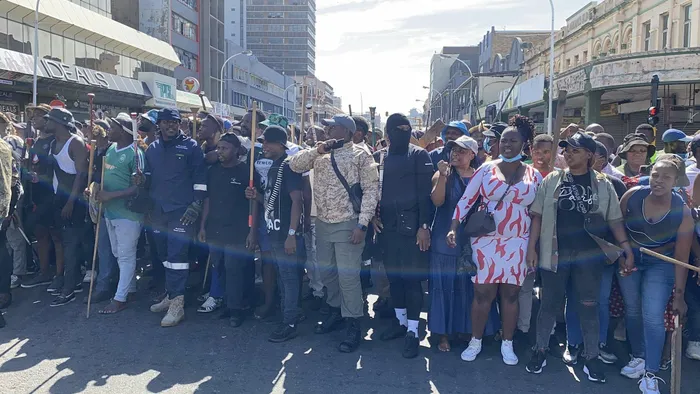
The March and March Movement's supporters on the streets of Durban's CBD. The writer says the biggest problem since 1994 and especially since 1996, when the Constitution was introduced, lies with our understanding and definition of “freedom” in our daily lives.
Image: Sipho Jack
Monday, April 27, was the 32nd anniversary of Freedom Day, when, in 1994, Black people voted for the first time in our Uhuru nonracial and democratic elections.
The South African 1996 Constitution has established the right to basic housing, healthcare, food, water, education, and social security.
Those rights are enshrined in Section 7(2) of the Bill of Rights in the Constitution, and it compels the state to respect, protect, promote, and fulfil all those rights. But since 1996, these rights have not been implemented and realised.
Probably, because subsection 26(2) also states that these rights can only be implemented if the state has the required resources.
Such a convenient caveat was this in the Constitution that, in 2000, Professor Themba Sono stated: “To claim, as our silly subsection 26(2) does, that the government shall deliver only when it has the material means to do so is to hoodwink the populace.
“What if the state never has enough funds to fulfil these rights? Does it mean these rights are held in permanent abeyance? Could such a right be a right then?”
Besides, who can believe that generally Black working-class townships across the country are in such a terrible state? How do people living under such terrible, crisis-ridden conditions celebrate Freedom Day?
The biggest problem since 1994 and especially since 1996, when the Constitution was introduced, lies with our understanding and definition of “freedom” in our daily lives.
The caveat I earlier referred to is the biggest weakness in our Constitution, which is precisely why, 30 years since it was passed, we have the highest levels of Black poverty, unemployment, and social inequalities arguably ever in South Africa.
In the final analysis, the biggest factor in which these serious social problems are rooted is the neoliberal macroeconomic constraints we have had since the 1990s. We have also had neoliberal austerity budgets, which hurt and harmed most of the ordinary residents in Black townships for many years.
The unvarnished truth is that Black majority rule has been a disaster for the majority Black working class, the same people who led those great anti-apartheid struggles in the 1970s and 1980s, which forced the previous white racist regime to negotiate with the African National Congress (ANC) in 1991.
That is why the ANC lost the 2024 elections for the first time since 1994 and why they will most probably lose the local government elections this year. They lost huge support in this election, dropping from 57% to around 40%.
But electoral losses had already begun in 2016 and 2021 when the ANC lost the local government elections in the powerhouse of production and nerve centre of the economy, Gauteng.
One would have thought that the loss in 2016 would have resulted in the ANC winning the 2021 elections in Gauteng, but they lost it again.
The same deceit occurs with Human Rights Day celebrations. When Black poverty, unemployment, and raging social inequalities are so starkly evident in Black townships compared to where the ANC leaders live in formerly white suburbia, who can celebrate Human Rights Day?
We need to think very carefully about what political freedom is worth to vote in elections when the vast majority of Black voters live in such appalling conditions. That is probably why the number of people who register to vote has dropped so much over the years.
The Black youth, languishing in probably the worst mass unemployment in living memory in townships, have also increasingly lost interest in elections and politics. And the number of residents who attend community meetings has also declined starkly over the past decade.
But many people don’t understand that, more than anything else, it is the deprivation of human dignity that is most hurtful regarding the violation of human rights in our constitution, especially that which concerns access to water, sanitation, electricity, food, and housing.
In fact, the Constitutional Court should be inundated with such cases, especially those that concern the deprivation of basic municipal services and the relevant Bill of Rights enshrined in our Constitution.
Those are arguably the most important cases that should come before that institution, especially since the Constitution is supposed to be the supreme law of the country.
This raises a key and critical question: How many of such cases end up being adjudicated in the Constitutional Court? Unless there are so many such violations that it is not treated with the seriousness it deserves.
Are the relevant organisations in civil society involved in taking up such cases? If not, it would be a serious weakness because violations of the Bill of Rights in the Constitution are arguably the most important, precisely because they represent a direct attack on the dignity of residents in Black townships.
Sociologically and politically, there is an inverse relationship between human rights and human dignity. Therefore, a denial or violation of human rights is a denial or violation of human dignity. In other words, they are inseparably related.
Yet, there are leaders in the government who know very well that they have miserably disappointed the poorest people with a host of service delivery failures, corruption, and incompetence in Black townships over many years but who have the audacity to tell us on Freedom Day that dignity begins with access to basic needs.
But with that historical background in mind, many people have concluded that the Black masses have been betrayed, especially by the ANC, which has been the ruling party since 1994 until it lost power in 2024. Faced with the ghastly daily facts of life in the Black townships, it is impossible to argue against that conclusion.
* Dr Ebrahim Harvey is a political writer, analyst, and commentator.
** The views expressed here do not reflect those of the Sunday Independent, Independent Media, or IOL.