

The Status of Boys in South Africa Report sheds light on the urgent need to address the mental health challenges faced by young males, advocating for a shift in societal norms to promote emotional well-being and gender equity.
Image: Tarikul Raana / Pexels / File
The widespread silence surrounding the challenges faced by young South African males was confronted on Friday, as the Status of Boys in South Africa Report was officially handed over to three deputy ministers at Jeppe High School for Boys, commemorating the International Day of the Boy Child.
The event marked a renewed, deliberate effort by the Department of Basic Education (DBE) and partners, including Premier FMCG, Aids Healthcare Foundation, and Primestars, to ensure boys are not the “invisible half” of gender equity conversations.
Nkosinathi Moshoana, CEO of Primestars, presented the overview, urging the nation to confront the hidden pressures placed on boys.
“Today, ask an uncomfortable but necessary question: What happens to a society when boys grow up believing they must suffer in silence because silence has consequences?” Moshoana stated.
He highlighted the corrosive societal scripts that equate vulnerability with weakness, leading to emotional pain manifesting as violence, depression, or addiction.
The report was officially handed over to Deputy Minister of Basic Education, Reginah Mhaule, Deputy Minister of the Department of Women, Youth and Persons with Disabilities, Mapaseka Letsike, and Deputy Minister of Social Development, Mogamat Hendricks, at the event.
The event focused heavily on prevention as the primary driver of change in dealing with the national disaster of gender-based violence (GBV).
“South Africa, and indeed the African continent, cannot police or prosecute its way out of gender-based violence. By the time violence reaches a courtroom or a police station, the damage has already been done,” Moshoana argued, emphasising the need for interventions to begin in schools, homes, and communities.
A key focus was the national preventative intervention, What About The Boys, launched in 2022. The programme has reached over 60,000 boys, and independent evaluations show promising behavioural shifts, including a 67% reduction in bullying in participating schools and improved classroom participation reported by 81% of teachers.
The evaluation revealed the impact of breaking the silence. “Many boys told us this was the first time in their lives they felt safe enough to speak honestly about their emotions,” Moshoana said.
Before the intervention, the extent of harmful inherited beliefs was stark; 16% of boys agreed there are times when a woman deserves to be beaten, and 74% believed a husband could have sex with his wife whenever he wanted.
Willy Qabe from LifeLine expanded on the devastating mental health landscape that results from this enforced silence.
He revealed a “silent crisis”, noting that while women are diagnosed with depression and anxiety more frequently, men account for nearly 80% of all mental health-related deaths in the country.
“Over 75% to 80% of people who take their own lives in South Africa are male,” Qabe reported, citing a staggering male suicide rate of approximately 37.6 per 100,000.
He pointed to traditional masculinity norms that demand emotional suppression, stating that depression in males frequently presents as anger, irritability, or risk-taking, rather than typical sadness.
Qabe also spoke of the profound loneliness and isolation that result from a lack of intimate, open friendships. He passionately advocated for a change in perspective.
“Showing emotion is not a sign of weakness, but it's a strength. I admire a man who will show emotion because they'll be in a better space after that,” he stressed.
He highlighted the secondary abuse many men face when seeking help, such as the mockery endured by a man reporting domestic abuse at a police station.
The evolution of the intervention, What About The Boys 2 (WATB2), was announced, which will now bring boys and girls together in a shared learning environment.
“You cannot ask boys to unlearn dominance if girls are still taught silence,” Moshoana explained, calling it a necessary trajectory to collectively challenge harmful gender norms and align with the country's National Strategic Plan on Gender-Based Violence and Femicide.
Moshoana addressed the young men present, asking them to remember the Good Man Pledge they were taking. “Being a good man is not perfection. It is a daily decision,” he said. “Change begins when silence ends.”
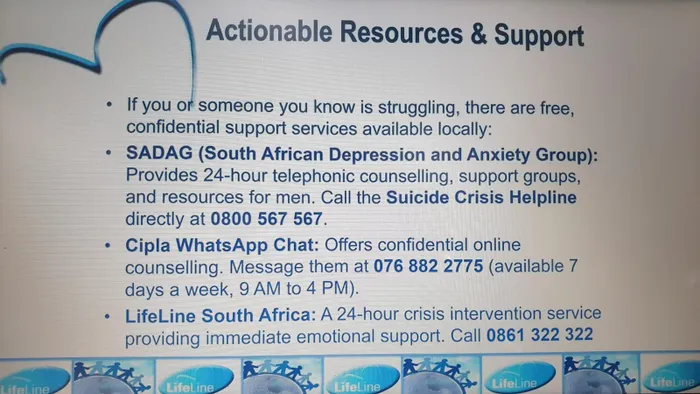
Many men feel they lack a supportive community, but help is available. If you or someone you know is struggling, reach out for assistance.
Image: Screenshot
karen.singh@inl.co.za