

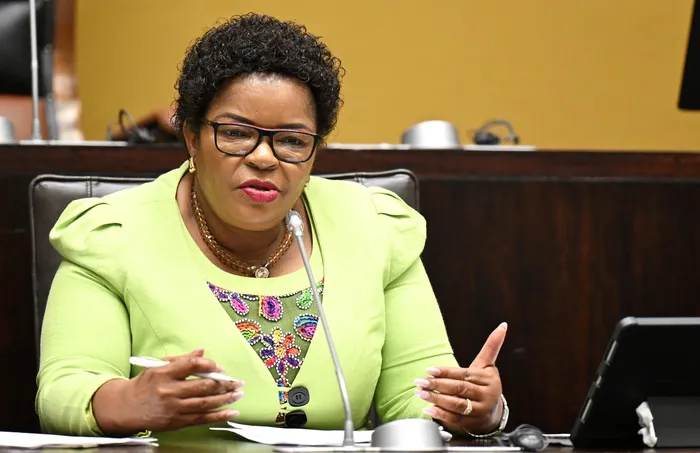
Chairperson of Subcommittee on Review of Assembly Rules, Doris Mpapane, said the draft impeachment rules will be circulated to the MPs before the next meeting.
Image: Phando Jikelo / RSA Parliament
While parties agreed on the need to push ahead with the impeachment of President Cyril Ramaphosa over the Phala Phala scandal and crafting water-tight rules, the ANC warned against rushing the process.
On Thursday night, the Subcommittee on Review of Assembly Rules received legal advice on the implications of the Constitutional Court judgment, which ordered that the Independent Panel report be referred to the Impeachment Committee and parliamentary rules be amended.
The MPs were advised on drafting the impeachment rules and impeachment protocols.
State law advisor Andrew Breytenbach said the matter was inherently urgent.
“You do not have the luxury of time because this is inherently urgent. I am not suggesting one has a long, drawn-out process; quite the contrary. It must be focused and ensure that the inquiry concludes without delays,” he added.
The discussion surrounding the impeachment process ignited apprehension that these proceedings may not unfold swiftly.
Breytenbach said the rules must ensure that while the process was fair, it was concluded within a reasonable timeframe.
“The rules themselves must regulate the Impeachment Committee to avoid a situation that takes unreasonably long,” Breytenbach said.
DA parliamentary leader George Michalakis said at the rate things were happening, he would be dead when the impeachment hearing happens.
He said Parliament and its reputation as a credible and effective institution rely on how it deals with the matter.
“The public wants to see this process completed and Mr Ramaphosa will no longer be the president by the time we are done, but Parliament’s credibility will be gone,” said Michalakis.
EFF MP Sam Matiase said the process should not be open to further abuse.
“The court judgment is about ensuring that, in the rules of the National Assembly, the Section 89 process is not open to abuse. The rules we develop must be water-tight to guard against such abuse,” Matiase said.
MK Party MP Mzwanele Manyi was initially pessimistic about the process, saying he had thought that the process would move quickly.
“I think what we hear now from the lawyers is refusal by stealth. The lawyers are saying to us before you move, start with policy, do legislation, do regulations, and draft a memorandum,” Manyi said.
He also said the process suggested by the legal team meant that it would take months to develop the rules, and that would have the effect of undermining the Constitutional Court and implicating Parliament more in terms of failing to hold the executive to account.
Rise Mzansi MP Makashule Gana said, based on the presentation by the legal team, the process might take three to six months to conclude.
“We ought to find the shortest possible path to execute the order of the Concourt,” Gana said.
ANC MP Mikateko Mahlaule reminded fellow MPs that while there is a desire for swift action, it is imperative to ensure thorough compliance with National Assembly rules.
“You can go the shortest way and commit a mistake, the court may find you have not complied with the rules of the National Assembly. I agree, let us not take a very long time,” Mahlaule said.
“Processes are there, and for us to do the right thing, we will follow the process so that we don't get another adverse judgment against the National Assembly,” he said.
Matiase agreed with Mahlaule that there should be a time frame.
“We can't work with an open-ended process. At some point, we need to finalise the work of the Subcommittee of Review of Assembly Rules so that we can send our recommendations to the Rules Committee, so that the Impeachment Committee, once the processes are done and dusted, can get on with its work.
“There must be well-crafted rules by our legal advisors, and in the shortest space of time, presented to the Rules Committee for consideration,” said Matiase, adding that the process should not serve the immediate interests of political parties.
Manyi agreed with Matiase that the rules must not be made for a specific incident.
“We must make rules for longevity, as it were. For that to happen, I don't think we should be under a time frame of sorts, but in the meantime, take the Concourt position and go with it,” he said in reference to the read-in provision rules provided by the Constitutional Court.
Senior parliamentary legal advisor Frank Jenkins said Parliament should plan for the worst.
“We need to make sure the rules or terms of reference are not only water-tight but are resolved easily,” Jenkins said.
Sub-committee Chairperson Doris Mpapane said the officials will work on the proposed amendments and regulations by Monday, and that members will be allowed to make inputs on the drafts ahead of the next meeting next Friday.
Mpapane said the draft rules will be circulated to the MPs before the next meeting.
“If they are not done, I will not push them to do rush-rush to avoid mistakes.
“We don't want mistakes. We want to establish rules that will stand the test of time. We are not creating rules for anyone but rules of the National Assembly that will stand the test of time,” said Mpapane.
mayibongwe.maqhina@inl.co.za