

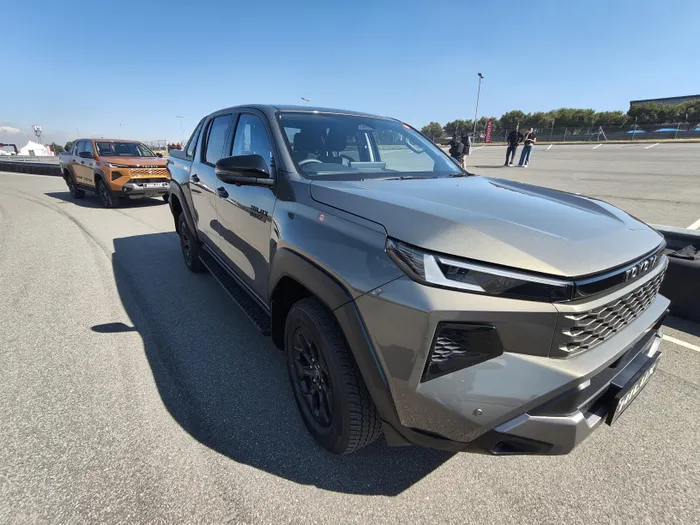
Although the Hilux retains its existing underpinnings, both the front and rear sections have been redesigned, while the cabin receives a much-needed comprehensive overhaul.
Image: Willem van de Putte
Toyota used its first ever Matsuri event at the Kyalami Grand Prix Circuit to showcase and allow the media to sample their new products being launched this year.
Matsuri means to celebrate or pay respect and the company has a lot to celebrate with a host of new vehicles set to be released this year.
We had an opportunity to have an up-close and personal look that included brief driving stints behind their wheels.
The bZ4X will be the company’s first full battery-electric vehicle destined for South Africa.
Built on Toyota’s dedicated e-TNGA platform, the bZ4X will be offered in single-motor front-wheel-drive and dual-motor all-wheel-drive configurations, depending on market specification which will be released on launch later this year.
Outputs range from 123kW to 150kW for the front-wheel-drive models, while the all-wheel-drive version produces up to 252kW.
Battery options are likely to include 57.7kWh and 73.1kWh packs, with Toyota claiming a driving range of up to 500km.
The bZ4X adopts Toyota’s latest EV design language.
The front fascia features a closed-off “hammerhead” nose with slim LED headlamps and contrasting black wheel arch cladding while the sloping rear roofline, split roof spoiler and full-width LED light bar add to its attractive look.
Inside there’s a seven-inch digital instrument cluster designed to be viewed over the steering wheel.
A large 12.3-inch infotainment display dominates the centre console, with wireless Apple CarPlay and Android Auto included.
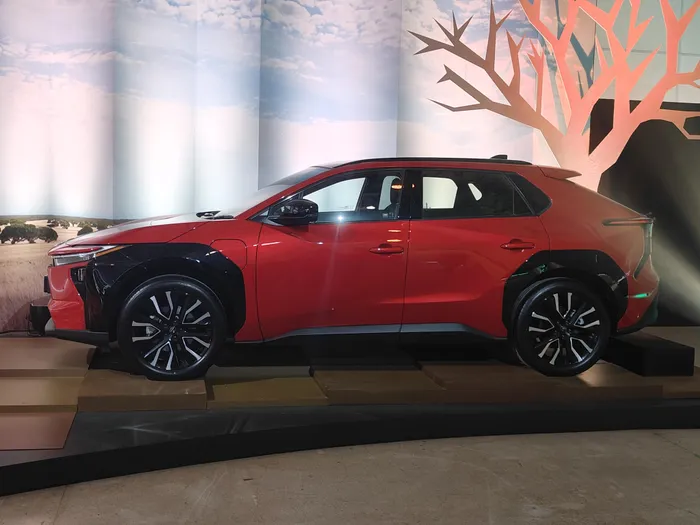
The bZ4X will be the Toyota's first full battery-electric vehicle destined for South Africa.
Image: Willem van de Putte
We had an opportunity to briefly drive it on a short slalom course, drag race as well as putting the all-wheel drive system to the test on a curated off-road course.
Its interior refinement and quietness stood out and with the low battery it zipped effortlessly through the cones with very little body roll and in the drag race the instant torque delivery gives it brisk acceleration.
On the offroad course the bZ4X proved its all wheel drive capabilities with relative ease.
Keep in mind that it’s not a 4x4 but it will get you to places that are far enough off the beaten track that two wheel drive vehicles won’t be able to access.
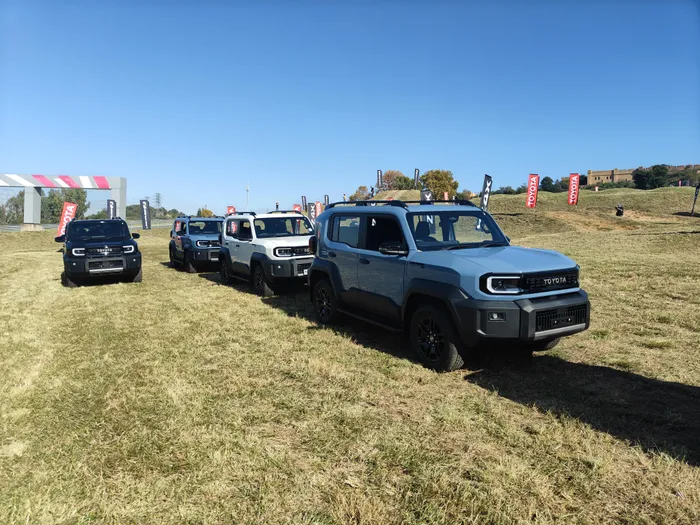
The exterior of the Land Cruiser FJ features a boxy silhouette, flared wheel arches and 245mm of ground clearance.
Image: Willem van de Putte
Based on Toyota’s IMV ladder-frame platform, shared in principle with the Hilux and Fortuner, the FJ is powered by a 2.7-litre naturally aspirated petrol engine producing 120kW and 246Nm.
Power is sent through a six-speed automatic transmission and part-time four wheel drive system with low range and a rear differential lock.
Two variants will be available in the form of the GX and VX.
The exterior features a boxy silhouette, flared wheel arches and 245mm of ground clearance. VX derivatives receive LED headlamps and black 18-inch alloy wheels, while removable bumper corners allow owners to replace damaged sections or fit aftermarket accessories more easily.
Inside, the dashboard follows the design introduced on the latest Prado. Toyota has thankfully retained physical controls for off-road functions, including a rotary dial for H2, H4 and low-range selection, as well as switches for traction control and the rear differential lock.
The cabin receives a digital driver display and touchscreen infotainment system with Apple CarPlay and Android Auto compatibility.
VX models add leather upholstery and dual-zone climate control.
On a short 4x4 course that included a 43 degree descent the FJ highlighted its offroad heritage and prowess.
The steering is light and visibility excellent thanks to the upright and flat windscreen while the short overhangs made obstacle approach and departure angles easy to drive.
With low range, rear differential lock and front view cameras, it’s likely to become a firm favourite among the offroad fraternity.
The petrol engine felt smooth and responsive but I do feel that if and when a diesel version is added to the range, Toyota will have an overflowing order book.
Toyota has confirmed local pricing with the Land Cruiser FJ 2.7 GX automatic priced at R714,000 and the VX derivative at R761,400.
We will be attending the launch of the FJ Cruiser at the end of the month so keep an eye out for a full review.
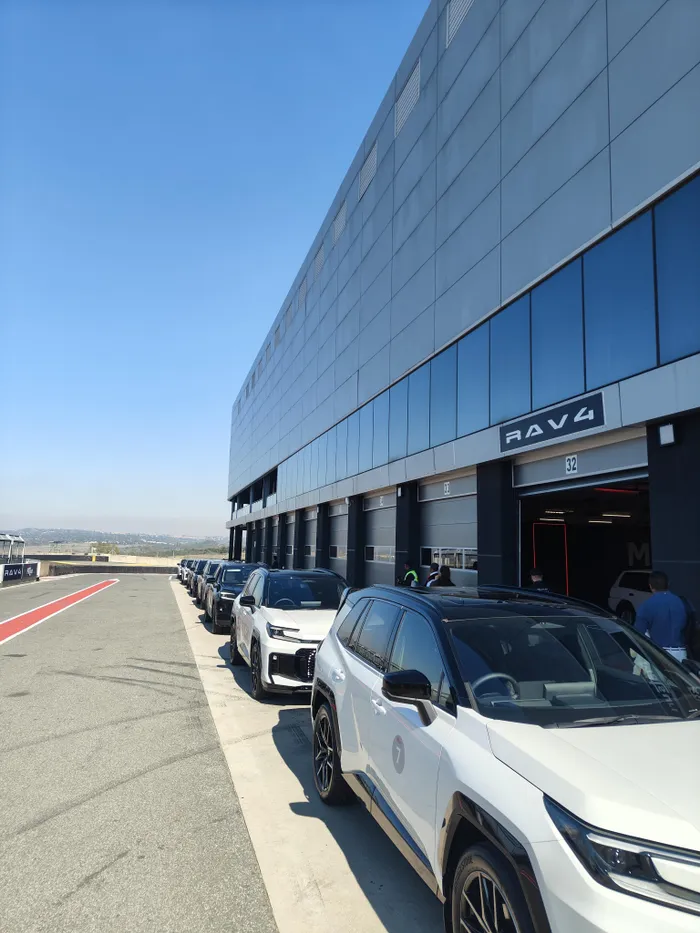
The RAV4 will move to a fully electrified range consisting of hybrid and plug-in hybrid models.
Image: Willem van de Putte
Toyota also previewed the next-generation RAV4, which will move to a fully electrified range consisting of hybrid and plug-in hybrid models.
The hybrid models pair a 2.5-litre petrol engine with Toyota’s latest hybrid system, producing between 135kW and 141kW depending on drivetrain configuration.
The plug-in hybrid model raises combined output to a claimed 223kW and offers up to 150km of driving range on the WLTP cycle with both AC and DC charging capability.
The exterior has a more angular and aggressive look, with a redesigned hexagonal grille and slim LED headlamps.
GR Sport models add a wider track, 20-inch gloss-black alloy wheels and red brake calipers while the plug-in hybrid gets unique styling details and two-tone paint finishes.
We drove the plug-in hybrid model between displays and the ride refinement was particularly impressive.
The chassis felt composed and the interior well laid out and put together.
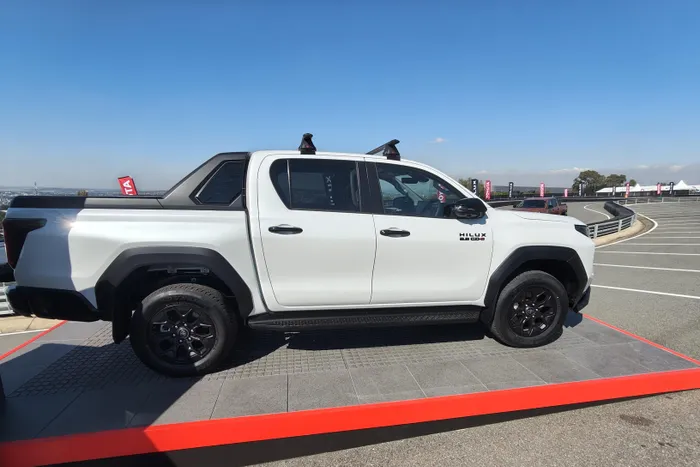
Under the bonnet of the Hilux the 2.8-litre GD-6 turbodiesel continues with outputs of 150kW and 500Nm.
Image: Willem van de Putte
We also got a closer look at the highly-anticipated updated Hilux range.
Although the bakkie retains its existing underpinnings, both the front and rear sections have been redesigned, while the cabin receives a much-needed comprehensive overhaul.
The new dashboard incorporates a floating infotainment screen, available in either seven-inch or 12.3-inch formats depending on model grade.
Wireless Apple CarPlay and Android Auto, a digital instrument cluster and an electronic park brake have also been added.
Under the bonnet the 2.8-litre GD-6 turbodiesel continues with outputs of 150kW and 500Nm. There’s no word yet whether the 2.4 GD-6 would join the stable at a later stage.
Toyota has also upgraded the Hilux’s chassis and suspension which we tested on a short handling course.
Although the drive was brief, it does feel like there is an overall improvement with direct steering and an ability to take sharp turns without too much fuss.
Toyota also showcased the new Toyota app for the Hilux.
It allows you to preset the air conditioning, tells you where the car is and importantly for the high-risk bakkie, an anti-theft feature that alerts you when the car is being tampered with.
We will be driving the new Hilux in Namibia next month where we will get the full low down and be able to fully test it.