


PCOS has officially been renamed Polyendocrine Metabolic Ovarian Syndrome (PMOS).
Image: Freepik
For years, women living with Polycystic Ovary Syndrome, better known as PCOS, have been told the condition is “just about cysts on the ovaries.” But according to global health experts, that understanding has always been incomplete.
Now, in what is being described as a major shift in women’s healthcare, PCOS has officially been renamed Polyendocrine Metabolic Ovarian Syndrome (PMOS); a change experts say better reflects the true complexity of the condition and could improve diagnosis, treatment and awareness for millions of women worldwide.
The condition affects more than 170 million women globally and has long been associated with symptoms such as irregular periods, infertility, acne, weight gain and excessive hair growth.
But researchers and healthcare professionals say the old name failed to capture the full picture.
The Endocrine Society, alongside more than 50 patient advocacy and professional organisations, supported the renaming process after years of research, international workshops and over 22,000 survey responses from patients and healthcare professionals around the world.
Professor Helena Teede, Director of Monash University’s Monash Centre for Health Research & Implementation, said the previous name often led to misunderstanding and delayed care.
“What we now know is that there is actually no increase in abnormal cysts on the ovary, and the diverse features of the condition were often unappreciated,” she explained.
The new name, PMOS, places emphasis on the endocrine and metabolic aspects of the condition, rather than focusing only on the ovaries.
For many doctors working directly with patients, the shift has been welcomed as long overdue.
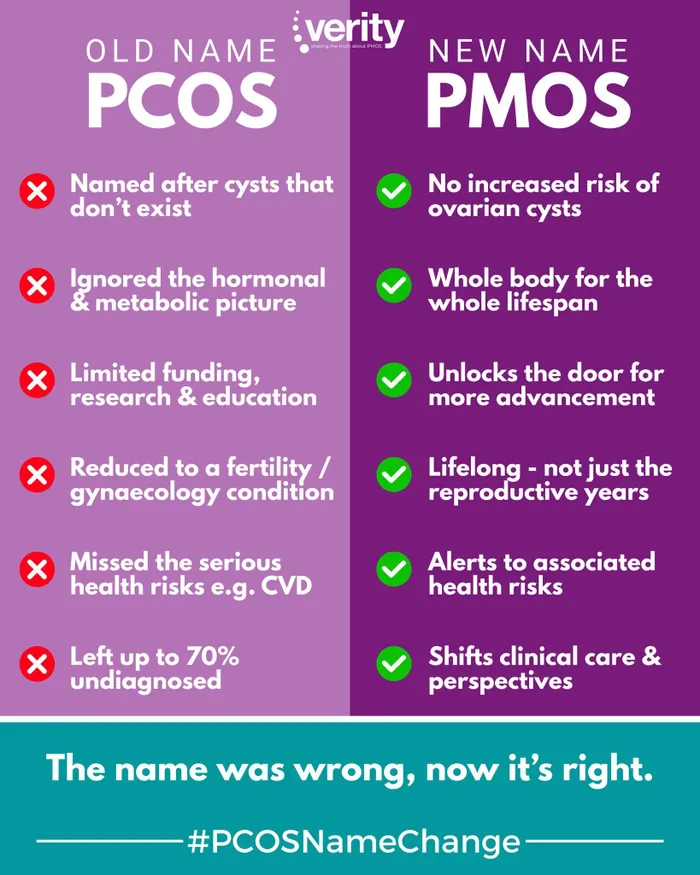
PCOS has officially been renamed
Image: VerityPCOS
Dr P. Theletsane, an obstetrician and gynaecologist, says the renaming is not about creating a new disease, but rather improving understanding of an existing one.
“It is a welcome change in the gynaecology space as the condition is about more than just ‘cysts’ in your ovaries,” she said.
“This name change is really a true representation of all the aspects to take into consideration when dealing with a patient with PMOS. It is not just about cysts in your ovaries, but there is also an endocrine, metabolic and reproductive component to consider.”
That distinction matters because many women with the condition do not actually have polycystic ovaries. In some cases, patients were dismissed or misdiagnosed simply because scans did not show ovarian cysts.
Dr G. Tsoke explained that the old terminology often confused both patients and healthcare providers.
“PCOS is an incorrect name for the condition, mainly because many think it is an exclusively ovarian condition where the ovary develops multiple cysts,” Tsoke said.
“There are women who may have this condition without polycystic ovaries, and as such, healthcare practitioners may delay in diagnosing it.”
Instead, doctors now want the public to understand PMOS as a complex condition involving multiple systems in the body.
The syndrome is closely linked to insulin resistance, which can increase the risk of developing Type 2 diabetes, cardiovascular disease and cholesterol abnormalities. It can also affect ovulation, fertility, skin health and mental wellbeing.
Dr Rinae Bonita Magwabeni said the updated name helps reflect the reality many women experience.
“The term PMOS better reflects the condition’s involvement of multiple body systems, including hormonal, metabolic, and reproductive health,” she explained.
“It highlights not only ovarian dysfunction, but also the broader effects of the condition on the entire body.”
The shift in terminology is also expected to change the way patients are treated.
Previously, management often focused heavily on contraception, fertility or regulating menstrual cycles. While those remain important parts of treatment, doctors say the new understanding encourages a far more holistic approach.
“The diagnostic criteria stay the same,” explained Dr Theletsane, “but the work-up and treatment of these patients is what is shifting as the condition has multiple components.”

Previously, management often focused heavily on contraception, fertility or regulating menstrual cycles.
Image: Cottonbro Studio / Pexels
Doctors are now emphasising the importance of multidisciplinary care, involving specialists such as dietitians, endocrinologists, psychologists, dermatologists and fertility experts, depending on a patient’s symptoms.
Lifestyle changes remain one of the first lines of treatment, particularly because of the condition’s strong metabolic component.
Tsoke said the updated name may also help reduce stigma around the condition, especially for women who have struggled with infertility, weight gain or visible symptoms such as acne and excess facial hair.
“It helps in removing the stigmatised nature of it being associated with fertility,” he said.
“It also helps with early identification and management of the condition before it presents late with complications which may be worse, such as cardiovascular risks, hypertension, diabetes, infertility and endometrial cancer.”
For women living with the condition, the renaming may also bring something less clinical but equally important: validation.
Patient advocates involved in the process say the old name often minimised what many women were going through.
By broadening the focus beyond the ovaries, PMOS acknowledges that this is not simply a reproductive issue but a lifelong health condition that can affect nearly every aspect of a woman’s wellbeing.
The transition to the new name will happen gradually over the next three years, supported by an international awareness campaign aimed at healthcare professionals, governments, researchers and patients.
Full implementation is expected in the 2028 International Guideline update.
For now, experts say women should not panic about the change. The condition itself has not changed; only the understanding of it has.
And for millions who have spent years feeling unheard, misunderstood or overlooked, that shift could make all the difference.