


Polycystic Ovary Syndrome has been officially renamed Polyendocrine Metabolic Ovarian Syndrome, a change driven by over 50 organisations to enhance awareness and improve healthcare outcomes for millions of women worldwide
Image: Pexels
Polycystic Ovary Syndrome (PCOS), a condition that affects more than 170 million women around the world, has officially been renamed Polyendocrine Metabolic Ovarian Syndrome (PMOS).
The Endocrine Society explained that more than 50 patient and professional organizations, including the Endocrine Society, took part in the process to develop the new name.
"PMOS is characterised by fluctuations in hormones, with impacts on weight, metabolic and mental health, skin, and the reproductive system," it said.
"What we now know is that there is actually no increase in abnormal cysts on the ovary, and the diverse features of the condition were often unappreciated," said Director of Monash University’s Monash Centre for Health Research & Implementation and Endocrine Society member, Professor Helena Teede.
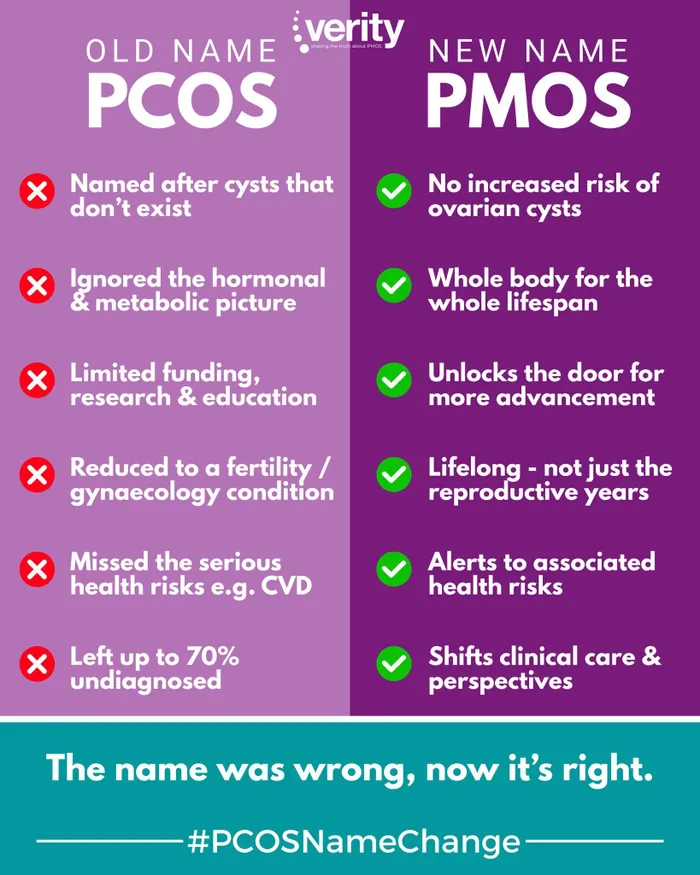
PCOS has officially been renamed
Image: VerityPCOS
She said it was heartbreaking to see women suffering through delayed diagnosis, inadequate care and limited awareness.
"While international guidelines have advanced awareness and care, a name change was the next critical step towards recognition and improvement in the long-term impacts of this condition," Teede added.
The process was led by Professor Helena Teede alongside International Androgen Excess and Polycystic Ovary Syndrome Society (AE-PCOS Society) President Professor Terhi Piltonen of Oulu University and Oulu University Hospital in Finland, AE-PCOS Society Executive Director Anuja Dokras from the United States, and Verity (PCOS UK) Chair Rachel Morman.
The initiative included 56 patient and professional organisations, among them the Endocrine Society, and involved more than 22,000 survey responses as well as a series of international workshops with patients and multidisciplinary healthcare professionals.
Researchers involved in a related paper found there was no increase in abnormal ovarian cysts linked to the condition, strengthening calls to replace the existing name.
The new name will be introduced during a three-year transition period supported by an international education and awareness campaign targeting healthcare professionals, governments, researchers and patients worldwide. Full implementation is expected in the 2028 International Guideline update.
Teede described the process as the largest initiative ever undertaken to rename a medical condition.
“The agreed principles of the new name included patient benefit, scientific accuracy, ease of communication, avoidance of stigma, cultural appropriateness and accompanying implementation,” she said.
Teede said the process was driven by people affected by the condition and aimed to better reflect its complexity.
Piltonen said cultural considerations played a major role in the renaming process.
“It was essential that the new name was scientifically correct but also considered across diverse cultural contexts to avoid certain reproductive terms that could heighten stigma and be harmful for women in some countries,” she said.
Australian patient advocate Lorna Berry, who has the condition and contributed to the process, said the change would improve clarity and healthcare outcomes for future generations.
Morman said the previous name failed to reflect the condition accurately.
“It is fantastic that the new name now leads with hormones and recognises the metabolic dimension of the condition,” she said.
She added that the shift would help reframe public understanding of the condition and encourage it to be treated more seriously as a complex long-term health issue.