

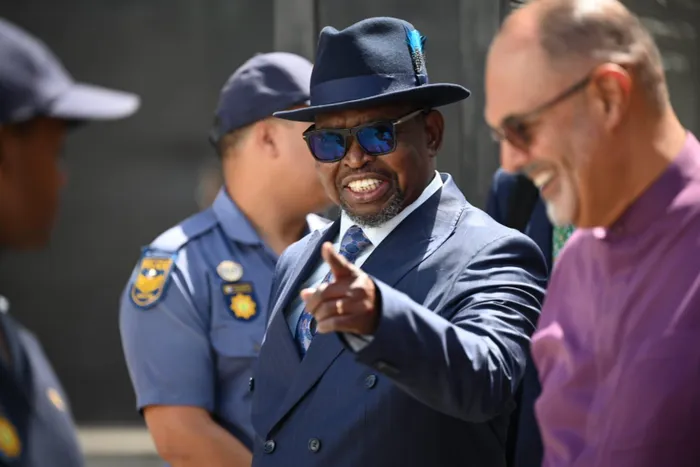
Finance Minister Enoch Godongwana delivered South Africa’s 2026 national budget speech in Parliament in Cape Town
Image: Armand Hough / Independent Newspapers
Economists have broadly welcomed the latest Budget Speech for signalling fiscal discipline and a commitment to stabilising public finances. However, with unemployment still hovering above 31% and youth unemployment significantly higher, questions remain about whether the measures announced will meaningfully shift South Africa’s labour market trajectory.
Dawie Roodt, chief economist of the Efficient Group, said the starting point is understanding the limits of fiscal policy.
“Well, it's not the job of the Minister of Finance, to create jobs. His job is to look after the finances of the State. And so that is certainly not his mandate, to create jobs.”
“But certainly what his mandate is, is to make sure that the fiscal accounts remain stable and sustainable because otherwise we can potentially get into trouble and that will be very bad for the economy and for jobs eventually.”
Roodt described the budget as 'a much more realistic and slightly more responsible budget,' suggesting it could be 'good for the economy and eventually for jobs as well.'
On persistently high unemployment, he said, “Despite the praise for the budget, unemployment remains pretty high… there are many other issues.”
He pointed to policy uncertainty and structural barriers. “The reason why that is so, is because of other policy obstacles that are still in place… These policy obstacles are things like expropriation… and things like BEE and so on. So those are policy obstacles in the way of stronger economic growth.”
"Until we get the real economy to grow, we're not going to create substantial numbers of jobs.”
Professor André Roux, Subject Head of Economics at Stellenbosch Business School, framed unemployment as central to South Africa’s broader challenges.
“South Africa’s chronically high unemployment rate lies at the heart of many of the country’s economic and socio-economic problems; not least of which poverty, inequality, and social discontent,” he said.
“The government’s fiscal stance is an important ingredient of the policy mix; and the annual budget speech provides a clear reflection of the government’s intentions in this regard.”
However, Roux emphasised:“The reality is that a budget is, in essence, an estimate of expected revenue and expenditure over a future period, as well as a plan on how to finance any possible revenue shortfall.”
“It is not incumbent upon the government to actually create jobs. Its role in this regard is to provide and implement an enabling environment that is conducive to economic expansion.”
On measures in the 2026 budget, Roux said:“The 2026 budget speech illustrates the government’s intent to improve the appeal of South Africa as a ‘place to do business’ by, for instance, taking measures to enhance fiscal rectitude, and by making further progress in the electricity, transport and logistic sectors.The decision to not place an additional burden on taxpayers through personal income tax should induce a moderate increase in consumer spending, while the SMME sector should benefit from the lifting of the compulsory VAT registration threshold from R1m to R2.3 million.”
Still, he cautioned:“These measures will not somehow magically create a multitude of jobs within months or even a few years; it takes time for the beneficial effects to filter through the system. In fact, in some ways the term ‘job creation’ is a misnomer. Jobs are not created; jobs happen.”
Economist Raymond Parsons echoed that warning.“Given the extent of the unemployment challenge in South Africa, there is no plausible strategy to dramatically reduce unemployment in the short term. Any claims of one Budget strategy being able to do so should be treated with scepticism.”
“The Budget must be supportive, but is not the major player here. Policies to broaden inclusivity in the labour market and reduce structural unemployment ultimately lie rather in faster economic growth, developing appropriate skills, and employment-friendly labour market reforms.”
On growth projections, he warned:“The forecast of only 1.6% GDP growth this year, hopefully rising to 2% by 2028, is simply not good enough to promote job creation on a large scale.To unlock its economic potential and create jobs South Africa needs to achieve a GDP growth of at least 3% or more to make a serious dent in the unemployment level.”
Professor Noluthando Mbangeleli of the Johannesburg Business School identified some positive steps in the budget.“There are some sensible job creation steps, notably R4.1bn allocated to the Presidential Employment Programme (PEP), which can expand short term work opportunities and reduce income distress.”
She added:“Public sector infrastructure spending exceeding R1 trillion over the medium term can create construction jobs and, if delivered well, unlock private investment and longer run employment.”
However, she warned:“The impact is constrained by delivery risks, including weak implementation capacity, slow project pipelines, and corruption or leakages that reduce the number, quality, and sustainability of jobs created.”
On the disconnect between praise and unemployment, Mbangeleli said:“The budget is praised because it signals fiscal discipline and stability… However, unemployment remains critically high… This disconnect arises because economic growth is still too weak to absorb labour.”
“I would recommend a State-capacity led development approach. Strengthen state capability to plan, procure, deliver and maintain infrastructure so spending turns into working assets and sustained jobs. Fix the jobs binding constraints by delivering reliable electricity, freight logistics, and water and municipal services.”
Across the board, the economists agree on one central theme: fiscal discipline may stabilise the environment, but without stronger growth, structural reform and improved implementation capacity, unemployment is unlikely to fall meaningfully in the short term.