

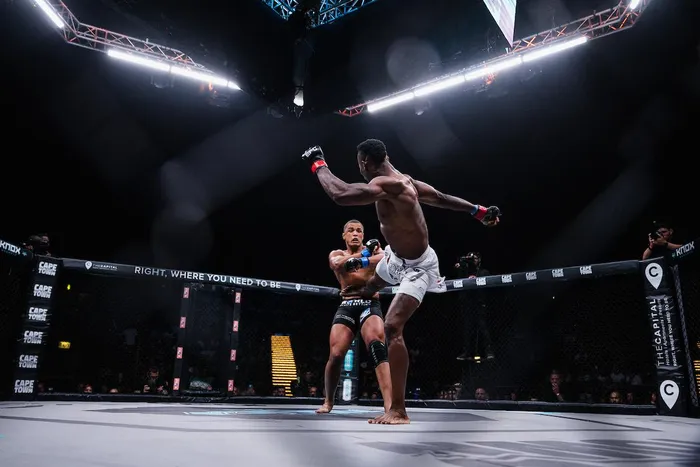
CIT's Diego Bandu stopped former EFC Middleweight champion Luke Michael to be crowned "And New" at last week's historic EFC KNOX Legacy Series event at the Grand Arena. Picture: EFCWorldwide.
Image: EFCWorldwide.
Former EFC middleweight champion Luke Michael’s Performance Institute Gym has submitted a formal appeal and list of grievances to Mixed Martial Arts South Africa following last week’s EFC KNOX Legacy Series event, in which its athlete competed.
Michael lost his title to new 185-pound champion DRC’s Diego Bandu, who stopped his opponent via TKO in the third round of their main event at the Grand Arena in Goodwood.
The much-anticipated EFC 131 KNOX Legacy Series marked the Extreme Fighting Championship’s return to the Grand Arena for the first time in seven years.
It was a historic night for Western Cape MMA fans, who have been craving live EFC events since the promotion’s last event in 2019.
While many are still reflecting on the 13-fight card with joy and nostalgia, the Performance Institute and some fans online have raised concerns about how certain processes and procedures were handled.
The Performance Institute officially submitted an almost 30-point formal appeal, violation, and evidence checklist to MMA SA, which has confirmed receipt.
“MMA South Africa confirms that formal correspondence has been received regarding the main event at EFC 131,” said MMA SA President William Oberholzer.
“As the sanctioning authority, MMA SA has formally logged the matter and initiated a structured review in line with its professional regulatory processes.”
Many of the complaints listed in the appeal are also directed at the promotion.
“We are aware that Luke Michael has submitted an appeal to MMA SA. The matter will follow the appropriate regulatory process, and we will notify you of any formal updates as soon as they are communicated to us.
“If the Performance Institute wishes to raise any additional concerns through the proper channels, they are of course entitled to do so,” said EFC VP Graeme Cartmell.
The Performance Institute’s appeal includes concerns listed under Technical & Officiating Breaches, Ethical & Neutrality Breaches, Administrative & Procedural Failures, and Safety & Security Incidents. One of the more controversial talking points among the general public — listed under Technical & Officiating Breaches — is an incident that took place in the first round. With three minutes remaining on the clock, Bandu delivered two powerful elbow strikes to Michael’s spinal area — a foul under the latest Association of Boxing Commissions and Combative Sports Unified Rules of MMA. As soon as referee Brad Bloch identified the blows, he called “time,” to which Bandu appeared visibly surprised. Bloch separated the two athletes and addressed Michael, though it remains unclear what was said during their exchange. Speaking to Independent Media and MzansiMMA, a source within the Performance Institute stated that referee Brad Bloch allegedly said: “I know that was illegal. I will give you time to recover.” “What should have happened is that a doctor should have been brought in to examine Luke. Then there should have been an action replay for review, followed by an immediate disqualification,” said the Performance Institute’s spokesperson, who asked not to be named.
As per the rulebook, when “time” is called after an illegal strike, the referee checks on the fouled fighter, allows a recovery period and, if necessary, consults a ringside physician to assess the damage.
While Michael appeared ready to continue shortly after being offered a break, there was no indication that Bloch approached Bandu to implement further action under the rules, which could include a warning, point deduction, or disqualification.
Many fans and Performance Institute teammates argued that the severity and placement of the strikes warranted the involvement of a ringside physician, although that decision ultimately rests with the referee.
“What happened outside of that — between rounds — was that a cutman came into the cage and asked Luke and my corner whether he wanted to keep fighting and how his back was.
“Obviously Luke Michael and his team are not going to say no, because then the win would automatically go to Diego.
“They realised Luke could not wrestle; his back was injured. Nobody was doing their job properly to protect him. So he decided to change his game plan and strike with Bandu going forward after that. The way all of that was conducted is not allowed,” added the Performance Institute spokesperson.
Was Michael’s willingness to continue so quickly essentially to his own detriment, given that he was ready to fight again in under 40 seconds after the referee called time?
While it remains unclear whether the blows to the spine ultimately impacted the outcome of the fight, Independent Media and MzansiMMA received EFC doctor Rezaan Ali’s examination from the Michael camp. In the report it confirms that Luke Michael was diagnosed with polytrauma following the bout, with his primary complaint being left chest wall pain around ribs 7–11 along the anterior axillary line. On examination, doctors noted palpable tenderness in the area but no crepitus, indicating no immediate signs of a displaced rib fracture. His respiratory assessment was normal, with good air entry bilaterally and no abnormal lung sounds, while his trachea remained central. Although Michael sustained multiple strikes to the head, he did not lose consciousness, recorded a Glasgow Coma Scale score of 15/15, and was fully conscious and alert. His pupils were equal and reactive to light, with no focal neurological deficits detected, and doctors reported no other significant injuries at the time of examination. Doctor Ali recommended that Michael undergo further examination at hospital, and the fighter subsequently visited the Netcare Blaauwberg Hospital Emergency Centre the day after the bout.
“To clarify, the post-fight medical process regarding Luke Michael was conducted in accordance with protocol. Our head doctor and medical team were present and managed the situation on site. Following that, the appropriate aftercare procedures were implemented, and communication with Luke continued thereafter,” added Cartmell.
“While I’m not in a position to share confidential medical details, I can confirm that the matter was handled by our doctors and management team as per standard procedure, and there was no disregard shown toward the athlete.”
On Friday, February 27th, Michael was assessed by Dr Anneke Ferreira, whose examination found that Michael’s vital signs were stable, with a blood pressure of 137/71, heart rate of 48, and oxygen saturation of 98%.
However, doctors noted tenderness and crepitus in the left parathoracic rib area, prompting imaging.
X-rays revealed a posterior fracture of the left eighth rib, described as slightly comminuted but not displaced, as well as a small apical pneumothorax measuring 17.3 mm, indicating a partial collapse of the lung.
The final diagnosis was a rib fracture accompanied by pneumothorax.
Following consultation with a cardiothoracic surgeon, it was decided that the injuries would be treated conservatively, meaning no surgical intervention was required, with the focus instead on monitoring and allowing the injuries to heal naturally.
Below is a reference to the updated Unified Rules set.
Under the Fouls category of the updated Unified Rules:
Strikes to the spine or the back of the head
a. The back of the head starts at the crown of the head, with a one-inch variance to either side, running down to the occipital junction.
b. This area extends at the occipital junction (nape of the neck) to cover the entire width of the neck, then travels down the spine with a one-inch variance from the spine’s centre line, including the tailbone.
A. Intentional Fouls
If an intentional foul causes an injury severe enough to immediately terminate the bout, the offending fighter shall lose by disqualification.
If an intentional foul causes injury and the bout continues, the referee must notify the authorities and deduct two points from the offending fighter. Point deductions for intentional fouls are mandatory.
If an intentional foul causes a laceration and/or swelling and the bout continues, but the injury later results in the fight being stopped after:
The injured fighter wins by technical decision if ahead on the scorecards. If behind or even, the bout is ruled a technical draw.
B. Accidental Fouls
If an accidental foul causes an injury severe enough for the referee to stop the bout before:
the bout results in either a no contest or disqualification.
If the bout is stopped after:
the bout results in a technical decision awarded to the fighter ahead on the scorecards. Partial rounds are scored. If no action has occurred, the round may be scored even at the judges’ discretion.
If a fighter visibly loses control of a bodily function (vomit, urine, or feces) during a round, the referee must stop the fight and rule it a TKO due to medical stoppage.
If this occurs between rounds, the ringside physician must evaluate the fighter. If not cleared to continue, the fighter loses via TKO (medical stoppage).
C. Foul Procedures
If a foul is committed, the referee shall:
Another controversial issue raised in the appeal concerns EFC Vice President Graeme Cartmell allegedly moving the weigh-in scale closer to one of the GrandWest Casino and Entertainment World entrances to prevent Bandu from missing the official weigh-in window and the bout being declared a non-title fight.
Athletes were required to weigh in between 8:00 and 10:00 a.m.
Under federation rules, once an athlete presents themselves on the scale within that window, they are granted two additional hours to make weight if necessary.
Cartmell explained that Team CIT was running late and expected to arrive just before the 10:00 a.m. deadline.
“Steph de la Rey (Bandu’s coach) messaged me saying the Uber had only just arrived. I told them they were going to be late — not because they would arrive after 10:00, but because they would get here at two minutes to 10. They would then have had to run across the venue to reach the weigh-in area,” said Cartmell in an Instagram post.
“As per federation rules, between 8:00 and 10:00 you have to step on a scale and present yourself. Otherwise, you are automatically deemed to have missed weight. My intention was to ensure we had a title fight.
“We’ve had a crazy year of title fights being missed. I made the decision to move the scale closer so that when Diego arrived at two minutes to 10, he wouldn’t have to run through the venue and miss weight on a technicality.
“He stepped on the scale, and from there we approached the association and asked for five to ten minutes to set up inside so he could officially make weight.
“There was no weight cutting at that time. He weighed in at 184.8 pounds — under the limit — and that was that.
“It became messy, with a lot of controversy. The opposing team was upset, understandably, because it wasn’t explained.”
A key question raised is whether the scale was permitted to be moved from its designated weigh-in area and whether MMA SA treasurer and event representative Nick Savvides authorised the decision.
When addressing MMA SA, Independent Media and MzansiMMA received feedback stating that “statements are being collected regarding the movement of the scale.”
Based on Cartmell’s video of what transpired, Bandu may not have reached the scale within the designated timeframe, in which case the bout should have been declared a non-title fight — disappointing as that would have been for fans.
“MMA South Africa remains committed to regulatory integrity, athlete welfare, and procedural fairness.
“The receipt of correspondence does not imply irregularity or predetermine any outcome. It reflects the existence of a governance framework that allows concerns to be raised and assessed objectively.
“The matter is currently under review. Should any formal findings arise, they will be communicated through official federation channels,” added President Oberholzer.
Below is the appeal list submitted by the Performance Institute.
The document references IMMAF. However, Independent Media and MzansiMMA have brought to the Performance Institute’s attention that the International Mixed Martial Arts Federation does not govern professional MMA.
The Institute conceded that this was an error and clarified that they intended to reference the Association of Boxing Commissions (ABC).
Independent Media and MzansiMMA have chosen to leave the document unchanged as originally received from the Performance Institute.
Exhibit A: Technical & Officiating Breaches
A.1: Fight Footage: Visual evidence of illegal strikes to the cervical spine and occipital area (back of the head).
Rule Violation: IMMAF Unified Rules Section 7 (Fouls).
A.2: The "Restart" Procedure: Footage of the Cutman (not the Physician) communicating with the athlete and referee during the injury timeout.
Rule Violation: IMMAF Medical Protocol (Only a Physician may authorize a restart after a suspected spinal/head injury).
A.3: Medical Report: Attachment of the post-fight hospital report detailing spinal bruising/trauma and concussion symptoms. This proves the athlete was "medically unfit" to continue at the time the Cutman gave the "option."
Exhibit B: Ethical & Neutrality Breaches
B.1: Witnesses confirming Referee Brad Block was in private conversation with Coach Morne Visser and Athlete Diego Bandu at [Wimpy Grandwest Casino 6pm] on fight day.
Rule Violation: IMMAF Code of Ethics Section 2.11 (Manipulation/Integrity).
B.2: Corner Behavior Video: Footage of the opponent's corner (Dricus Du Plessis) standing, shouting, and striking the canvas while intoxicated.
Rule Violation: MMASA/IMMAF Code of Conduct for Seconds.
Precedent: Verification of Luke Michael’s current suspension for identical behavior (proving selective enforcement/bias).
Exhibit C: Administrative & Procedural Failures
C.1: Weigh-In Log: Documentation or video of the scale being moved to the car park.
Rule Violation: Failure to maintain a "Controlled Environment" and "Certified Calibration" (Standard Commission Protocol).
C.2: Social Media Audit: Screenshots of the 9-month harassment campaign by the opponent, contrasted with EFC’s lack of intervention vs. their intervention against Team Michael.
Violation: IMMAF Safeguarding Guidelines 2024 (Cyber-bullying and Online Harassment).
Exhibit D: Safety & Security Incidents
D.1: Medical Room Altercation: Video/Statements regarding security and police physically obstructing the spouse/next-of-kin from a distressed athlete.
Violation: Breach of "Duty of Care" and "Athlete Welfare" standards.
D.2: Drug Testing History: A formal request for SAIDS (South African Institute for Drug-Free Sport) to provide the testing logs for the Main Event. If no testing occurred, this is a Category 1 Governance Failure.
Illegal Strikes to the Spine (Major Foul): Video evidence confirms multiple strikes to the spinal column. Per IMMAF Rule 14.1, these require immediate point deduction or DQ.
Breach of medical Protocol & Medical Negligence:
Despite identifying a strike to the spine (a "Major Foul" under IMMAF Rule 14.1), the Referee failed to summon the Ringside Physician for a mandatory clinical evaluation.
IMMAF Rule 11 (Foul Procedure): "If an injury is produced and the contest is allowed to continue, the referee... must automatically deduct points." * Duty of Care: By acknowledging the illegality but failing to call the Doctor, the Referee bypassed the safety mechanism designed to protect athletes from life-altering spinal trauma.
Referee Negligence: Referee Brad Block failed to deduct points for the spinal strike and the subsequent strike to the back of the head, directly influencing the outcome of a title fight
Pre-Fight Fraternization: Referee Brad Block was sighted in a private meeting with opponent Diego Bandu and Coach Morne Visser at a restaurant on the day of the event. This is a severe breach of the IMMAF Code of Ethics regarding official neutrality.
Conflict of Interest (Cornering): Dricus Du Plessis was permitted to act in a highly disruptive and intoxicated manner in the opponent's corner. Despite Luke Michael currently serving a MASA suspension for similar "cornering behavior," the rules were selectively enforced, allowing the opponent an unfair psychological and environmental advantage.
Scale Calibration Failure: At the official weigh-in, the scale was moved to a car park (unlevel surface) to accommodate the opponent, without notifying Team Michael. The scale was not re-calibrated upon returning to the stage.
Special Treatment: Preferential treatment was granted to "save a title fight," undermining the fair-play standards expected of a National Federation.
Failure of Medical Security: Following the bout, 5 security personnel and police physically barred the athlete's Next of Kin (Chelsea Michael) from the medical room, despite her being the emergency contact. This resulted in a physical altercation involving a female, which is unacceptable under EFC/MASA safety standards.
Anti-Doping (SAIDS) Negligence: Luke Michael has not been tested by SAIDS in over 2 years. We note highly suspicious physical changes in the opponent on fight night and demand to know why testing protocols have been abandoned, putting athlete lives at risk.
Cyber-Bullying & Harassment: EFC failed to intervene during 9 months of defamatory posts by the opponent targeting Luke’s family and sponsors, yet selectively enforced social media "etiquette" against Team Michael.
IOL Sport