

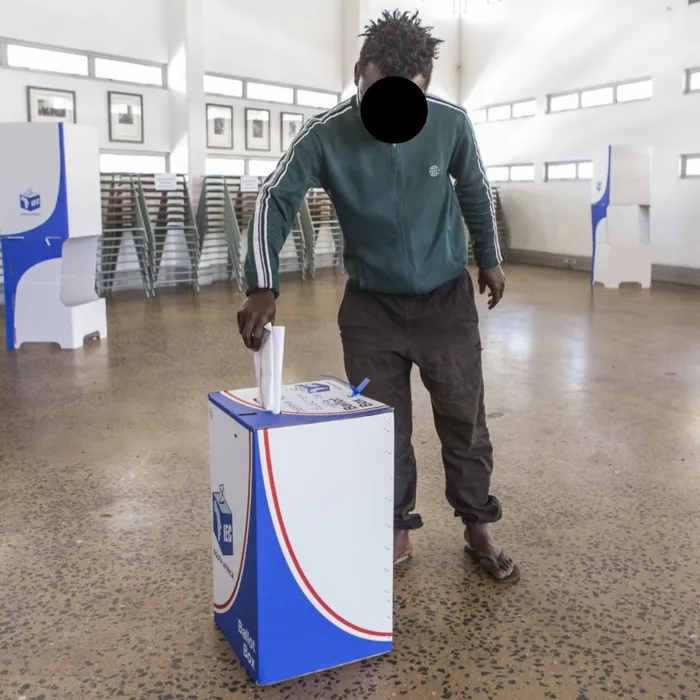
The National Homeless Network is in the process of drafting a National Homeless Manifesto in preparation for the Local Government Elections in November 2026.
Image: Denis Hurley Centre
Homeless people will get a chance to vote in the Local Government Elections, come November 2026, provided they supply officials with an address, 'even if they live under a bridge'.
"You don't need a home address," explained Sphamandla Mhlongo, project manager for the Democracy Development Programme (DDP); rather, a shelter, outreach centre, or consistent location can be used.
Mhlongo was speaking at the National Homeless Network webinar that is in the process of drafting a National Homeless Manifesto for the municipal elections on November 4, 2026.
The meeting was convened by the Denis Hurley Centre (DHC) in Durban which is registered as a voting station and deals with homeless people frequently.
Mhlongo, whose DDP has been operating since the 1994 elections, believes that every person regardless of housing status has the right to participate in the decisions that affect their lives.
“We need more vulnerable population engagements. The exclusion from civic life deepens vulnerability, while inclusion builds dignity and power. Voting in the local elections directly affects homeless communities,” he said.
The DDP identified common barriers faced by the homeless for example, no fixed address, lack of ID documentation, distrust of government systems and limited access to information.
“Homeless individuals face unique obstacles to registering and voting yet their lived experience shapes policy. They deserve representation and we feel they are underrepresented in municipal councils. Ward councillors and municipalities decide on shelters, public spaces and social services,” Mhlongo added.
Nokwazi Gumede, representing the Electoral Commission of South Africa (IEC), said the country has 39.7 million people that are eligible to vote but only 27.6 million are registered
“We are concerned that people are not taking part in the election, especially the youth. Some people are registered but do not vote. We don't chase a person away if they don't have an address but it is important to tell us where you stay,” she said.
Raymond Perrier, the director of the Denis Hurley Centre, said there was a misapprehension that people cannot vote because they do not have an address. He said the network has representatives from each municipality to work at a local level, and connect with one another around the country.
He said each municipality has their own challenges. Perrier said the IEC is expected to partner with the network across the country to help ensure that homeless people participate in the elections.
“The five focus areas of the national homeless manifesto are, shelter, access to health care. access to sanitation and ablutions, equal treatment by the police and security and increasing economic opportunity. It is a realistic list of what we can demand from a municipality,” Perrier said.
During June, each town will work on completing their local version of the manifesto.
"We will then share the local ones with the wider network, in case by reading another location, you are inspired to change yours in some way.The plan would be to have the manifesto ready for launch in August," he added.
zainul.dawood@inl.co.za