

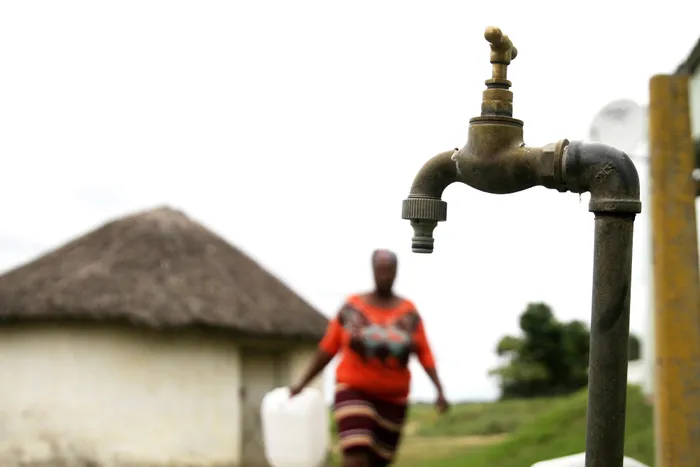
The provincial government outlines a comprehensive plan to address the water crisis in alignment with national directives.
Image: Bongani Mbatha/ Independent Newspapers
KwaZulu-Natal is set to overhaul its water sector, following a national directive that elevates the water crisis from a municipal service issue to a national economic priority. This comes after President Cyril Ramaphosa elevated the water crisis to a national priority during his State of the Nation Address (Sona).
During KZN Premier Thamsanqa Ntuli’s recent Premier’s Coordinating Forum (PCF), provincial Department of Cooperative Governance and Traditional Affairs (Cogta) deputy director general (Development and Planning) Barbara Mgutshini outlined some of the province's responses to the water crisis in alignment with Sona 2026 interventions.
Alleviate the water crisis as a national priority
Mgutshini said that the water shortage was declared a national economic and social delivery crisis, prompting the establishment of the President-led National Water Crisis Committee, central coordination across all spheres, and the development of a comprehensive short, medium, and long-term water action plan.
“For the KZN context, this is a national directive; there is therefore a possibility for the provincial executive to consider rendering the same national water prices to a provincial structure,” Mgutshini said.
Direct intervention in failing municipalities
Mgutshini noted the president also highlighted the collapse of local water service delivery. Actions include deploying technical experts, using constitutional interventions, and enforcing accountability with consequence management.
“For the province, currently, we do have the Section 63 interventions underway in uMkhanyakude and uThukela,” Mgutshini said.
Massive infrastructure investment
The DDG said the president announced R156 billion over three years for water and sanitation.
“As we need to prioritise major water projects which include which were highlighted as the Lesotho Highlands Water Project and so forth. We need to expand dams, pipelines and bulk water supplies,” Mgutshini said.
“For KZN, we need to then confirm this R156 billion, and how much of it will be making its way to the province. We already have big dam projects underway.”
Fix municipal infrastructure and reduce water losses
Mgutshini noted the R54 billion presidential incentive for metros to reinvest in water systems, ring-fence revenue for maintenance, and focus on reducing high non-revenue water, infrastructure decay, leaks and losses.
“For the KZN context, the metro trading reforms are already underway, and there is a turnaround plan for eThekwini in place, which is due for presentation to the PCF and the provincial executive. We also have a non-revenue water project, which may need enhancing,” Mgutshini said.
The DDG said Sona 2026 marks a major shift, “from a municipal service issue to a national economic crisis. Water is no longer just a matter of municipalities, but it has become a national economic crisis. There’s also a shift from the fragmented intervention to a call for centralised coordination and enforcement. There’s also a shift from policy focus to more implementation and accountability.”
Additionally, the Department of Water Services has implemented reforms, including changes to existing legislation.
“The major change is the separation of the operator and the regulator: The Water Service Authority (the municipality) function being separated from the Water Service Provider (may or may not be the municipality) function, where the water service provider will now be licensed and if you do not meet the minimum criteria and requirements, you will not be able to get that license to deliver water. That may improve accountability in terms of the water service delivery,” Mgutshini said.
Premier Thamsanqa Ntuli said water access is a fundamental human right, not just a matter of service delivery.
“The reality we confront demands urgency, innovation, and accountability. Water challenges in our municipalities reflect deeper issues of infrastructure maintenance, governance, and long-term planning—areas that require decisive leadership and coordinated action,” Ntuli said.
“In this context, we draw guidance from the leadership of Cyril Ramaphosa, who has elevated the water crisis to a national priority. Through the establishment of a National Water Crisis Committee and the commitment of significant infrastructure investment, the president has set a clear and firm direction. He has also underscored the need for accountability, particularly where municipal failures undermine service delivery.”
thobeka.ngema@inl.co.za