

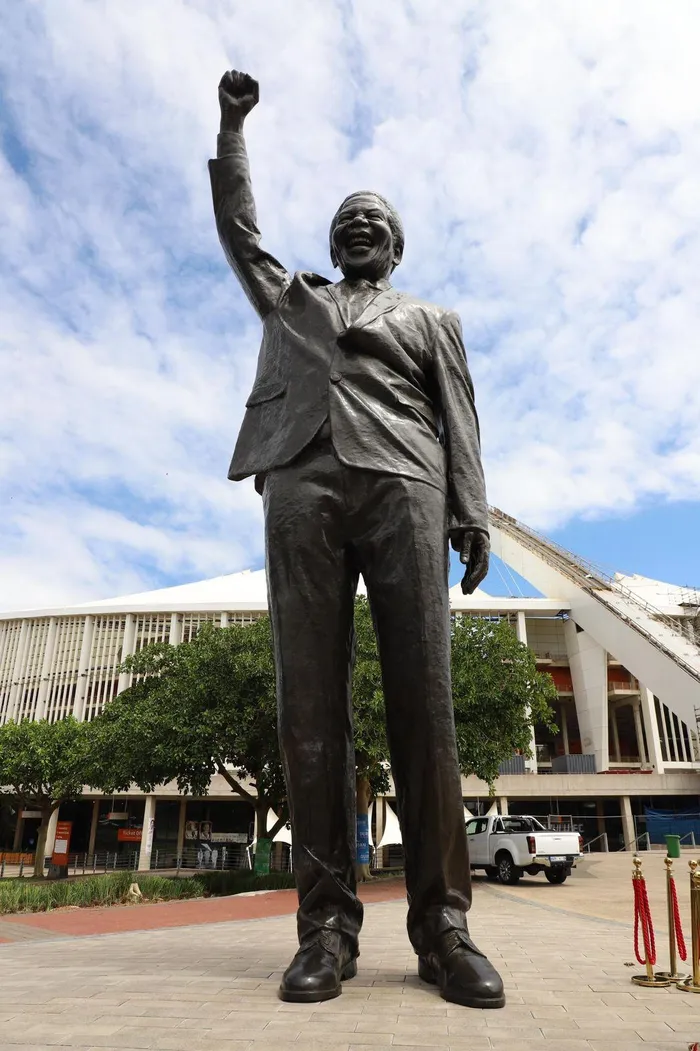
A 10-metre-tall bronze statue of Nelson Mandela was unveiled in eThekwini, sparking debate over municipal priorities.
Image: Thuli Dlamini
Experts have scrutinised the eThekwini Municipality's preference for erecting statues over providing essential services. These specialists concur on the poor state of local governance and the misuse of public funds.
This comes after President Cyril Ramaphosa’s visit to eThekwini on Tuesday, where he unveiled 10-metre-tall bronze statues of former president Nelson Mandela and apartheid activist Oliver Reginald Tambo.
This project, costing R22 million, has drawn strong criticism from the MK Party, EFF KZN, ActionSA, and the DA. These parties argue that the expenditure is a “misplaced priority” given the severe service delivery, financial, and governance crises in eThekwini.
They also highlight numerous issues in the municipality, including collapsing infrastructure, sewage flowing into rivers and beaches, erratic water supply, dry taps, pothole-ridden roads, electricity outages, waste management challenges, and a significant housing backlog.
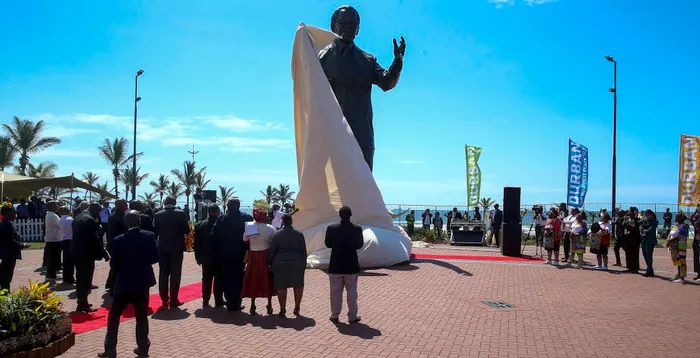
President Cyril Ramaphosa presided over the unveiling of the landmark statues of Struggle icons president Nelson Mandela and former ANC president Oliver Reginald Tambo in Durban.
Image: Leon Lestrade / Independent Newspapers
North-West University governance expert Professor André Duvenhage said they know municipalities are falling apart and that the metros are facing particular major challenges.
“Against that backdrop, to pay R22 million for erecting statues is completely unacceptable. At this point in time, it’s a question of doing the basic things right, delivering services to the people,” Duvenhage said.
He said the ANC typically responds to dwindling support with rhetoric and symbolism. This appears to be a renewed effort to mobilise support ahead of the 2026 election.
“Well, there’s no doubt that the R22 million is in conflict with all the principles of good governance; responsible government and accountable government are part of that. If you cannot deliver your basic services, how can you fund R22 million on statues? Especially in an environment where the municipality is facing complete collapse.”
He said having the Presidential Working Group looking into eThekwini matters is worsening the situation. It is failing to hold the municipality accountable and is, in fact, part of the problem.
Duvenhage said water, sanitation, roads, and other forms of service delivery should be prioritised.
Cultural heritage projects are not unimportant or necessarily irrelevant, but should be done after the basics are done.
“Clearly, we are talking about a municipality that is failing to the extent that it cannot fulfill its constitutional mandate. So in that sense, it is completely unacceptable,” Duvenhage said.

Members of the DA protesting during President Cyril Ramaphosa's visit to eThekwini, for the unveiling of the landmark statues honouring Nelson Mandela and Oliver Reginald Tambo.
Image: Leon Lestrade / Independent Newspapers
University of KwaZulu-Natal local government specialist Professor Purshottama S. Reddy acknowledged the contributions of Mandela and Tambo to the liberation movement and the necessity of honouring them.
However, he argued that they have already been honoured sufficiently. Given the current discussions and debate, he suggested that the matter is now one of setting priorities.
He stated that while the statues are important for heritage tourism and would typically be a priority, Durban faces major challenges like water, electricity, and housing. Therefore, all resources must be prioritised and directed towards addressing these issues.
“There are major challenges with basic services delivery in Durban, especially water - i.e. an uninterrupted supply of water, water quality, loss of water estimated at 60%, and inflated billing. These issues together with housing, electricity, and urban decay should be a priority,” Reddy said.
“If these services are adequately provided and local communities are happy, then we can proceed with honouring our political stalwarts, who incidentally have been honoured elsewhere.
“The best way for municipalities to honour our Struggle heroes is by ensuring that they discharge their constitutional imperatives - ensuring basic service provision efficiently and effectively, thereby enhancing the lives of local communities.”
Reddy urged national and provincial governments to exercise oversight, ensuring the municipality prioritises essential needs like water, housing, and electricity, and intervening if priorities are neglected.
He emphasised that national and provincial parliamentary committees must gauge the local electorate’s mood and step in when communities express dissatisfaction with municipal priorities.
thobeka.ngema@inl.co.za