

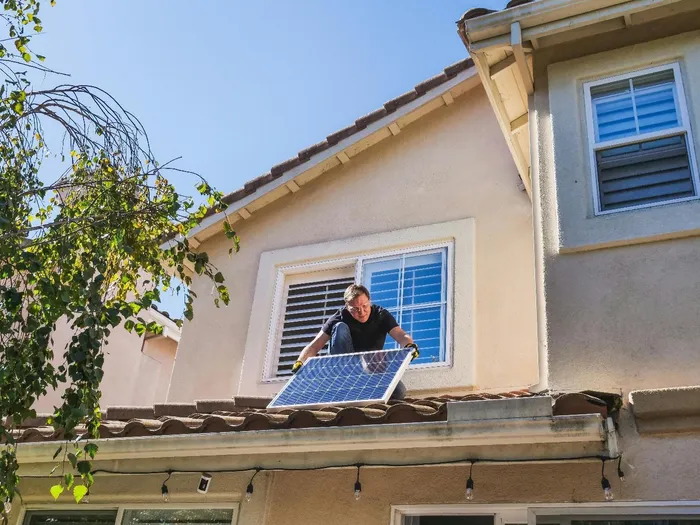
A property expert warns against the hidden costs of rooftop solar and urges homeowners to comply with the law.
Image: Supplied
While the race to move away from an unstable national power grid has sparked a massive rooftop solar boom across South Africa, Paul Stevens, CEO of Just Property, warns homeowners about the danger of getting into a “solar debt trap”.
Beyond the initial capital outlay, he says, the surge in non-compliant installations, evolving municipal penalties, and strict new insurance requirements are creating financial burdens that, unless planned for, could outweigh the savings on monthly electricity bills.
As local authorities and Eskom prepare to enforce hefty fines, with unregistered systems facing penalties of R6,000 to R30,000 by the newly extended September 2026 deadline, Stevens urges owners to address the rigorous compliance that goes with going off the grid.
“We are seeing a worrying trend in which homeowners view solar as a ‘set-and-forget’ solution to load shedding. In reality, an uncertified or unregistered system isn’t an asset; it’s a legal and financial liability that can derail a property sale.”
Many homeowners assume that once the panels are on the roof, they are covered by standard building insurance. However, he warns, insurers are increasingly demanding proof of professional installation before settling claims related to fire, weather damage, or theft.
“The days of ‘DIY’ solar are effectively over regarding insurance perspectives. If you can’t produce a valid Certificate of Compliance (CoC) or an ‘as-built’ report like the PV GreenCard, your insurer may have grounds to void your entire building policy,” Stevens warns.
There’s also a serious risk for people living in complexes or estates since many owners don’t realise that they can’t just place panels on their roof because it’s actually legally common property.
Living in a complex does not mean that you can’t have a solar system, but it does mean that you’re part of the legal process governed by the Sectional Titles Schemes Management Act (STSMA).
Stevens explains that owners usually require a Special Resolution (75% approval) or they need to have the roof space designated as an Exclusive Use Area (EUA) before they can legally install solar panels.
Without one or the other, corporate bodies can force them to remove the unapproved panels at their own cost, which could be around R100,000 or more.
Eskom and a number of municipalities around the country have issued deadlines for solar registration.
“The current waiver on registration fees offers significant savings for those who act before the end of September deadline.”
Stevens says taking advantage of the amnesty is the smartest move a homeowner can make.
While Eskom previously made a “U-turn” on fines, municipal enforcement can now include administrative fees of around R6-000 plus capacity-based penalties for unregistered systems.
On a positive note, according to Stevens, the current waiver includes the Smart Meter installation and connection fees, which could otherwise cost households anywhere from R9,000 upwards.
He also warns against “fly-by-night” installers who don't use the DC circuit protection, UV-resistant cabling, and other components on city-approved inverter lists, or that don’t meet the SANS 10142-1 wiring standards.
“A cheap inverter is a triple threat: it’s a fire risk, it’s uninsurable, and it’s legally unregistrable. If your system doesn't meet the specifications, you’re essentially pouring money down the drain because you’ll have to replace it to achieve legal compliance.”
New “fixed charges” and “availability fees” mean that even if a home uses zero electricity from the grid, the owner may still end up with a hefty monthly bill, Stevens warns.
While solar can add to a property’s value, Stevens says this premium will only apply if the system is fully registered as a Small-Scale Embedded Generation (SSEG) installation.
zelda.venter@inl.co.za