

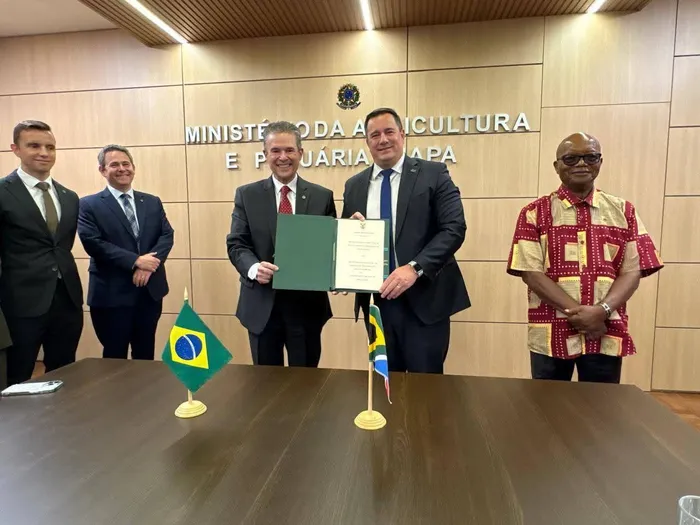
Minister André Carlos Alves de Paula of Brazil and Minister John Steenhuisen of South Africa have signed a Memorandum of Intent (MOI) and a comprehensive Action Plan to enhance cooperation between the two nations. Brazil's success in eradicating Foot-and-Mouth Disease (FMD) offers valuable lessons for South Africa, providing critical technical expertise and practical insights to strengthen its response to FMD.
Image: Supplied
In a major diplomatic effort to confront South Africa's persistent Foot-and-Mouth Disease (FMD) crisis, Minister of Agriculture John Steenhuisen has secured a strategic alliance with Brazil, signing a Memorandum of Intent and a comprehensive Action Plan designed to fast-track FMD eradication.
The move comes as the South African government faces mounting pressure and legal action over what critics have called a “lethargic” response to the animal health emergency.
Meeting with his Brazilian counterpart, Minister Andre Carlos Alves de Paula, on Thursday, Steenhuisen tapped into Brazil's hard-won expertise.
Brazil achieved FMD-free status without vaccination from the World Organisation for Animal Health (WOAH) on May 29, 2025, a historic milestone that took 64 years of rigorous policy implementation.
“By aligning with a nation that has successfully eliminated the disease, South Africa aims to achieve FMD-free status with vaccination, transforming biosecurity from a trade barrier into a bridge for economic growth,” Steenhuisen stated.
The newly adopted Action Plan for 2026-2028 mandates immediate, full implementation. South Africa will dispatch animal health experts to Brazil the week of May 19, 2026, for an intensive knowledge exchange.
Following this, South Africa will host a seminar involving a high-level Brazilian delegation, including researchers and livestock farmers, to share strategies, policies, and technologies used in their decades-long fight.
Brazil’s support will cover vital technical areas, including assistance with vaccination protocols, post-vaccination monitoring, and generating field-based evidence.
Minister De Paula, while pledging support, offered a sharp piece of advice to his South African counterpart: “Government must not abdicate its responsibility to be at the centre of the fight against FMD, as it is a notifiable disease and needs a regional approach.”
The collaboration with Brazil deepens South Africa's commitment to a South-South partnership, following a recent high-level working visit to Argentina. That visit concluded with a separate 2026–2028 FMD Work Plan and pivotal agreements focused on securing a stable vaccine supply.
To date, South Africa has successfully secured and distributed 2.5 million doses of FMD vaccines from the Argentine firm Biogénesis Bagó. This includes one million doses of bivalent SAT-1 and SAT-2 vaccines, and 1.5 million doses of trivalent SAT-1, SAT-2, and SAT-3 vaccines.
Furthermore, the delegation inspected production facilities in Argentina, where a critical five million additional doses are ready for export, pending local regulatory approval.
“Our immediate priority is to secure a stable and sufficient vaccine pipeline so that we can scale up vaccinations rapidly across the country,” Steenhuisen said following his Argentina visit, underscoring the urgency.
Despite these diplomatic wins, the government’s pace has been severely criticised at home. Just days before the Brazil alliance was announced, the Gauteng High Court, Pretoria, reluctantly granted the government a postponement in a legal bid by farmers' organisations to allow the private sector to procure and administer FMD vaccines.
The court, however, showed its displeasure by granting punitive costs against the government and ordering Steenhuisen to publish a compulsory vaccination scheme by May 5.
Judge Corrie van der Westhuizen openly criticised the government’s handling of the crisis, noting that officials appeared to be “no longer considering it to be of such importance” despite the FMD outbreak having been declared a national emergency.
This judicial admonishment echoes the warnings from the agricultural industry.
FMD Response SA, a coalition of dairy, pork, and beef producers, has warned that the government's current “slow-motion” approach is heading toward a national disaster.
“South Africa’s 14 million cattle must be vaccinated within a six-to-eight-week window to create herd immunity in 80% of them and stop transmission,” argued FMD Response SA spokesperson Andrew Morphew, citing the intensive, short-term mass campaigns successfully used by Brazil and Argentina.
karen.singh@inl.co.za