

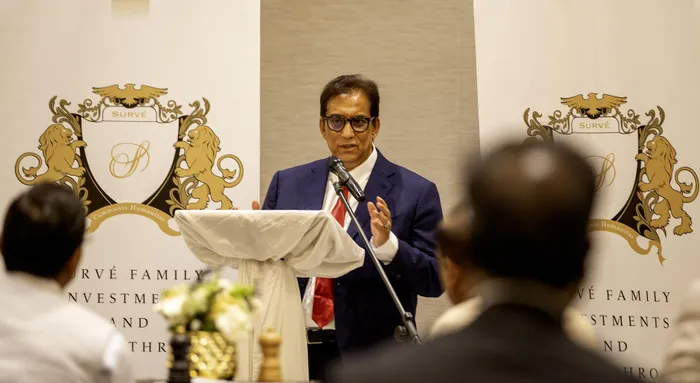
Dr Iqbal Survé said the book reflects a collective journey rather than a personal one, shaped by the many people who supported him along the way. He said it was important to acknowledge those contributions openly, which led to the inclusion of a chapter titled 'Gratitude'.
Image: Leon Lestrade / Independent Newspapers
At the launch of A Shared Future for Humanity in Johannesburg — held at Wanderers Stadium and later at the Marriott Melrose Arch — Dr Iqbal Survé addressed staff, friends, and key stakeholders drawn from across different sectors of society.
He spoke not simply in his public roles as a businessman, author, or philanthropist, but as someone shaped by lived experience. His presence and words reflected a life influenced by people, hardship, memory, and purpose, underscoring the idea that no journey is ever walked in isolation.
His reflections were personal, yet they carried a broader relevance. They pointed to a belief that life is measured less by what we gain than by what we give, by the people we support, and by the connections we sustain through both difficult and hopeful times.
A central theme of Dr Survé’s message was the interconnectedness of our futures. Although the book is not an autobiography, it draws heavily on shared human experience. It speaks through relationships formed, sacrifices made, lessons learned, and resilience built over time. In recounting his own journey, he invited others to see elements of their own stories reflected within it, stories shaped by perseverance, faith, community, and a search for meaning.
He also spoke candidly about resilience, emphasising that it does not emerge from ease or comfort. Rather, it is developed through challenge, loss, and uncertainty. His reflections on Robben Island were particularly striking in their honesty.
By confronting the harsh realities of that experience without romanticising them, he highlighted how growth, personal and societal, depends on a willingness to face difficult truths with integrity and compassion.
The depth of his message stemmed from his consistent recognition of others. Dr Survé expressed gratitude to his family, colleagues, mentors, and even to those who challenged him. He spoke of his mother’s influence in shaping his sense of responsibility toward those less fortunate, and how this informed a belief that success has little value unless it benefits others.
This sense of humility reinforced one of the evening’s key messages: leadership is not about elevation above others, but about solidarity with them. Effective leadership listens, remembers, and serves. It recognises that progress cannot endure unless it includes and uplifts those it affects.
Throughout his reflections, Dr Survé returned to the importance of a connected society grounded in shared values, empathy, dignity, respect, and perseverance. In a world often fractured by division, his words served as a reminder that our common humanity remains a stronger force than our differences.
In the end, his message was both reflective and challenging. It asked those present to consider how they live, how they lead, and what values guide their decisions. It encouraged reflection not only on what is being built, but also on the purpose behind it and the people it is meant to serve.
By sharing his journey, Dr Iqbal Survé offered more than personal insight. He offered a sense of possibility that resilience can be cultivated, that connection can be renewed, and that through shared values and collective effort, a more compassionate and humane society remains within reach.
Mike Ntsasa is Co-Chief Executive Officer of Volt Africa