

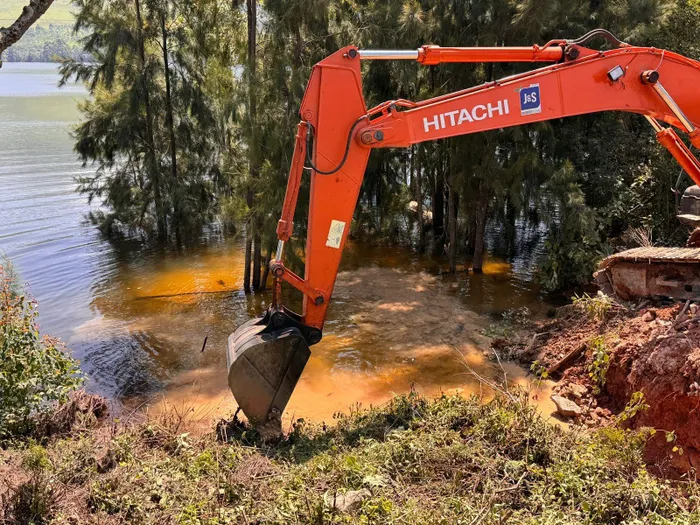
Excavations continue at the Senteeko Dam in Mpumalanga, as the emergency spillway channel is being expanded to reduce the dam's capacity.
Image: GCIS
The risk of spillway collapse at the Senteeko Dam in Barberton, Mpumalanga Province, is still high despite the implementation of additional risk mitigation measures, as erosion continues underneath the spillway.
This was after the recent floods exposed the structural failures of the privately owned dam, prompting the Department of Water and Sanitation (DWS) to implement measures to minimise risk.
According to Wally Ramokopa, DWS’s head of specialist unit for Dam Safety, the dam's capacity is equivalent to more than 720 Olympic-sized swimming pools, at 1.82 million cubic metres of water.
“We issued a warning because of the damage to the downstream of the spillway. When the dam is 100% full, the water is allowed to spill over the dam, but over the years, there was a concrete lining on the spillway channel that got damaged.
“The owners of the dam replaced that concrete channel with a High-Density Polyethylene (HDPE) lining, which is a ‘black sort of plastic bag’ to lessen the erosion on the downstream. But with the current floods, there was a lot of erosion that happened underneath the HDPE lining because it seems like it was not properly anchored into the concrete,” Ramokopa said.
He added that the department, working with the Irrigation Board and the dam owners, has restricted the flow of water on the spillway by opening another spillway, referred to as the emergency spillway channel.
“We have now widened that spillway to ensure that water is restricted on the existing spillway and is redirected to come out on the side. This is the temporary measure that has been put in place. We are still trying to lower the capacity of the dam to reduce the risk, even if the dam fails,” Ramokopa stated.
He highlighted that there has been a drop in water levels, but it is not enough for DSW to declare the dam safe.
The DWS stated that it has conducted a flood path analysis to identify and assess the areas that may be affected in the event of dam failure, and only farming communities have been identified on the flood path.
“No densely populated communities were identified in the analysis for at least 30km, to the bridge on the R40 provincial road. The water flow will have no impact on neighbouring countries like Mozambique and Eswatini.
“Meanwhile, irrigation for Senteeko citrus is also affected due to pumps that have submerged. Irrigation will commence once the water has subsided and the pumps are repaired,” the department said.
In a joint statement by DSW, the Mpumalanga Department of Cooperative Governance, Human Settlements, and Traditional Affairs (CoGHSTA), the Department of Agriculture, Rural Development, Land, and Environmental Affairs, the Ehlanzeni District Municipality, and the City of Mbombela, stated that authorities are working jointly around the clock to reduce the impact should the dam fail.
It was stated that coordination of disaster preparedness and evacuation readiness for farmers living downstream continues, and local authorities continue to directly engage the nearby farming communities on flooding implications.
“While highly concentrated communities such as New Consort or Low's Creek would not experience any impact as they are approximately 25km away from the dam impact point, CoGHSTA emphasised that all affected stakeholders are being engaged to save lives should the dam fail. Further, consolidation of reports caused by the devastation of the recent rains and flooding is nearing completion,” read the statement.
It was further stated that the risk mitigation measures are being implemented by the Shamile Communal Property Association (CPA), the dam's owner, in collaboration with its appointed professional under DWS supervision.
The multi-disciplinary team continues to monitor the situation closely and is taking all necessary precautions to protect communities, read the statement.
Wisane Mavasa, DWS spokesperson, said the Senteeko Dam has changed ownership, and the current owners, Shamile CPA, assumed ownership in 2007, according to the Deeds Search information.
“We, therefore, cannot attribute the damage to the dam’s spillway to ‘decades of neglect’ by the CPA. Our records show that the old concrete-lined spillway channel was reported to be in poor condition in 2002, and at the time, the dam was owned by the Transvaal Sugar Limited (TSL),” Mavasa said.
Should downstream damage occur, she said, the liability is ultimately a matter for the judicial system, which will consider the owner’s legal duties, compliance history, and any contributory factors; however, DWS aims to prevent this.
She added that enforcement actions are taken by the department when there is non-compliance by a dam owner.
The DWS is currently reviewing compliance by various sectors, and the reports will be made public at the end of the current financial year, while they continue to issue directives to non-compliant dam owners, Mavasa said.
She stated that the department regulates more than 5,700 registered dams, which must be inspected and evaluated at least once every five years.
These evaluations must be conducted by a dam engineer approved by the department. It is the responsibility of the dam owner to appoint these engineers and must ensure that the engineer’s recommendations are implemented, she explained.
“The department regularly conducts Dam Safety Compliance Monitoring Inspections (DSCMI) on dams that are identified as a priority for inspections, as it is humanly impossible to carry out such work on more than 200 dams in a single year. Dam owners who are not complying with the five-yearly dam safety evaluations are being reminded and compelled to comply with this requirement.”
She emphasised that the department has not failed to enforce safety standards at Senteeko Dam.
Mbulelo Hlalukana, a senior practitioner for Engineering and Legal Enforcement at the Engineering Council of South Africa (ECSA), confirmed that the matter concerning the Senteeko Dam has been noted for formal attention.
Hlalukana added that ECSA is liaising with the relevant authorities to obtain all pertinent information, and urged the public to follow all official safety directives issued by the disaster management authorities.
“In line with our mandate to protect the public and uphold engineering standards, ECSA will follow its established processes to review the conduct of all relevant registered (if any) persons involved. The precise mechanism, whether an Investigative Committee or another process, will be determined as per our rules and the findings of a preliminary assessment,” he stated.
Hlalukana said that the Council is cognisant of the need to integrate climate resilience into engineering practice.
“This forms part of our ongoing engagements with engineering practitioners, tertiary institutions, and relevant bodies to ensure the profession adapts to evolving environmental and societal needs. We also continue collaborating with DWS on our Discipline-Specific Training Guide to help engineering practitioners meet the required competencies in this sub-discipline,” Hlalukana stated.
gcwalisile.khanyile@inl.co.za