

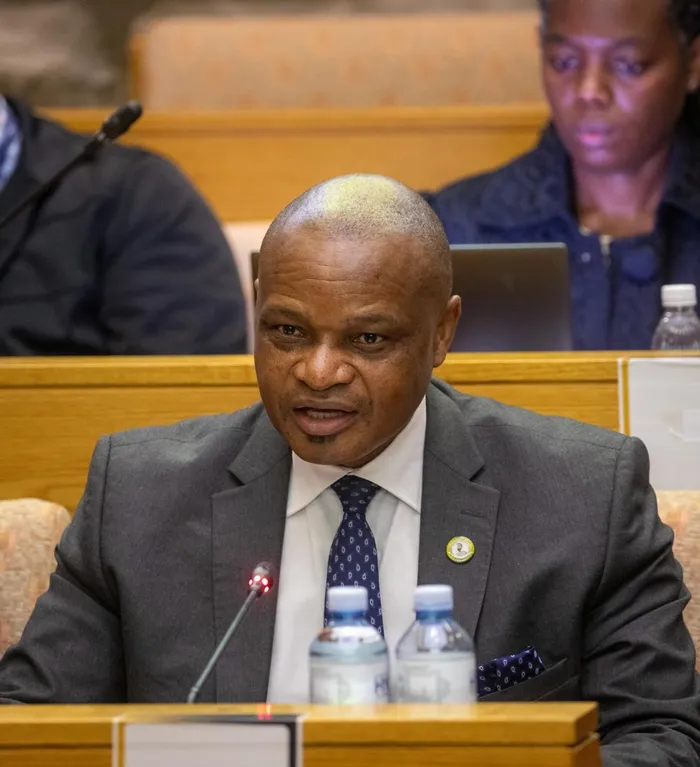
Political analysts and opposition parties say Andy Mothibi's appointment as the National Director of Public Prosecutions (NDPP) is a strategic move to protect President Cyril Ramaphosa's nephew, Hangwani Maumela, who is implicated in the Tembisa Hospital corruption scandal.
Image: File
The appointment of Andy Mothibi as the National Director of Public Prosecutions (NDPP) could be a strategic move to protect politicians, including President Cyril Ramaphosa’s nephew Hangwani Maumela, who is involved in the looting of Tembisa Hospital, from prosecution.
Political analysts said this is a political appointment that is aiming to protect Maumela and other politicians, including Ramaphosa himself, from being arrested and prosecuted.
Mothibi was appointed without undergoing the public interview process conducted by an advisory panel last year. The panel, led by Justice Minister Mmamoloko Kubayi, interviewed six shortlisted candidates, but none of them were suitable for the role.
Mothibi's appointment is set to take effect on February 1, 2026, following Advocate Shamila Batohi's retirement.
During his tenure as the head of the Special Investigating Unit (SIU), Mothibi identified Maumela as the head of one of three major syndicates that siphoned more than R2 billion from Tembisa Hospital through a complex web of fraudulent tenders, inflated prices, and non-existent deliveries.
The syndicates used shelf companies and non-compliant bidders to benefit from the funds meant for healthcare services.
The investigation into Tembisa Hospital was initiated following a report from whistle-blower Babita Deokaran, the chief financial accounting officer at the Gauteng Department of Health, who flagged suspicious transactions prior to her assassination in August 2021.
Political analyst Professor Andre Duvenhage said he believes that it will be difficult for Mothibi to take action against Maumela and senior ANC politicians, including Ramaphosa.
Duvenhage said these senior politicians include those implicated in the Zondo Commission of Inquiry into allegations of state capture and those currently investigated by the Madlanga Commission into criminality, political interference, and corruption in the criminal justice system.
“I have serious concerns about this. Maumela’s position is linked to senior politicians, and as a result, with a dysfunctional system, you just don’t do the work, and automatically delay the processes,” he said, adding that this is a form of de-democratisation, undermining the Constitution.
Another political analyst, Zakhele Ndlovu, said it is important for Mothibi to fast-track prosecution against Maumela, adding that he would be seen as protecting him on the instruction of Ramaphosa should he drag his feet.
“Ultimately, the pressure is on both Ramaphosa and Mothibi to expedite the prosecution of this case. They don't want to create the impression that some people are above the law,” Ndlovu said.
The SIU's investigation found that Maumela allegedly used a network of 41 companies to siphon off R820 million from Tembisa Hospital.
As a result, the SIU raided his home as part of an operation to seize assets linked to the alleged corruption.
Among the items confiscated during the raid were three Lamborghinis, designer furniture, expensive artwork, and other property. The total value of assets preserved was R133.5 million, with a total of R900 million worth of assets targeted.
On the other hand, the National Prosecuting Authority (NPA) in 2024 declined to prosecute Ramaphosa and the head of South Africa's Presidential Protection Service (PPS), Wally Rhoode, in connection with the Phala Phala farm scandal.
The scandal originated from a 2020 burglary at Ramaphosa's private farm, where an estimated $4 million (roughly R60 million) in foreign currency hidden in a couch was stolen and instead of reporting the matter to the SAPS, he chose to handle it through a private, “off-the-books” investigation, allegedly instructing Rhoode to use the Presidential Protection Unit (PPU) and Crime Intelligence resources for the matter.
Another political analyst, Professor Ntsikelelo Breakfast, said the fact that Ramaphosa was not transparent about his intentions leads him to believe that Mothibi's appointment was not made in good faith.
He added that the appointment is politically motivated.
“Something is not right about this appointment. It should not have been done this way. The appointment was not made in good faith. This is a smack in the face to the citizens of this country,” he said, adding that these powers are vested in the president to advance the national interests, not personal interests.
“In this case, there are political dynamics, and this is a real political move,” said Breakfast.
The MK Party also said the decision to appoint Mothibi is intended to shield Maumela from imminent arrest and prosecution, calling on Mothibi to act decisively without delay by ensuring his immediate arrest and prosecution.
The EFF also called on Mothibi to prosecute cases without fear, favour, or political consideration, regardless of who may be involved.
Ramaphosa on Wednesday told journalists that he used his constitutional powers to appoint Mothibi after the panel told him that none of the candidates who were interviewed was suitable for the job.
Meanwhile, Batohi, in a statement issued on Wednesday, welcomed Mothibi’s appointment as her successor. She said this appointment comes at an important moment, as the NPA continues on its journey of rebuilding, strengthening institutional integrity, and advancing justice.
Mothibi's leadership has been described as having transformed the SIU into a highly effective anti-corruption body.
As head of the SIU, he has been widely credited with successfully leading investigations into state capture at Transnet, Eskom, and PRASA, which resulted in significant financial recoveries and consequences for wrongdoers.
He recovered approximately R710 million at Transnet by the end of the 2023/24 financial year, successfully froze R4.2 billion linked to a locomotive supplier, and pursued civil proceedings to recover another R834 million.
He also secured recoveries of R1.577bn and set aside or invalidated contracts worth approximately R10.2 bn at Eskom.
An SIU report last year revealed that PRASA executives awarded irregular contracts worth R2.8 billion over a decade. Six security companies were identified as the primary beneficiaries of R1.6 billion in irregular tenders.
manyane.manyane@inl.co.za