

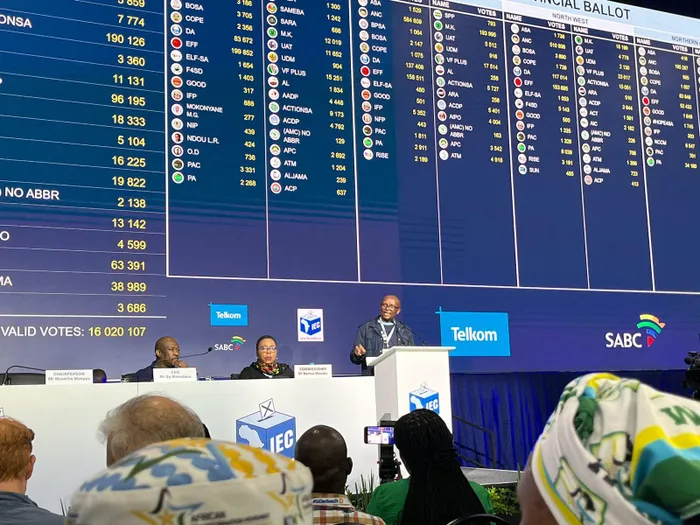
Political parties contesting the 2026 local government polls could have shorter political election broadcasts if the Independent Communications Authority of SA has its way.
Image: Kamogelo Moichela / IOL
Political parties and independent candidates contesting the 2026 local government elections could have to do with less time to canvass for votes through political election broadcasts (PEBs) played on television and radio stations.
The Independent Communications Authority of South Africa (Icasa) is proposing a reduction in the length of PEBs from 50 seconds to 40 seconds.
Icasa has released its draft amendments to the Municipal Party Elections Broadcasts and Political Advertisements Regulations 2026, inviting interested parties to make written representations by no later than the close of business on January 9 next year.
In terms of the draft regulations, PEBs must not exceed 40 seconds in duration, and Icasa explained that the reduction has been justified by financial implications on broadcasting service licensees (BSLs), which are television and radio stations required by law to broadcast during the election period.
According to Icasa, when slots are not utilised, BSLs lose money because these slots could have been used for advertising or other programming, and in previous elections, political parties were not using the maximum duration of their slots to record their PEBs.
The regulations apply to all BSLs, political parties, and independent candidates contesting the municipal polls.
Broadcasters are required to make available daily and throughout the election broadcast period 12 time-slots of 40 seconds each for PEBs, excluding the concluding message (tail) disclaimer.
Another proposal by the authority is that the electronic submission of PEBs and political advertisements (PAs) should be allowed, and this will allow political parties and independent candidates to choose a delivery method that is most convenient to them, as well as lessening the administrative burden of the BSLs relating to the physical delivery of PEBs and PAs.
However, physical submission is still allowed, according to the regulations.
Additionally, Icasa has reviewed technical standards and quality during elections to align with technological developments in the sector.
”This also reduces the financial burdens on stakeholders when the PEB is rejected and the political party or independent candidate has to align it with the correct technical standards and quality suitable for broadcasting,” the authority explained.
Political advertisements are broadcasts intended or calculated to advance the interests of any particular political party or independent candidate, for which advertisement the relevant BSL has received or is to receive, directly or indirectly, any money or other consideration.
Allocation principles will apply if there are sufficient PEB slots to accommodate all the contesting political parties and independent candidates, including 60% of slots to be allocated to all political parties and independent candidates contesting seats in the municipal elections.
The remaining 40% will be divided into 15% each allocated according to the number of candidates fielded by parties on the local and district municipalities lists, and an additional 10% for the number of proportional representation seats currently held at the district and local level.
loyiso.sidimba@inl.co.za