

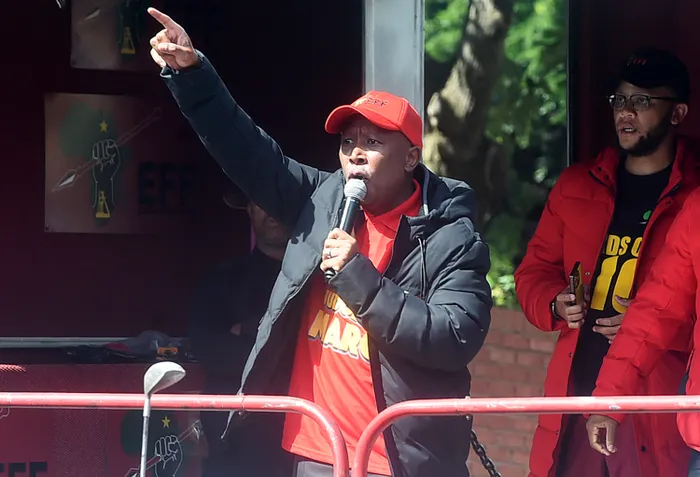
EFF leader Julius Malema addresses party members outside the Constitutional Court on Friday following the Court's ruling on Cyril Ramaphosa's ongoing Phala Phala scandal. The Constitutional Court's ruling on Phala Phala marks a pivotal moment in South African politics, exposing the ANC's manipulation of parliamentary power and challenging Ramaphosa's leadership, writes EFF leader Julius Malema. This judgment raises critical questions about accountability and the future of democracy in South Africa.
Image: Itumeleng English / Independent Newspapers
The Constitutional Court judgment delivered on Phala Phala marks one of the most devastating constitutional indictments of the ANC’s and Ramaphosa’s abuse of parliamentary power since the democratic breakthrough of 1994. It confirms what the Economic Freedom Fighters (EFF) has maintained from the very beginning: that in 2022 the ANC transformed Parliament from an institution meant to hold the executive accountable into a shield for presidential protection and constitutional delinquency.
For four years, the EFF stood firm against a coordinated effort to normalise one of the gravest scandals in democratic South Africa. We rejected the absurd proposition that millions of foreign currency concealed on a private property belonging to a sitting President could be treated as a private matter. The EFF refused to accept that a President constitutionally entrusted with safeguarding democratic institutions and preserving public trust could preside over hidden foreign cash transactions while presenting himself as the face of ethical governance.
The Constitutional Court on the day that South Africa celebrated 30 years of its signing, vindicated the EFF’s insistence that Parliament acted unlawfully when it blocked the Section 89 impeachment process against President Cyril Ramaphosa. The Court confirmed that the ANC abused its parliamentary majority to shield Ramaphosa from constitutional scrutiny and suppress accountability.
The judgment reaches far beyond Phala Phala itself. It exposes the collapse of constitutional morality within the ANC and reveals how deeply the governing party has subordinated democratic institutions to the political survival of its leadership. Parliament was never designed to function as a protection mechanism for compromised Presidents. Yet that is precisely what the ANC has continuously reduced it to when it voted to prevent a proper impeachment inquiry from proceeding.
South Africans were promised a New Dawn with Cyril Ramaphosa at the helm. What emerged instead was a presidency concealed behind couches stuffed with foreign currency, protected by parliamentary manipulation and sustained through institutional cowardice. The New Dawn has become a dawn of concealed wealth, constitutional evasion, and executive arrogance.
At the centre of this crisis is a President who has survived politically not through exoneration but through the shielding of corruption while ordinary South Africans endure collapsing municipalities, worsening unemployment, rising food and fuel prices, economic stagnation, and poor service delivery. Ramaphosa remains consumed with preserving his political position.
The tragedy confronting South Africa is that accountability has operated differently depending on who stands accused. Ordinary citizens experience the full force of the law without compromise, delay, or political protection. The EFF will never tolerate a system that oppresses our people and protects the political elite because no constitutional democracy can survive under a two-tier system of accountability.
On Monday, May 11, 2026, Ramaphosa once again demonstrated the arrogance that has come to define both his presidency and the ANC’s relationship with constitutional accountability. Instead of confronting the Constitutional Court judgment with humility and honesty, he stood before the country in true ANC fashion and announced that he would not resign.
He took no meaningful questions because his presidency survives through carefully staged appearances and protection from genuine scrutiny. A President secure in his moral legitimacy would subject himself openly to democratic accountability, yet Ramaphosa addressed the country in isolation while the media remained locked outside the Union Buildings, denied any opportunity to question him directly.
Ramaphosa instead wants to continue to hide behind legal technicalities and review processes while insisting that he will remain President regardless of the profound constitutional crisis surrounding his office. The EFF will not be intimidated by this posture and will continue to pursue the matter within the perimeters of parliament.
The greatest threat facing South Africa today is not merely the conduct of Ramaphosa as an individual, but the ANC’s growing belief that electoral dominance entitles it to undermine constitutional governance itself. Parliament has increasingly become a political insurance policy for compromised leaders rather than an institution that safeguards the people against executive abuse of power.
Phala Phala will ultimately be remembered as the moment the carefully manufactured mythology of Ramaphosa’s ethical presidency collapsed completely. The image of a constitutional reformer and clean administrator has now been replaced by the reality of a leader shielded by parliament, protected by elites, and delayed in accountability.
Even now, Ramaphosa continues to behave as though South Africa cannot survive without him. This is the dangerous arrogance that often emerges when leaders remain in power for too long and begin to confuse personal political survival with national stability. South Africa existed before Cyril Ramaphosa’s presidency, and it will continue to exist long after him. No individual is greater than the Constitution, and no President is entitled to govern indefinitely while public trust collapses around him.
The EFF remains the only consistent political force in South Africa that has refused to compromise in the struggle against corruption, abuse of power, and constitutional delinquency. While others retreated into silence, negotiated themselves into comfort through the GNU, or surrendered before executive authority, the EFF remained unwavering in defence of accountability and constitutional justice.
History will remember this period as a defining test for South Africa’s democracy. It will remember that when Parliament abandoned its constitutional obligations, when the ANC weaponised its majority to shield executive power, it was the Economic Freedom Fighters that stood firm in defence of constitutional accountability. The Constitutional Court has now exposed the ANC’s manipulation of Parliament and shattered the illusion that Ramaphosa’s presidency rests on moral legitimacy. What remains is a President clinging to power through delay, procedural evasion, and arrogance, while the democratic credibility of the state deteriorates before the nation's eyes. No amount of legal manoeuvring, political shielding or carefully staged national addresses can conceal the inevitable truth: the New Dawn has collapsed, and with it the myth of Cyril Ramaphosa’s ethical leadership.
Ramaphosa’s calculated address will neither intimidate nor silence the EFF. Parliament must now be allowed to confront the Constitutional Court judgment without the side shows. The EFF will continue to fight for justice from the picket linesto the courts and from the benches of Parliament itself. The question confronting the GNU partners now is whether they will South Africans stand on the side of constitutional accountability or degenerate into the ANC’s shielding of Ramaphosa from the consequences of his actions.
* Julius Malema is the CIC and President of the Economic Freedom Fighters.
** The views expressed do not necessarily reflect the views of IOL or Independent Media.