

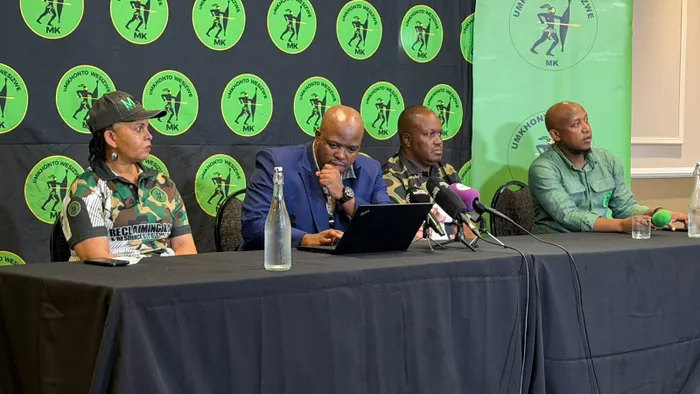
MK Party leadership addressed the media in Woodmead on Wednesday following their two-day meeting.
Image: Karabo Ngoepe
The uMkhonto weSizwe Party has moved to reposition itself ahead of South Africa’s next electoral cycle, outlining an aggressive political and organisational strategy while taking direct aim at the country’s governing coalition.
In a detailed address following a National Officials meeting in Durban this week, Secretary-General Sibonelo Nomvalo said the party is entering a new phase of consolidation after what he described as “rapid growth and widespread support” across the country.
The meeting, held over two days in KwaZulu-Natal, was guided by party leader Jacob Zuma, who provided what Nomvalo described as “solid political guidance and direction” to the party’s national leadership.
According to Nomvalo, internal reports presented at the meeting confirmed both the party’s momentum and its growing pains.
“While the MK Party has experienced rapid growth and widespread support across the country, there are areas that need strengthening within the party’s overall institutional framework,” he said.
The leadership has since adopted a “strategic institutional and political roadmap” aimed at stabilising the organisation and positioning it as what Nomvalo called “a beacon of hope for the downtrodden masses.”
Central to the party’s messaging is a sharp critique of South Africa’s Government of National Unity (GNU), led by the African National Congress in partnership with the Democratic Alliance.
Nomvalo dismissed the arrangement as ineffective and self-serving.
“The GNU is nothing more than a coalition of political parties interested in holding on to power for the sake of power itself, and not in the interest of the ordinary masses of South Africa,” he said.
He pointed to persistent challenges including unemployment, inequality, governance failures and a worsening water crisis as evidence that the current political arrangement is not delivering.
The party also linked its critique to ongoing revelations emerging from the Madlanga Commission and parliamentary processes, arguing that they expose “a trust deficit between the state and ordinary citizens.”
In a notable political signal, Nomvalo reiterated Zuma’s call for unity among what he described as “progressive black parties,” following recent engagements between Zuma and EFF leader Julius Malema.
The MK Party is positioning itself as more than an electoral vehicle.
“We are not just another political party seeking votes,” Nomvalo said. “We are a liberation movement committed to the fundamental transformation of society.”
The party also used the platform to connect domestic challenges to global developments, warning that geopolitical tensions could worsen economic conditions at home.
It cited the escalating conflict involving Iran, Israel and the United States, noting that rising oil prices are already filtering through to developing economies.
“Disruptions to major oil supply routes have pushed crude oil above $100 per barrel,” Nomvalo said, warning that higher fuel costs will drive up food prices, transport costs and overall living expenses.
“It is the poor and working class who suffer the most from these price shocks,” he added.
Despite its outward confidence, the MK Party acknowledged internal weaknesses that could undermine its ambitions if left unaddressed.
Nomvalo pointed to administrative strain, leadership contestation and the risks of opportunism within a fast-growing organisation. The party’s rapid rise, he said, came with structural challenges.
“The organisation did not have sufficient time to fully consolidate leadership structures, vet cadres, and build strong institutional systems while having to build an immediate election machinery,” he said, referring to the period leading up to the 2024 elections.
In response, the party has prioritised organisational rebuilding. Key interventions include strengthening dispute resolution mechanisms, improving internal administration and rolling out a nationwide consultation process with members.
Nomvalo said the party would also reinforce central coordination through the Office of the Secretary-General, with stricter reporting and accountability systems.
“We are making it clear: the MK Party must operate as a united, disciplined, and mission-driven movement,” he said.
With local government elections looming in 2026, the MK Party is positioning itself as a serious contender for control of municipalities, with longer-term ambitions of taking national power in 2029.
The party believes its electoral performance in 2024 provides a foundation to build on, but acknowledges that future success will depend on whether it can transition from a fast-growing movement into a structured political machine.
karabo.ngoepe@inl.co.za