

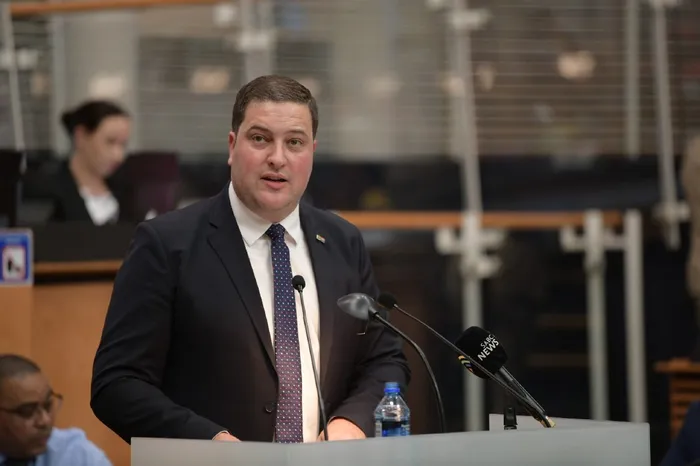
DA leader Geordin Hill-Lewis.
Image: File
Government of National Unity (GNU) leaders, DA Geordin Hill-Lewis and Correctional Services Minister Pieter Groenewald, have butted heads over reports that suggested there are almost 28,000 untraceable parolees.
This after Hill-Lewis took to the social media platform X to demand that Groenewald not hide behind excuses.
“He must act today to find these parolees, bring them back before the law, and hold every official accountable who allowed them to disappear,” he said.
He made the remarks after the investigative media group, Amabhungane, reported this week that the Department of Correctional Services cannot account for 27,797 high risk parolees who have absconded.
It also reported that more than half of those who cannot be traced were 15,860 “archived absconders”, parolees who were released between 1991 and 2004, and that the cases were listed as “non-active” and remain separate from the current case loads of absconders.
Despite the department dismissing suggestions that it has abandoned the tracing of absconders as incorrect, Hill-Lewis still posted that his party will not accept a system where criminals roam free, and communities are left to pay the price.
“A DA-led government will implement electronic monitoring, proper supervision, and real accountability,” he said.
In response, Groenewald warned the newly minted DA leader against cheap politicking.

Minister of Correctional Services Pieter Groenewald.
Image: Independent Media Archives
He told Hill-Lewis that the number referred to in the article dates back to 1991.
Groenewald further said he had on record stated that he was in the process of electronic bracelets for parolees.
“There is progress,” he said without elaborating on the same initiative Hill-Lewis indicated his party would implement.
Groenewald also said the department had last year in September held a parole summit on the revision of the parole system.
“We are busy with legislative amendments. Don't practise cheap politics,” said the minister who has been in office under the GNU established two years ago.
Unperturbed by Groenewald's response and the criticism from those who responded, Hill-Lewis charged that the minister was grateful for the summit, which was a talk-shop, while many of the 28,000 parolees were convicted of violent offences under the minister’s watch.
“And you want the victims of murders and rapists who re-offend because you’ve done nothing to find these criminals for two years,” he said.
In a statement, Hill-Lewis said his party will write to the Portfolio Committee on Correctional Services to request a full parliamentary review of the community corrections system.
“We will also call for a resolution from the portfolio committee petitioning the Minister of Correctional Services to issue a request for proposals for GPS-enabled electronic monitoring within 90 days, for a pilot programme to commence within 12 months, and for legislative amendments to ensure mandatory electronic monitoring of all parolees convicted of violent crimes,” he said.
Kgomotso Ramolobeng, chairperson of the portfolio committee, said she has noted with concern reports about absconding parolees and will request urgent information on the matter from the department.
Ramolobeng also said the committee was especially concerned that the media reports indicated that some of the absconded parolees served sentences for serious crimes such as murder, armed robbery, and rape.
“The committee received several requests for an urgent meeting on the matter. The committee will slot in an urgent engagement with the department to receive a full report on the allegations in the media before it pronounces on the matter,” she said.
Meanwhile, department spokesperson Sibongakonke Nxumalo said the department maintained active tracking and tracing capabilities in all regions and no longer used “archived absconders” as an inactive category.
“Dedicated regional teams continue to strengthen monitoring and re-apprehension efforts. Therefore, any suggestion that the department has abandoned efforts to trace absconders is incorrect,” he said.
Nxumalo stated that parolees and probationers were subjected to various forms of supervision.
“Absconding remains a criminal offence, and every absconder is immediately reported to the South African Police Service to support tracing and investigation processes.”
Nxumalo rejected suggestions that parolees were left unmonitored or that systems do not exist to address absconding.
“Community Corrections officials continue to perform supervision duties under difficult and often dangerous conditions to ensure compliance with parole conditions and protect communities.”
Nxumalo further said the electronic monitoring matter remains before the courts.
“As the matter is sub judice, the department is limited in what it can publicly discuss at this stage,” he said.
mayibongwe.maqhina@inl.co.za