

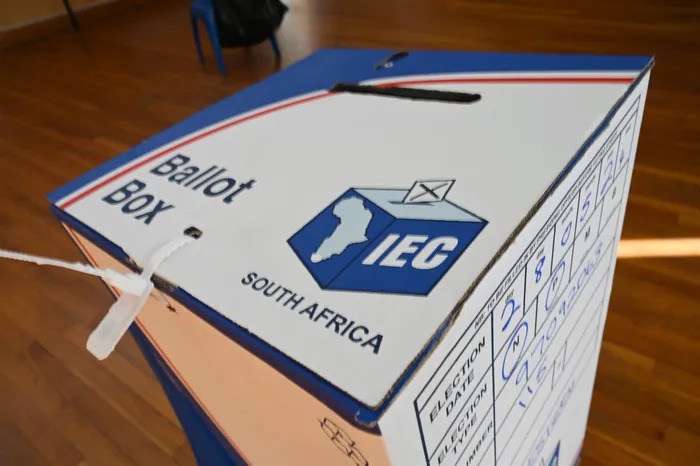
IEC is challenging political parties to come out stronger to convince young people to register for the upcoming elections.
Image: Armand Hough / Independent Newspapers
As statistics show that 70% of eligible young people are unregistered to vote, the Electoral Commission of South Africa (IEC) has called on political parties to up their game in convincing them to register, almost five months before the November local government elections.
The IEC revealed during its voter education campaign launch at Gallagher Convention Centre in Johannesburg that a huge number of young people between the ages of 18 and 19 are not registered.
According to its voter registration statistics, 11.3 million young people, between the ages of 18 and 39, are registered to vote of which 4.6 million of them are between the ages of 18 and 29.
KwaZulu-Natal IEC spokesperson Thabani Ngwira said the survey states that young people highlight high rates of unemployment, lack of service delivery, and a weak economy as reasons not to participate in elections.
“If those things can be resolved and political parties convince the youth, the youth will be willing to participate,” said Ngwira.
The IEC will hold a voter registration weekend on June 20 and 21, and there is also online registration available. He said further registration weekends will depend on budget availability.
He said in KwaZulu-Natal, the IEC has employed about 160 municipal outreach coordinators to visit communities, register people, and conduct voter education.
He said unemployment and lack of service delivery were the main issues stopping young people from registering.
Ngwira said since those issues might need a long-term solution, political parties would need to address them significantly in their manifestos to convince young people that they would bring solutions.
“If you convince them enough that if you let us in, we will come up with a solution that would increase voter turnout. It will depend on how they (parties) sell themselves to voters,” he said.
University of KwaZulu-Natal political analyst Zakhele Ndlovu said it would be a challenge to convince the youth as they are “generally very cynical”.
“Given what we have been seeing in the Madlanga Commission and Zondo Commission, young people have lost faith in the system, as they feel that people in positions of power are inherently corrupt and unethical.
“They see no need in legitimising something that is not working for the country.”
He said many people have lost interest in politics while others are disillusioned.
“Campaigns such as March and March attract many young people because they believe that the system has let them down," he said.
Ndlovu said he recently told his students that democracy is the number’s game and that most people in South Africa are illiterate and many of them are high on drugs to care about voting.
“The apartheid left a huge damage in people’s lives and their right to vote does not help them. Young people also think that their vote will not make a difference because they would be beaten by numbers.
“I once asked another young woman who was wearing an EFF T-shirt that ‘You are always filling the stadium, but why is that not reflected in votes?’ and she said she wanted to fit in with the EFF, but she did not believe that voting is making a different because numbers are not on their side,” Ndlovu said.
He said it would be difficult to convince young people who are hooked on drugs to register to vote.
“That is another challenge,” he said.
ANC Youth League (ANCYL) national spokesperson Sindiswa Scheepers said the league has already formulated programmes to encourage young people to register.
“One thing that we probably undermine is that young people think that ‘my one vote won’t make a difference’. What would happen if you got a thousand people saying that?” asked Scheepers.
She also concurred that young people are no longer interested in political parties.
“They are just not interested in party politics hence a lack of participation. Another problem is the old method of going to the voting district and registering because young people don’t have time for that, as they are despondent and discouraged by unemployment.
“Innovative ways of reaching them through the social media where they are, would assist,” said Scheepers.
She said the ANCYL has also realised that many young people socialise with social activist groups.
“Now that we have also noted that, we would want to work hand in glove with social activists to ensure that we get their viewers and followers to understand that they should register to vote because we are in a democratic country that is governed and eventually a certain political party would have to govern them,” she said.
The ANCYL said it is going all out to recruit young people to register for elections ahead of November, but Ndlovu believes that this will be futile, as corruption has robbed them of their faith in the government system.
The IFP Youth Brigade also attributed the decline of young people's interest in voting to failed economic transformation, failed economic development, and sluggish social transformation.
“IFP Youth Brigade currently has a voter registration programme targeting the strongly organised community like student populace and sporting community through various campaigns like sport Day and Campus Visits to encourage and assist young people to vote and educate them about governance of the country,” said IFPYB national chairperson Sanele Zondo.
bongani.hans@inl.co.za