

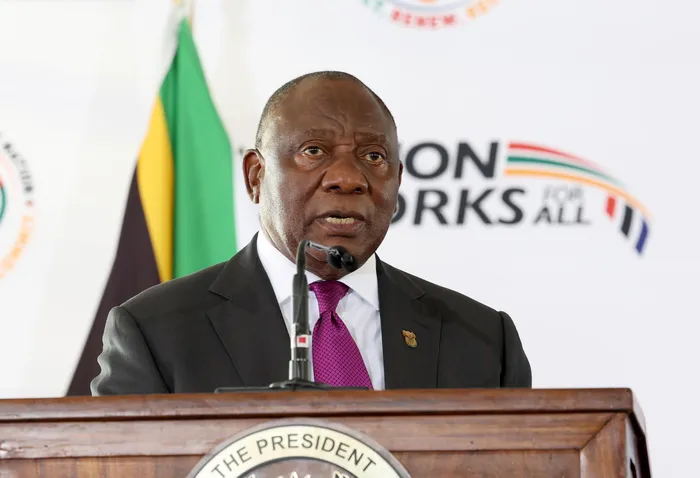
Parliament’s rules on motions of no confidence have come under focus after Speaker Thoko Didiza rejected attempts to table a motion against President Cyril Ramaphosa over the Phala Phala matter.
Image: File
National Assembly Speaker Thoko Didiza’s decision to decline requests for a motion of no confidence against President Cyril Ramaphosa over the Phala Phala matter has placed renewed attention on how such motions work and what happens if they succeed.
The issue emerged after the African Transformation Movement (ATM) and the uMkhonto weSizwe (MK) Party sought to invoke Section 102 of the Constitution following the Constitutional Court ruling that Parliament’s handling of the Section 89 Independent Panel report into the Phala Phala matter was unconstitutional and invalid.
A motion of no confidence is one of the most powerful constitutional mechanisms available to the National Assembly to remove a sitting President or Cabinet if they no longer enjoy the support of Parliament.
Under Section 102 of the Constitution, any Member of Parliament may introduce a motion of no confidence against the President or Cabinet. Once submitted, the motion must comply with parliamentary rules and clearly set out the grounds on which it is based before it can be scheduled for debate.
Parliamentary rules also require the Speaker to give such motions due priority and consult with relevant parliamentary leaders before determining when the matter should be debated.
If a motion of no confidence is passed against the Cabinet, excluding the President, the President is required to reconstitute the Cabinet.
However, if a motion of no confidence is passed against the President, the consequences are broader. Section 102(2) of the Constitution states that if the National Assembly adopts the motion with majority support, the President, Cabinet, and Deputy Ministers must resign.
For the motion to succeed, it requires a simple majority of at least 201 of Parliament’s 400 Members of the National Assembly.
Unlike a motion of no confidence, impeachment proceedings under Section 89 of the Constitution deal with allegations of serious misconduct, serious violations of the Constitution, or inability to perform the functions of office.
Such proceedings also require a higher threshold, with at least a two-thirds majority of the National Assembly needed for a president to be removed.
The distinction has become important in the current Phala Phala matter, as Parliament is already proceeding through an impeachment-related process following the Constitutional Court ruling.
Didiza said she declined the requests because the issues raised by the ATM and MK Party are already before Parliament through an ongoing inquiry process.
“In keeping with Rule 129(3) and (4), I am declining this submission as the grounds contained in the motion are the subject matter the Assembly is already seized with,” Didiza said.
Didiza said the motion must also clearly state the grounds on which the proposed vote of no confidence is based.
She added that the matter had already been referred for further parliamentary consideration.
“This process is currently underway and, in accordance with Rule 90, discussion of the matter and related issues should not be anticipated, albeit introduced through another mechanism,” she said.
IOL Politics