

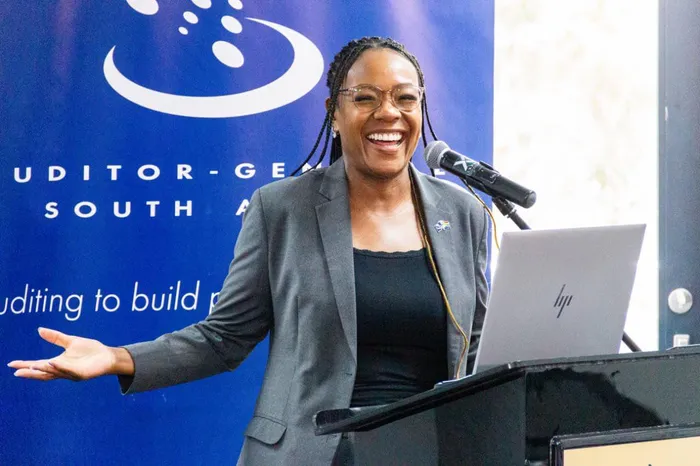
While Auditor-General Tsakani Maluleke was grateful with the progress made by the Hawks into material irregularities, parliamentarians complained about the time it took to investigate and bring those responsible to book.
Image: Auditor-General South Africa / X
Parliamentarians on Friday expressed concerns regarding the slow movement in the investigations into material irregularities referred to the Directorate for Priority Crime Investigation (DPCI) by the Office of the Auditor-General.
This, after the DPCI briefed the Standing Committee on Auditor-General about the cases referred by Auditor-General Tsakani Maluleke.
Lieutenant-General Patrick Mbotho said Maluleke had referred 17 cases, and through their investigations, they opened an additional four cases, bringing the matters to 21.
“Four are on the court roll, three have been referred to the National Prosecuting Authority (NPA) for a decision, and 14 cases are under investigation,” he said, adding that one was concluded with a guilty verdict.
The 14 cases that are under investigation focus mainly on the Free State and North West municipalities and provincial departments.
Maluleke said she was grateful for the progress made since the last report was presented in September 2025.
“It will assist us to continue to join hands between us as the Auditor-General of South Africa and DPCI in terms of driving more efficient and effective investigations and ultimately get the NPA to prosecute,” she said.
Maluleke said her office was in the process of referring two additional matters involving the Thabazimbi and Matlosana municipalities.
“There is more coming on the system within AGSA,” she said, adding that their Memorandum of Understanding would enable them to engage in risk assessments such as overtime payments in Mangaung Metro.
“It would allow us to assess matters of overtime happening elsewhere and drive much quicker action,” Maluleke said.
However, MPs expressed dissatisfaction with the lengthy duration of investigations, noting that some cases were referred as long as four years ago.
DA MP S’bongiseni Vilakazi said while Maluleke applauded progress made, the majority of the cases remained under investigation.
Vilakazi said the minimal prosecution was not serving as a deterrent and weakened the material irregularity regime.
MK Party MP Sanele Mwali wanted to know the delays in the investigations.
“Justice delayed is justice denied. This picture is not good and is not what you would expect,” he said, adding that those responsible were not being held accountable.
Committee Chairperson Wouter Wessels said there was movement in the investigations, but it was too slow.
“The investigations take very long. There are cases from 2021, and five years later, we are not in the prosecution and court yet,” he said.
“We are alive to the fact that we have court backlogs, and cases of this magnitude will take a long time in the court phase. We do comprehend that the investigations are complicated and require warm bodies to do complicated investigations.”
DPCI acting head Siphesihle Nkosi blamed the lapse of time between the referrals by the A-G and the time the allegations took place.
He also said they have difficulty obtaining evidence on matters that took place years ago.
“We prioritise the investigations. We have put a team that investigates 50% of the cases at the main office,” Nkosi said.
He also said they were increasing the number of investigators through the recruitment processes.
Acting Police Minister Firoz Cachalia said the progress was not sufficient given the scale of the problem being experienced.
“It is very clear that the problem that has developed in our country is correctly characterised as systemic. That affects critical parts of the systems, particularly municipal procurement systems across the country,” Cachalia said.
He also said the audit work by the A-G and DPCI investigation did not work optimally but can be improved in light of the delays and time to make referrals.
“We can and must make improvements in the respective parts of accountability.”
He said there were efforts in place to strengthen the DPCI.
“I can confirm that there are projects to strengthen the forensic and data analytical capabilities. Those are complicated projects and take time to implement. They are costly and have limited skills.”
mayibongwe.maqhina@inl.co.za