

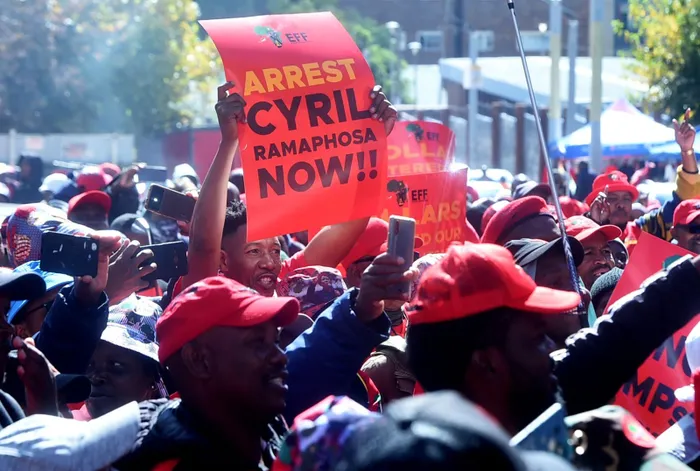
The ANC says it will respect the Constitutional Court’s decision on the Phala Phala case and allow Parliament to properly consider its next steps, while rejecting claims that the ruling undermines democracy.
Image: Itumeleng English / Independent Newspapers
The ANC says it does not consider the Constitutional Court ruling in favour of the EFF in the Phala Phala case involving President Cyril Ramaphosa to be a major blow or a test of South Africa’s democracy.
Speaking outside court on Friday, Party’s national spokesperson, Mahlengi Bengu, said the ANC respects the judiciary and its decisions.
“This judgment must be transmitted to the ANC for proper consideration, including our work in Parliament. All we can say at this point is that we respect the decisions of the courts and our constitutional tradition.”
“We will ensure that what needs to be done is done correctly. We are called the leaders of society, and we must set the standard. We are guided by the Constitution and the Bill of Rights, and we will do the right thing,” she said.
When asked whether the ruling amounted to a major setback for the party, given that its president and head of state is central to the matter, Bengu dismissed the suggestion.
“No, we do not think it is a test of the strength of our democracy. We do not see it as a massive deal,” she said.
She added that the ruling should be understood in the context of strengthening democratic institutions rather than weakening them.
“I think it is a test of democracy, and all of us, including the media, understand the importance of the rule of law. We do not see it as a blow, but rather as part of a democratic process. It is a lesson for South Africa and for political parties,” she said.
Bengu also said the ANC would not engage in “grandstanding” over the ruling, criticising what she described as opposition parties seeking political advantage.
She said the EFF had been “vindicated” by the Constitutional Court ruling, noting that its leader, Julius Malema, had called on MPs to prioritise the Constitution over party politics.
Pressed again on whether ANC MPs should vote according to party lines or their conscience if the matter proceeds further in Parliament, Bengu said MPs across all parties should uphold the Constitution.
“We would urge all Members of Parliament, regardless of party, including the ANC, to always choose the Constitution and the Bill of Rights of South Africa,” she said.
She added that the ANC remained committed to the rule of law and constitutional governance.
The comments follow the Constitutional Court ruling that Parliament acted unlawfully when it voted in 2022 to reject the Section 89 independent panel report into allegations linked to Ramaphosa’s Phala Phala farm.
The court found Parliament’s decision irrational and inconsistent with the Constitution, and ordered that the report be reconsidered, effectively reopening the possibility of an impeachment inquiry.
The case was brought by the EFF and the African Transformation Movement, which argued that Parliament failed in its oversight duties by closing the matter prematurely.
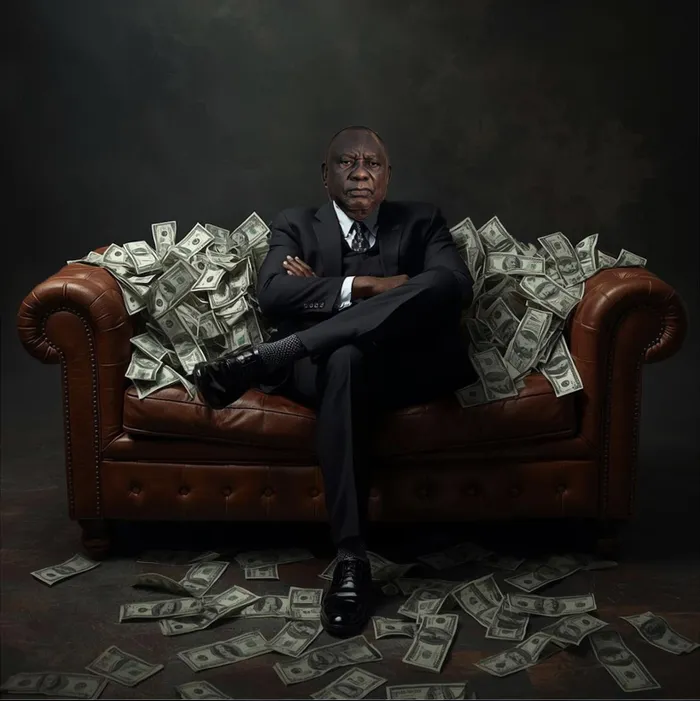
The ANC has downplayed the Constitutional Court’s judgment on the Phala Phala matter, insisting it should be seen as part of normal democratic processes rather than a political setback.
Image: IOL Graphics / Shaakirah Lagadien
The ruling means Parliament must now revisit the panel’s findings and determine whether to proceed with a full impeachment process.
The matter stems from a 2020 burglary at Ramaphosa’s Phala Phala game farm in Limpopo, where large sums of foreign currency were allegedly stolen.
DA federal chairperson Solly Msimanga said the party will study the Constitutional Court judgment on the Phala Phala matter before deciding on its next steps.
He said the ruling raised important constitutional questions, including the validity of Rule 129 and the possible establishment of an impeachment committee by Parliament.
“The Chief Justice and the panel have been very clear that the process tells us a number of things. One is that the constitutionality of Rule 129 now needs to be relooked at by Parliament. It also moves the process from where a committee was deliberating to the setting up of an impeachment committee,” he said.
Msimanga said these developments would require careful consideration by the party.
“Those are things we are going to need to look at going forward,” he said.
He stressed that the DA would not shield wrongdoing.
“The DA is on record. We are not going to, in any way or form, shield any wrongdoing,” he said.
Msimanga said the party would take time to study the judgment before making further comments.
“It is important that we study the case and the judgment, and then we will apply our minds. We will study the judgment, apply our minds, and set the record straight going forward,” he said.
He was also asked about the implications of the ruling, given that the DA had previously supported the adoption of Rule 129 and later participated in electing President Cyril Ramaphosa in 2024 despite the allegations against him.
Responding to questions on whether Ramaphosa should step aside during any impeachment process, Msimanga said it was too early to draw conclusions.
“I think it is important that we are allowed a moment to reflect on the judgment itself and what its implications are. This was, if you like, earth-shattering. The Constitution has been tested,” he said.
He added that Parliament would now need to reassess its rules and procedures.
“We now need to look at what it means if this rule is to be scrapped or relooked at, and what that means for the prerogatives of Parliament and its members,” he said.
Msimanga said any further steps, including whether the president should step down, would depend on the impeachment process.
“We need to consider what the judgment and the report are saying. Perhaps the president must step down, but that is something that may be determined by an impeachment committee. It is not a call I can make here,” he said.
He added that the party would communicate its formal position after due consideration.
“We will do that, and we will make sure the media and the public are informed of our response,” he said.
ActionSA national spokesperson Michael Beaumont welcomed the ruling, saying it strengthened accountability.
“We are really glad that the Constitutional Court has found this way. We look forward to the matter returning to Parliament, where the ANC no longer has a majority thanks to the South African people, and where they will not be able to protect the president at all costs,” he said.
Beaumont said the party would work with other opposition parties to ensure accountability.
Meanwhile, political analyst Lukhona Mnguni said the Constitutional Court judgment carries significant legal and political consequences, particularly regarding Parliament’s powers and accountability processes.
“The court definitely has jurisdiction to review a rule of Parliament, of the National Assembly, that was brought before it, which is Rule 129,” he said.
Mnguni said Rule 129, introduced after earlier Constitutional Court rulings on Section 89 impeachment procedures, had effectively allowed Parliament to block accountability.
“Effectively, what Rule 129 does is it allows the National Assembly to vote down a report of an independent panel if they do not like what the report has to say, which then kills the process of accountability,” he said.
He said the court found the rule to be unconstitutional.
“You need to ensure that you protect accountability and transparency, and you need to create rules that in and of themselves do not also circumvent accountability. And therefore, that’s why the rule was found to be invalid and unlawful,” Mnguni said.
He added that the ruling now changes the process going forward.
“The court has now said the panel report must now go straight to an impeachment committee. Now it means there’s no process in between,” he said.
Mnguni said Parliament would now have to establish a committee to deal with the matter.
“That impeachment committee will be made up of members of Parliament. It will not be made up of outsiders,” he said.
“It will almost resemble an ad hoc committee, but Parliamentarians have seen the shortcomings with ad hoc committees in terms of investigations and evidence handling.”
He said the Speaker of the National Assembly would now need to provide clarity on the process, following correspondence from the EFF requesting guidance on the next steps.
simon.majadibodu@iol.co.za
IOL Politics