

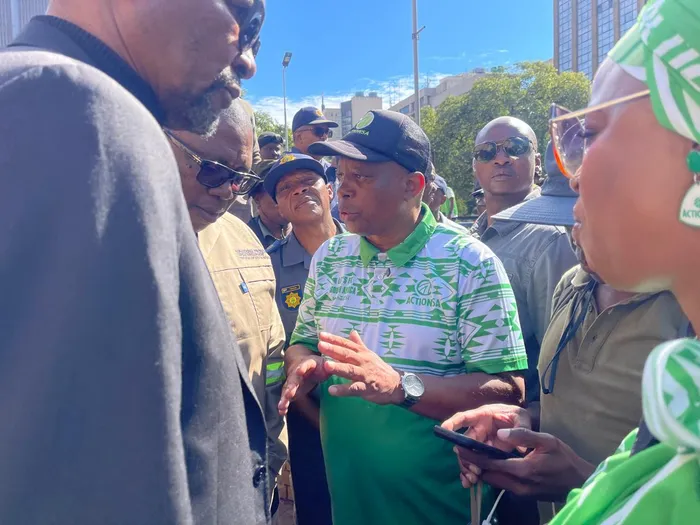
Herman Mashaba with Gauteng Premier Panyaza Lesufi during Wednesday's protest action in the Johannesburg city centre over illegal immigration.
Image: ActionSA
The decline in the country’s economy and political opportunists mobilising for the local government elections were some of the factors instrumental in getting ordinary citizens to drive anti-illegal immigration sentiments.
This was the view of political analyst Sandile Swana following the anti-illegal immigrants protest in Johannesburg this week.
The anti-illegal immigrant movement wants the government to tighten immigration controls, stricter visa regulations, a review of asylum policies, action against businesses employing undocumented foreign nationals, accountability for corrupt police officers, and limits on services for undocumented migrants.
“People who have capital to do political mobilisation use it opportunistically for the 2026 local government elections. Those are the political entities that mistakenly think they are going to benefit from political mobilisation,” he said.
“They have no solution on the table. They are going to cause trouble and increase insecurity and damage South Africa, like some of them, as they did in July 2021,” Swana said.
He added that the government needs to create economic growth, as the country’s growth rate was once above 5% in 2007 during the term of former president Thabo Mbeki.
The GDP growth rate is projected at 1% in 2026, and the citizens in their households don’t feel economic improvement.
“Wealth and income are social lubricants. They reduce friction as income flows into the community. For you to create a lubrication of society, you need to be at about 4% and 6% GDP growth rate. We are nowhere that.”
Swana blamed the scenario on the abandonment of the micro and macro policy, monetary and industrial policy practised during Mbeki, and had not been implemented as an alternative.
He said what also fuelled matters were the austerity measures, and what is playing out was a competition for limited resources.
“I have not heard of engagement from Operation Dudula, March and Mach, ActionSA, and other parties saying to (Home Affairs Minister Leon) Schreiber, give us a report on how we have moved on the issue of human trafficking and syndicates that undermine the border control, and where can we help?
“Instead, you see attacks on individuals that are suspected of being foreigners,” he said about the anti-illegal sentiment that has turned locals against each other in parts of the country.
“The ideological basis is that of apartheid… There is no sophisticated ideology in this thing. It is also characterised by political opportunism,” said Swana.
In recent months, protests have been waged against foreigners taking jobs meant for South Africans, with some groupings preventing undocumented people from obtaining health care at clinics and hospitals, and claims that South African learners are kept out of school because foreign learners took their space.
There is a view that the country’s borders are porous, and corruption at the Home Affairs Department makes it easy for illegal foreigners to stay in the country.
Health Minister Aaron Motsoaledi previously said that while there was no mechanism for the provincial departments of Health to recover the costs from the countries of origin for all immigrants if their accounts remain unpaid, nobody may be refused emergency medical treatment in line with the Constitution.
Basic Education Minister Siviwe Gwarube has stated previously that only 1.8% of learners in public schools are foreign nationals, thus far below any threshold that would suggest an overwhelming influence
Speaking at a May Day rally on Friday, EFF leader Julius Malema questioned the motive behind the marches against illegal foreigners.
“Why are you not coming back to tell us we expelled 10 foreigners and we give so many South African jobs?” Malema said.
He warned that foreigners were doing the jobs South Africans don’t want because they want proper jobs with a pension and medical aid.
Malema, who spoke against the chasing of foreigners from health facilities, said those involved in criminal activities should be dealt with according to the law, not through mob justice
“You must stop it before it comes to you. Before it comes, let's deal with illegal immigration through the laws of this country,” he said.
He was referring to South Africans who are attacked because they can’t speak isiZulu.
Malema questioned why the protesters were not marching to Schreiber’s office or Cape Town, where there is a lot of white immigrants.
“So many white people are here in South Africa illegally, they must be treated the same way we treat others,” he said.
However, ActionSA leader Herman Mashaba has given his unconditional support to the protesters.
“We have reached a stage where foreigners have shown total disrespect to us. The only way I believe we are to save this country is through actions like this. Please keep on doing this,” he told the marchers.
“We are gatvol as a country. We can’t take it any longer,” said Mashaba.
Acting government spokesperson Nomonde Mnukwa said the government noted the ongoing public discourse on immigration, particularly on issues related to illegal immigration.
“Government is strengthening measures to address illegal immigration, including tightening border controls to combat unlawful entry, illicit trade, and fraudulent activities that undermine revenue collection and the rule of law.
“These efforts form part of a broader programme to modernise and reform South Africa’s immigration and border management system into one that is secure, efficient, and responsive to the needs of a modern economy,” Mnukwa said.
She said the government has taken steps to improve infrastructure at ports of entry, including the planned redevelopment of major land ports through strategic partnerships, aimed at improving security, efficiency, and service delivery.
“Government emphasises that South Africa is a peaceful and responsible member of the international community, committed to maintaining strong and constructive relations with countries across the region and the world.”
Mnukwa urged members of the public to work together with law enforcement authorities in addressing concerns related to illegal immigration and unlawful activities.
“Such concerns should be reported to the South African Police Service, immigration authorities, or other relevant law enforcement agencies to ensure they are addressed lawfully and effectively. In this regard, members of the public are urged not to take the law into their own hands.”
She added that the Department of Labour and Employment was in the process of hiring 10,000 additional permanent labour inspectors to strengthen enforcement of labour laws, combat exploitation, and ensure compliance alongside the police and Home Affairs.
“Government will continue working with relevant stakeholders to ensure that immigration is managed in a manner that protects national interests and the safety of citizens, while promoting economic growth and maintaining social cohesion.”
In a recent parliamentary reply, Schreiber said 42,547 illegal foreigners were deported during the current financial year ending on March 31.
March and March leader Jacinta Ngobese-Zuma took to social media on Saturday to laugh off criticism of their actions by those she said “defended illegal immigrants with their long paragraphs (but) never ever say anything to address the crime, the overpopulation, the ailing infrastructure, their attitude, behaviour, the law being broken, the overstretched resources”.
“So, according to these ppl, once we remove white people, ALL South Africans will be executives and owners of everything in the economy,” she said.
mayibongwe.maqhina@inl.co.za