

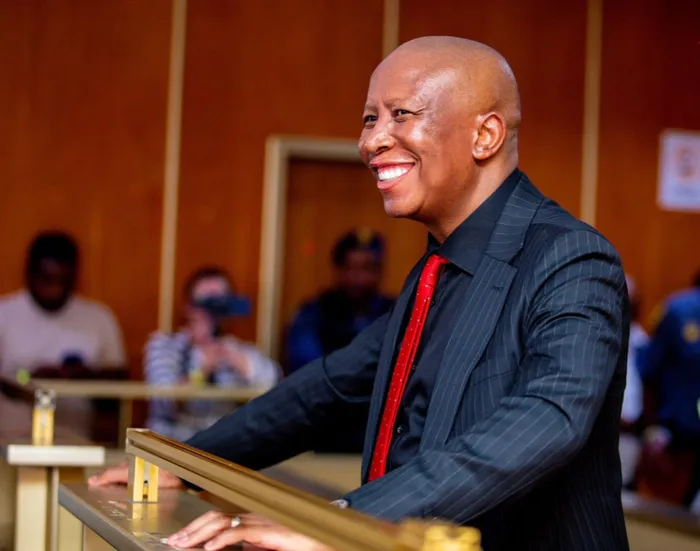
Political activists and analysts say Julius Malema’s five-year prison sentence reflects deeper tensions in South Africa’s justice system and raises questions about political interference.
Image: Facebook / EFF
The sentencing of EFF leader Julius Malema to five years’ imprisonment for firing a semi-automatic rifle into the air at a 2018 rally in Mdantsane, Eastern Cape, has been described as tainted by political interference.
Malema was sentenced on Thursday by Magistrate Twanet Olivier in the East London Magistrate’s Court.
He was found guilty of violating firearm laws.
The court granted him leave to appeal the sentence but dismissed his application to appeal the conviction. He has been released on warning pending the appeal.
The case was brought by the controversial lobby group AfriForum, which has long clashed with Malema over his political rhetoric.
Social activist and author of No White Lies, Kim Heller, said the ruling appeared politically influenced.
“The Magistrate's decision appears tainted by political contamination. This is not a pristine exercise of the rule of law. Neither is it judicial neutrality,” she said.
Heller argued that South Africa’s justice system remains uneven.
“Those who dare to disturb elite and entrenched power will be politically persecuted. Black radical political voices that challenge the racist economic and societal structures and power relations face legal scrutiny and persecution,” she said.
She said the rule of law is critical but that this case reflects injustice.
“A five-year sentence imposed on Malema hampers organisational leadership and disrupts parliamentary participation. It also threatens the EFF electoral campaign,” she said.
Heller added that the outcome could strengthen Malema politically.
“In fact, this miscarriage of justice will elevate Malema to martyr status, garnering stronger EFF support,” she said.
She criticised the use of legal processes for political ends.
“The use of legal instruments to political ends in South Africa should worry us all,” she said.
On sentencing, Heller said the ruling deviates from precedent.
“In firearm-related matters, South African jurisprudence shows that sentences vary according to intent, harm caused and injuries. A suspended sentence would have been appropriate in this matter, given legal precedents,” she said.
She added that the case departs significantly from established patterns.
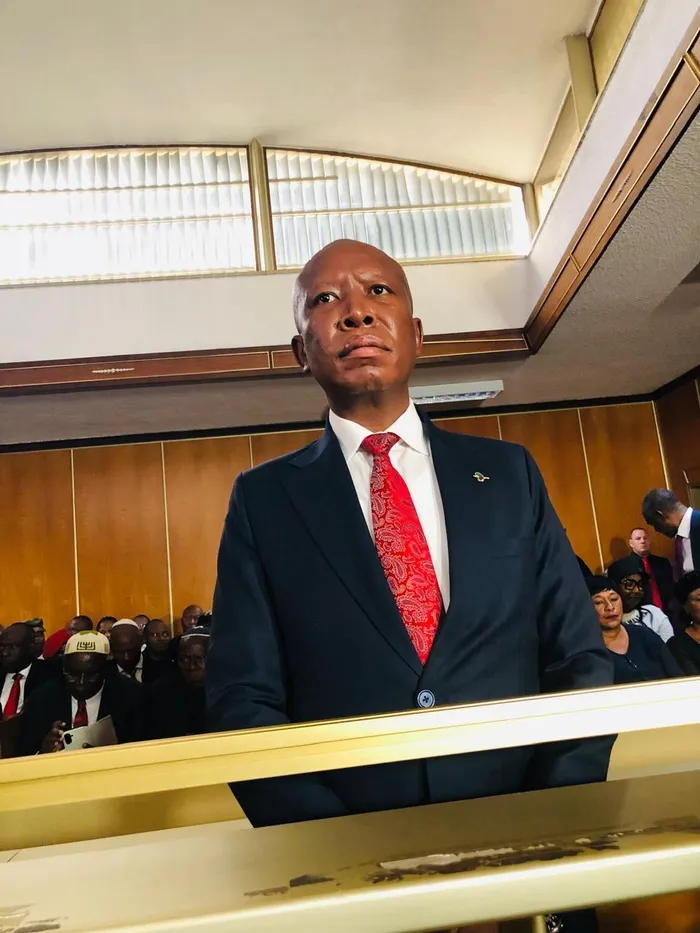
The sentencing of EFF leader Julius Malema has sparked claims from analysts and activists that the ruling is politically influenced and undermines judicial neutrality.
Image: Abongile Ginya
Heller also linked the timing of the judgment to broader political developments, including the Phala Phala matter involving President Cyril Ramaphosa.
“This court outcome coincides with heightened attention on Phala Phala and provides a useful distraction from this serious matter, conveniently so. This is a miscarriage of justice, purposely crafted and executed,” she said.
Malema’s sentencing comes as the Constitutional Court recently said it was at an advanced stage of preparing its long-awaited judgment in the Phala Phala matter.
Constitutional Court Chief Registrar Simoné-Lanique Tjamela, responding to the EFF, said the judgment was nearing completion and was expected to be delivered within a month.
The EFF protested outside the Constitutional Court on March 26. The case, heard on November 26, 2024, centres on the party’s bid to have Ramaphosa held to account over the Phala Phala controversy.
The EFF approached the apex court in 2024 to challenge Parliament’s December 2022 decision not to adopt a Section 89 panel report, which found that Ramaphosa may have a case to answer.
The matter stems from the theft of about $580,000 (about R8 million at the time) from Ramaphosa’s Phala Phala farm in Limpopo in 2020. The cash was allegedly hidden in a sofa on the property.
More recently, the Independent Police Investigative Directorate (IPID) released a declassified report into an alleged cover-up linked to the incident.
The report was obtained through a Promotion of Access to Information Act application by ActionSA and the African Transformation Movement (ATM) after then police minister Senzo Mchunu indicated it would remain classified.
It recommends disciplinary action against Major General Wally Rhoode, head of the Presidential Protection Unit, and Constable HH Rekhoto of the Presidential Protection Services Unit in Pretoria.
They are accused of concealing the theft, conducting an unauthorised investigation using state resources, falsifying official documents, and bringing the South African Police Service into disrepute.
Meanwhile, speaking with IOL News, renowned political analyst Professor Sipho Seepe said the case raises complex legal and political questions.
“In between, we are going to deal with issues of what Malema and the EFF call political prosecution. And some call it political execution,” he said.
He pointed to the role of AfriForum in pursuing the matter.
“In this case, it is AfriForum that insisted on this case. And it’s not the first time that they have tried to take Malema down,” Seepe said.
“And unfortunately for him, they managed to get to one point where the law is very clear about the use of firearms. And they felt that they must hold on to that.”
He questioned whether the National Prosecuting Authority (NPA) would have acted without external pressure.
“The question is, had it not been AfriForum, would the NPA have followed the case? If not, why was the state sleeping?” he said.
“It gives an impression that some can instruct the NPA to do its work.”
Seepe contrasted this with the handling of the Phala Phala matter.
“If you listen to the findings, they talk about serious violations. And the NPA has not done anything,” he said.
“So the issue is, are some more equal than others?”
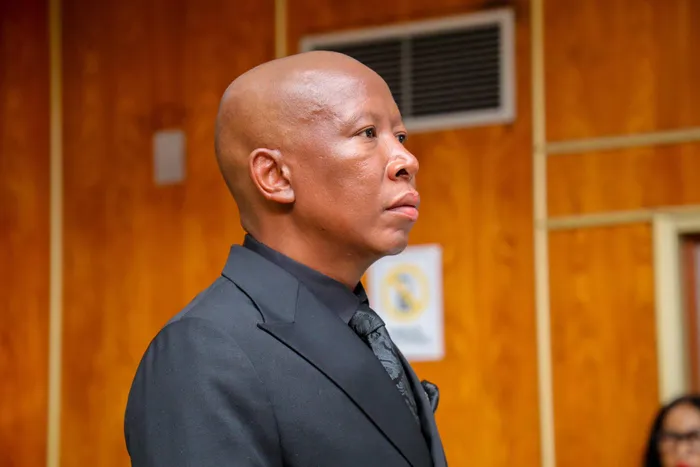
A five-year sentence handed to EFF leader Julius Malema has triggered debate, with critics arguing the ruling is shaped by political pressure rather than legal neutrality.
Image: Social Media/EFF
He cautioned against drawing definitive conclusions about political targeting.
“We must also accept that when people get arrested, there is an action or conduct that they are said to be guilty of. It is not like they were forced to do that,” he said.
“So we are not yet there where we can say this is political targeting. In some cases, it is difficult to make that one-to-one correspondence.”
However, he said the case carries clear political consequences.
“It cannot simply be seen as persecution, but there is no doubt that it will have political ramifications,” Seepe said.
He also addressed remarks by US President Donald Trump in , who previously called for Malema’s arrest.
Last year in May 2025, Trump called for the arrest of Malema over his use of the controversial “Kill the Boer” chant, escalating already strained relations between the two countries.
Trump made the remarks during the meeting with Ramaphosa at the White House.
“There is no doubt about that,” Seepe said, responding to question on whether Trump has influenced narratives and pressure around Malema.
“Trump did say he does not understand why Malema is not in jail. But the case has long existed before that,” he said.
“It would be irresponsible to suggest a direct link.”
However, Seepe criticised Ramaphosa’s response.
“The President failed to defend the country and the criminal justice system,” he said.
Malema, speaking outside court, accused Olivier of racism and claimed she had not properly considered the defence’s arguments.
“Magistrate Olivier is a racist of high note. She is a member of the AfriForum,” he told thousands of EFF supporters.
simon.majadibodu@iol.co.za
IOL Politics