

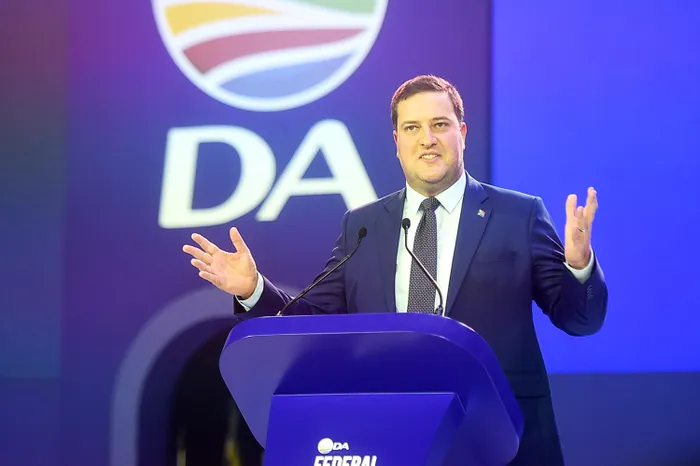
South Africa - Johannesburg - 12 April 2026 - Cape Town Mayor Geordin Hill-Lewis has been elected leader of the Democratic Alliance (DA).
Image: Itumeleng English / Independent Newspapers
Newly elected Democratic Alliance (DA) leader, Geordin Hill-Lewis, said his party will actively oppose policies within the Government of National Unity (GNU) that undermine growth, fairness, and constitutional freedoms.
Delivering his acceptance speech at the party’s elective conference on Sunday, Hill-Lewis rejected the idea that participation in government required silence or compromise at any cost.
Instead, he cast the DA as a party determined to prove its distinct approach to governance—both in principle and in action.
“We are not in government for positions or titles… We are there to show the DA difference in word and deed,” he said.
That difference, he made clear, will include direct resistance to policies the party views as harmful.
“We will continue to oppose policies in the GNU that block progress,” Hill-Lewis said, in one of the speech’s most pointed moments.
His remarks signal a recalibration of the DA’s role inside the GNU.
He expressed his ambitions for the DA to be in power in the 2029 elections.
“Our ambition must be to lead the national government,” he said.
He outlined a series of policy positions that draw sharp contrasts with elements of the current governing agenda, including opposition to what he described as “crony enrichment schemes” benefiting politically connected elites while millions remain trapped in poverty.
He also rejected approaches to healthcare reform that could undermine existing private access, arguing instead for a system that expands quality care to the poor without penalising those who cannot afford medical aid.
“We will show that it is possible to build a health system that better serves the poor, without taking anything away from those who have worked hard,” he said.
On economic transformation, Hill-Lewis pushed for a model of empowerment focused on broad-based advancement rather than narrow enrichment, while reaffirming the DA’s long-standing opposition to cadre deployment and race-based barriers to opportunity.
“We will fight for a country where government jobs are awarded to the best candidates,” he said, “not through cadre deployment.”
The speech also touched on contested issues of property rights and education, with Hill-Lewis pledging to defend citizens’ rights to own property “without fear of expropriation” and to receive education in their mother tongue.
Framing these positions as fundamental freedoms rather than policy preferences, he argued that they are essential to lifting the country out of poverty and restoring trust in government.
“Our purpose is to see people lifted out of poverty,” he said. “Defending these freedoms is essential to building the future South Africa deserves.”
Beyond policy, Hill-Lewis struck an unmistakably political tone, positioning the DA not just as a coalition partner, but as a party with national ambitions.
While acknowledging the realities of coalition governance, he made it clear that the DA’s long-term goal is to lead.
“I am not satisfied with being a junior partner. Our ambition must be to lead the national government,” he said.
He tied that ambition to upcoming electoral milestones, including local government elections expected in the coming months, where the DA aims to expand its control in major metros such as Johannesburg, Tshwane, and eThekwini.
Rejecting narratives of national decline, he closed with a message of defiance and optimism.
“I reject completely the idea that this country cannot be fixed. South Africans deserve a government that works as hard as they do,” he emphasised.
With that, Hill-Lewis has not only defined his leadership but said the DA will cooperate, but it will not conform.
kamogelo.moichela@iol.co.za
IOL Politics