

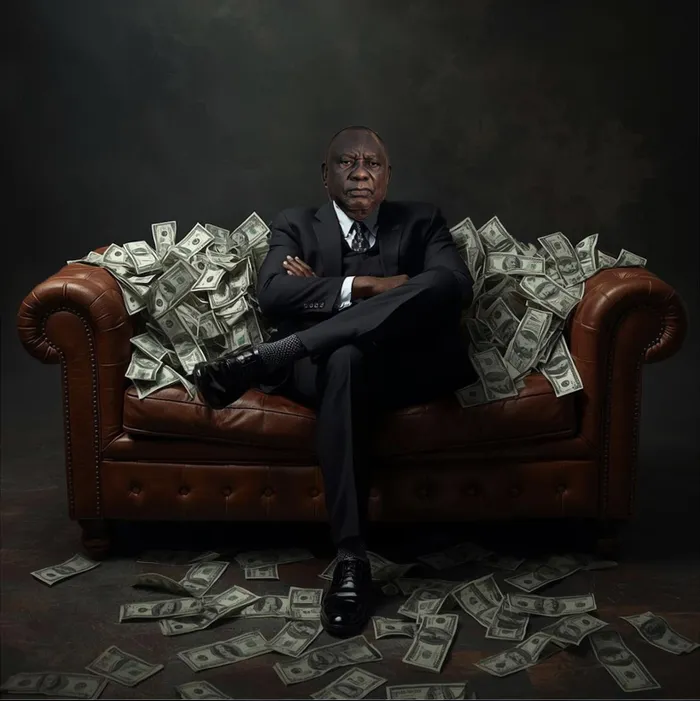
$580,000 in cash was allegedly stolen in a 2020 break-in at President Cyril Ramaphosa's private game farm.
Image: IOL Graphics / Shaakirah Lagadien
It cannot be that two police officers are made to carry the can for the Phala Phala scandal while President Cyril Ramaphosa walks away untouched.
This is the conviction of analysts, corruption watchdogs and civil society organisations following the release of a report by the Independent Police Investigative Directorate, or IPID.
The report, which relates to the theft of about $580,000 from Ramaphosa’s Phala Phala farm in Limpopo in 2020, was declassified this week.
ActionSA and the African Transformation Movement secured its release through a Promotion of Access to Information Act application after suspended police minister Senzo Mchunu said last year it would remain classified.
The money — roughly R8m at the time — was allegedly stolen during a break-in at the farm, where it was reportedly hidden inside a sofa. (See a full timeline of the Phala Phala scandal in the sidebar at the end of the article).
The IPID report, seen by IOL, recommended disciplinary action against Major-General Wally Rhoode, head of the Presidential Protection Unit, and Constable HH Rekhoto, a legal officer in the same unit.
They are accused of concealing the theft, conducting an unauthorised investigation using state resources, falsifying official documents, and bringing the South African Police Service into disrepute.
No case was opened at the time, though IOL and Sunday Independent broke the story of the robbery at the president's private farm.
It was only two years later, after former State Security Agency director-general Arthur Fraser went public with the matter, that a case was formally opened with the police.
Civil society groups, analysts and corruption watchdogs IOL spoke to said the report indicated that Ramaphosa was the architect of "an extra-departmental investigative vacuum".
Political analyst Prof Andre Duvenhage said it was high time for accountability and transparency.
“We have been waiting for clarity on this matter," he said.
“There must now be proper consequences based on a full and fair process, not selective accountability."
Duvenhage said while the timing of the report may raise questions, he did not believe it was politically driven.
“The timing is always going to be questioned, but I don't think this was deliberately engineered," he said.
"The real issue is that the matter should have been made public much earlier for proper scrutiny and possible judicial oversight.”
Forum for South Africa (FOSA) leader Tebogo Mashilompane said Ramaphosa’s decision to report the theft of money from his farm to himself was questionable and raised concerns.
“When a crime happens, it must be reported to the authorities, not to any other person,” Mashilompane said.
He alleged that Ramaphosa attempted to conceal the presence of the money at the farm.
“The money was not even supposed to be there," he said.
"Ramaphosa knew that if he reported the matter to the police, they would have to investigate.
"Unfortunately, the information leaked and the public became aware of the money.
“Ramaphosa was likely trying to hide the matter from public knowledge. It was wrong and must be condemned.”
Mashilompane added the president remained subjected to the Constitution.
“Even as president, he is not above the Constitution, which is clear that crimes must be reported directly to the authorities,” he said.
“We cannot have a president with a gangster attitude.
"We need leadership we can trust — leadership that is ethical.
"His behaviour was unethical. He must either step down or be impeached by Parliament."
Activists and Citizens Forum spokesperson Dennis Bloem said the Phala Phala matter had long been viewed as a cover-up.
“The police are responsible for handling reported crimes — not heads of divisions or private security," Bloem said.
"Ramaphosa should have reported the matter to authorities, not his personal protectors.
“It is unlawful and wrong. He must be held accountable.”
Bloem argued that Ramaphosa should face charges.
"He overstepped his authority as president. It is clear he intended to cover up the matter,” he said.
Organisation Undoing Tax Abuse (OUTA) CEO Wayne Duvenage also raised concerns about the conduct of those involved and the alleged cover-up.
“The key question is the extent of the president’s knowledge.
"Whose money was it, and why was it on his property?” Duvenage said.
"He should have reported the matter to the police, not his protectors.”
Policing analyst Patricia Mashale said the findings were significant but warned accountability could not stop at lower ranks.
“It is a step in the right direction, and it is welcome that the report is finally out,” she said.
“But we cannot pretend that only junior or mid-level officials are responsible for what happened here.
“The public still needs answers on the broader chain of command and who ultimately knew what and when.”
She added: “If accountability ends with two officers, then it will feel incomplete.
"There are still unanswered questions that go to the heart of public trust in the police service and the presidency itself.”
According to the report, Ramaphosa told Rhoode that money had gone missing from the farm.
While no case was opened at a police station at the time, Rhoode launched his own operation to identify suspects and recover the cash.
To do so, he allegedly kidnapped suspects and interrogated them at the farm with their hands bound in cable ties, while keeping the operation concealed from his superiors.
Rhoode’s direct superior, then national commissioner General KJ Sitole, was not informed and only learned of the operation after his retirement, when it emerged in media reporting.
“Rhoode named drop the President’s name every time he conducted his unauthorised investigations into Phala Phala farm theft," the report stated.
"Whenever he completed itineraries he will use the President’s name so that he cannot be asked questions.”
It further stated that Rhoode repeatedly used Presidential authority as justification in official travel documentation linked to the investigation.
On Rekhoto’s deployment, the report said:“On March 7 2020, Rhoode wrote a letter to Operational Support Section Head: Brigadier Biyela and the Section Head Finance and Administration, Colonel Ralethe requesting Rekhoto and his driver Mr JS Mahlangu to travel to Cape Town for meetings with office of the Presidency and perform driving duties.”
It further noted the trip was later used for operational surveillance activity unrelated to any recorded official meetings.
“The only document that Rekhoto was able produce as a proof of his role and visit in Cape Town, is the investigation draft notes that he crafted," the report said.
“Constable HH Rekhoto further lied in his affidavit that he went to Cape Town to meet with Major General WP Rhoode and Research team…”
Rekhoto spent eight days in Cape Town conducting surveillance and confirming addresses of suspects linked to the case, but could not produce any minutes or attendance registers for the alleged meetings.
In June 2020, Rhoode crossed into Namibia with Presidential envoy for Africa Dr Bejani Chauke, using VIP protection resources Chauke was not entitled to.
His travel forms described the trip as Presidential Protection duties, while a memo to the National Commissioner claimed Ramaphosa had personally instructed the deployment.
The report noted the alleged security breach at the President’s farm was never recorded in the SAPS Annual Report for 2020/2021.
However, it does not find that President Ramaphosa directed or participated in any cover-up.
It stated he reported the theft to Rhoode, after which the matter was handled within the Presidential Protection Unit outside normal policing procedures.
IOL