

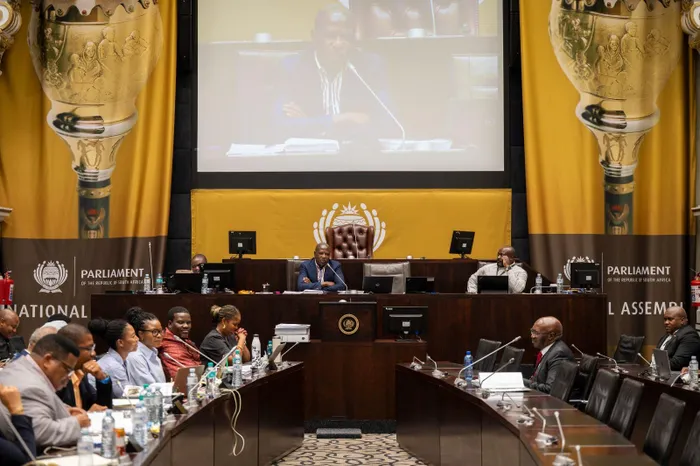
The Ad Hoc Committee is expected to receive an overview of the evidence presented before it and deliberate on a report compiled by the secretariat before making a recommendation to Parliament.
Image: Armand Hough / Independent Newspapers
After five months of evidence by witnesses during its probe into the allegations made by KwaZulu-Natal Police Commissioner Nhlanhla Mkhwanazi, the Ad Hoc Committee wrapped up its public hearings on Wednesday.
Mkhwanazi and National Commissioner Fannie Masemola returned to the stand this week to address counter-allegations from some witnesses and clarify specific issues.
During his testimony, Mkhwanazi explained why he retracted serious allegations he made against former police minister Bheki Cele.
He also expressed his concern at how members of the committee handled evidence presented to them, with some MPs seeming to prejudge things.
“My understanding is that the committee’s job is to listen to evidence, probe, and not make conclusions that certain things are wrong or certain individuals. It is that which was a concern to me.”
Mkhwanazi said the media briefing he conducted on July 6, 2025, was the last resort when he could not engage the executive over the directives issued by suspended Police Minister Senzo Mchunu.
The KwaZulu-Natal top cop insisted Mchunu was captured to the extent of writing the letter with the directives to disband the Political Killings Task team (PKTT).
“I still believe, and I am convinced that Minister Mchunu was used to do what he did.”
According to Mkhwanazi, evidence suggested that suspended Deputy National Commissioner Shadrack Sibiya was a criminal.
“There cannot be peace between me and Sibiya,” he said.
Mkhwanazi denied that he assaulted and tortured suspended police sergeant Samkeliso Mlotshwa.
“I deny my involvement in the torture. I believe he has opened a case that needs to be investigated. I hope it will be thoroughly investigated to establish the truth.”
He said Mlotshwa was a suspect in the kidnapping of KwaZulu-Natal businessman Zukariya Desai, whom he allegedly went with to Mozambique illegally.
“He comes here with (Fadiel) Adams to lay the same complaint registered, hoping there will be a different team. I will not be surprised if that case is now with IDAC because it seems Mr Adams has found a different way of making sure cases are investigated,” he said.
He added that Adams gave evidence before the committee without facts other than his thoughts.
Mkhwanazi confirmed that he still does not have a security clearance certificate, and he made an application in 2022.
“I was told there was a case involving a so-called hit squad in 2013 in KwaZulu-Natal, in which I was implicated. At the time, I was working in Pretoria and had never worked in KwaZulu-Natal,” he said.
Meanwhile, Masemola said it was still his evidence that Mchunu never consulted him about the directives.
“At no stage did the minister hint or indicate that there is this imminent disbandment of the PKTT. There was ample opportunity to discuss if there was an urgent need to disband the PKTT, and there was no discussion whatsoever.”
Masemola said it was after businessman Vusimuzi “Cat” Matlala’s phone was confiscated and the PKTT went through his messages that it was established the disbandment was a “planned thing”.
He never alerted Mchunu to “the discovery” because “he never made time” to be briefed.
Masemola denied receiving money from Matlala arising from the tender awarded to his company.
“I did not receive any money from Mr Matlala. I saw (Brown) Mogotsi’s allegation. I will deal with it at other forums.”
He added that Mogotsi must come with evidence, including that he and Cele plotted against Mchunu.
He denied that he targeted retired General Francinah Vuma for not abandoning some investigations in 2022.
Masemola equally dismissed the allegations that he lived beyond his means and that he owned six properties, saying it was “blue lies”.
“I pay for everything that I have,” he said.
“I know that (whistle-blower Patricia) Mashale and (fraud examiner Paul) O’Sullivan say I have got six properties, and they don’t know how I afford them and that my salary can’t afford that,” he said before giving details of the four properties he and his wife have in Pretoria, Bloemfontein, and Durban.
In another development, President Cyril Ramaphosa finally submitted his written responses to the questions from the Ad Hoc Committee.
Ramaphosa said he learnt on February 1, 2025, from Masemola that he was instructed to disband the PKTT by Mchunu, who, 12 days later, confirmed doing so.
“I conveyed my dissatisfaction at not having been consulted prior to this decision being taken. I furthermore indicated that in my view, this was a decision for the national commissioner to make,” said Ramaphosa.
He said he did not approve of the decision to disband the PKTT.
“It was my understanding, from my initial discussion with the national commissioner, that the PKTT would continue its work.”
Ramaphosa said he was not informed of any illegality the task team was engaged in.
“I came to know that the minister holds these views when he appeared before this Ad Hoc Committee and the Commission,” he added.
Ad Hoc Committee Chairperson, Soviet Lekganyane, said the evidence leaders will present the overview of the evidence, and the secretariat will provide a report to be deliberated by the MPs.
“Members would have gone through the report, be satisfied with the evidence, and get that recommendation that they would have to make,” he said.
Lekganyane was confident that there would be no difficulties in adopting the report.
“The problem would be if we want to bring party political shenanigans into the report. That is what would delay us,” he said.
The committee has until March 31 to conclude its work and report to the National Assembly.
mayibongwe.maqhina@inl.co.za