

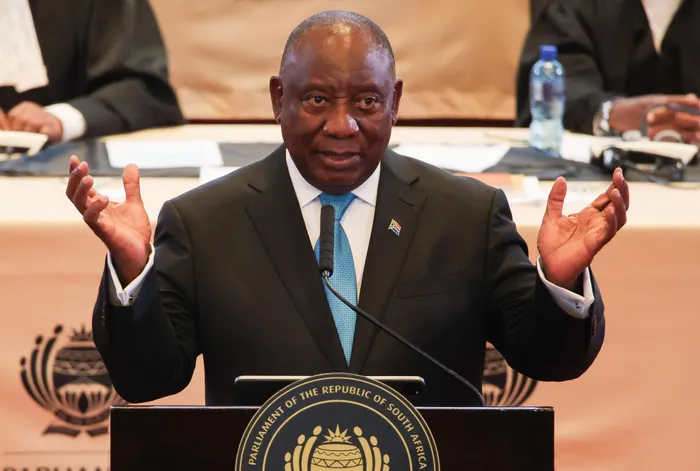
President Cyril Ramaphosa says over R1 trillion has been allocated to infrastructure projects, alongside reforms to boost job creation and expand social services for millions of South Africans.
Image: IOL
President Cyril Ramaphosa says the 2026 National Budget will accelerate inclusive growth, create jobs, and tackle poverty, as government builds on recent progress to stabilise and reform the economy.
In his weekly letter to the nation, speaking on the budget presented by Finance Minister Enoch Godongwana, Ramaphosa said every allocation reflects a developmental choice aimed at improving the material conditions of South Africans.
“Every budgetary allocation is a developmental choice: ensuring there are teachers in classrooms, nurses and doctors in clinics, electricity and basic services in homes and businesses, infrastructure to grow the economy, and employment opportunities for communities,” he said.
The president said the budget comes after a prolonged period of economic uncertainty but builds on progress made in recent years to stabilise, reform, and transform the economy.
Improvements in public finances, stabilising debt, a narrowing budget deficit, credit rating upgrades, and improved market confidence all signal what he described as the beginning of an economic recovery.
“A stable macroeconomic environment boosts investor confidence and increases the government’s capacity to invest in both growth and poverty relief without compromising sustainability,” Ramaphosa said.
He added that the stabilisation of public finances had created space to accelerate public investment, sustain the social wage, and direct resources to reforms that drive growth and job creation.
The social wage accounts for over 60% of government spending after interest payments.
Ramaphosa said the allocation for the current financial year will enable government to provide healthcare services to 84% of the population, social grants to 26.5 million beneficiaries, and free basic services to more than 11 million indigent households.
It will also support approximately 13.6 million learners at school.
“This is a redistributive budget that reduces inequality, builds the capabilities of our people and strengthens the foundations for inclusive growth,” he said.
Ramaphosa said Basic education has been identified as a key foundation for long-term growth.
Additional spending has been allocated to employ more educators, while further funding has been directed to the early childhood development grant to reach an additional 300,000 children and to align the National School Nutrition Programme with food inflation.
The budget also places strong emphasis on infrastructure as a driver of inclusive growth, he said.
Over the next three years, public spending on infrastructure will exceed R1 trillion to build and maintain roads and rail lines, expand energy infrastructure, and invest in water and sanitation systems.
“Improved infrastructure lowers the cost of doing business, raises productivity, and supports our country’s exports,” Ramaphosa said.
However, he acknowledged that the government cannot finance infrastructure needs on its own.
''We are therefore mobilising investment from private and other sources, and opening the space for public-private partnerships.
''As we encourage private investment in electricity, rail, and port operations, we are maintaining state ownership of strategic national infrastructure,'' he said.
Under Operation Vulindlela, departments and public entities are undertaking reforms in energy, telecommunications, water, and logistics.
Ramaphosa also conceded that many municipalities remain in financial distress, driven by weak revenue collection, poor management, and substantial service delivery backlogs.
Over the medium term, R19.2 billion will be reallocated to reform electricity, water, sanitation and solid waste trading services in metros, with funding linked to performance against clear targets, he said.
The Municipal Infrastructure Grant is being reformed to address underspending and misuse of funds. Over the next three years, R86.9 billion has been allocated to support the provision of free basic services to indigent households.
To stimulate employment, an additional R4.1 billion has been allocated to the Presidential Employment Stimulus to provide work opportunities to more young South Africans.
He said the Government has also moved to ease the regulatory burden on small businesses by more than doubling the VAT registration threshold and significantly increasing the capital gains tax exemption for small business owners who wish to sell or transfer their enterprises.
Ramaphosa said the budget is anchored on three imperatives: maintaining fiscal sustainability, driving inclusive growth, and protecting society’s most vulnerable.
“As we build on the momentum of our recovery, we will continue to be guided by fiscal discipline, structural reform, targeted investment and an overarching commitment to improving the material conditions of every South African,” he said.
hope.ntanzi@iol.co.za
IOL Politics