

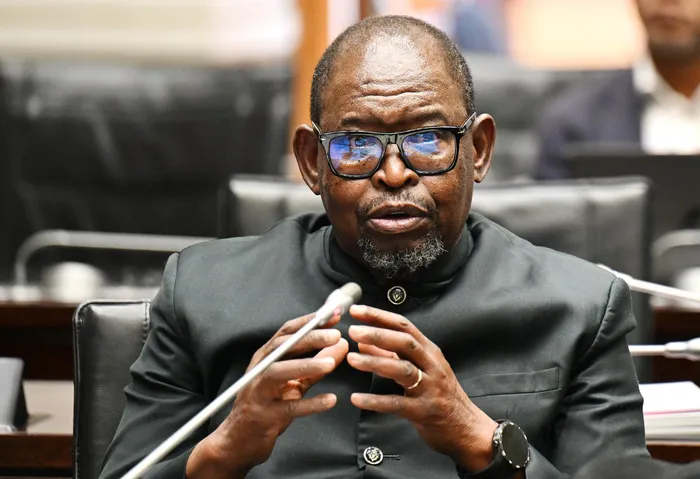
Finance Minister Enoch Godongwana says BEE can't just be done away with because it is a constitutional requirement.
Image: Phando Jikelo / Parliament RSA
Finance Minister Enoch Godongwana has called for a significant shift in the debate surrounding the country's Black Economic Empowerment (BEE) policy.
Rather than continuing the contentious conversation regarding the potential scrapping of the policy, Godongwana urges stakeholders to focus on the unintended consequences that may have arisen from its implementation.
He said BEE was provided for in the Constitution.
“We must have an honest debate about it. First and foremost, it's a constitutional injunction. You can't dismiss Black Economic Empowerment. It is required by the Constitution,” he said.
“Now, what you need to say is, 'Are there any unintended consequences?' You can't say, 'Do away with it'. Are there any unintended consequences?” said Godongwana.
He was responding to DA MP Andrew Bateman when he upped the ante on his party’s calls to scrap BEE when Godongwana and the National Treasury made a presentation on the 2026 Budget before the joint meeting of the Finance and Appropriations parliamentary committees on Friday.
Bateman said BEE has been damaging to investment, economic growth, and job creation.
“In other words, it has contributed to massive issues we face with unemployment and the general lack of opportunities for advancement if we look at its effect.”
He also said BEE has empowered some black South Africans at the expense of all South Africans, a vast majority of whom are black.
“So, it failed in its central objective on balance,” said Bateman.
In response, Godongwana said if the debate on BEE started from an objective basis of analysing some of the unintended consequences, there could be a constructive discussion.
“At the moment, it's an ideological attack rather than an objective analysis of its efficacy, and I think let's move away from the ideological attack of Black Economic Empowerment and go to the practicalities of analysing what some of the effects which were not intended are.”
The debate on BEE comes in the wake of President Cyril Ramaphosa’s State of the Nation Address (SONA), where he said the transformation of the economy was necessary to drive sustained growth, reduce inequality, and correct the injustices of the past.
“We are undertaking a review to refine, realign, and strengthen our Broad-Based Black Economic Empowerment framework to ensure that it supports greater transformation and inclusive growth.
“All of these actions will create a stronger economy and fix the foundations that were broken.”
During the debate, DA leader and Agriculture Minister John Steenhuisen said the restrictive BEE policies should be replaced with genuine Broad-Based Empowerment that included skills, ownership, and opportunity for all, not just the connected few.
“We must replace failing race-based empowerment frameworks with ones that tackle poverty. The DA’s Economic Inclusion for All Bill represents a significant step toward achieving a vision of genuine economic empowerment for all South Africans, and is the type of reform our country urgently needs.”
In defence of B-BBEE, Ramaphosa said the critics of the policy were falsely claiming that it benefited only a few and inhibited economic growth, and enabled corruption.
“We must see Broad-Based Black Economic Empowerment not as a cost to the economy, but as an investment in the sustainable growth of our economy.
“That is why I announced in the State of the Nation Address that we are undertaking a review of our Broad-Based Black Economic Empowerment framework to ensure that it supports greater transformation and inclusive growth.”
In reaction to Ramaphosa’s remarks, Steenhuisen maintained that the DA will continue to fight for an alternative that creates a more inclusive economy for all.
“It is for this reason that the DA has tabled the Economic Inclusion for All Bill. We will relentlessly pursue the replacement of BEE with a policy that truly focuses on addressing poverty,” he said.
mayibongwe.maqhina@inl.co.za