

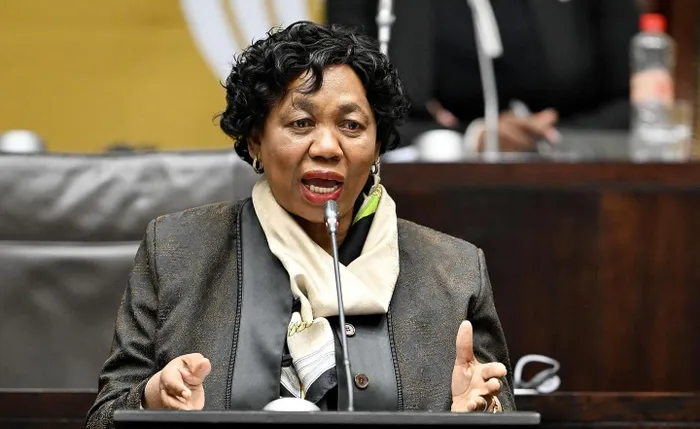
Defence Minister Angie Motshekga said she had not reprimanded SA Navy Chief Vice-Admiral Monde Lobese for raising concerns, but reminded him that operational security and military discipline are paramount.
Image: Parliament of SA
Defence Minister Angie Motshekga said her leadership and actions taken amid South African Navy Chief Vice-Admiral Monde Lobese remarks about the underfunding of the country's defence capabilities were consistent with her oath of office.
Motshekga stated that the Department of Defence operates under strict governance, command and control protocols.
“When concerns are raised by any senior officer, including the Chief of SA Navy, the matter must be processed through appropriate command channels, subjected to factual verification and handled in a manner that preserves the integrity of the institution,” she said.
Motshekga’s remarks come in light of a recent parliamentary inquiry from EFF MP Carl Niehaus, who questioned whether Motshekga’s actions towards Lobese were compatible with her oath of office and the principles of transparency and accountability.

Navy Chief Vice-Admiral Monde Lobese.
Image: SANDF
Lobese, addressing an event in November, voiced alarm over the impact of persistent budget cuts on the SANDF’s operational readiness.
“I often find myself questioning whether those responsible for making significant decisions, particularly regarding the funding of the defence force, may be directly or indirectly influenced by these drug cartels, illegal traders, maritime criminals and human traffickers.
“Because it will appear that this consistently underfunding and incapacitation of the SA Navy and defence force, (which) in general is to ensure the success of the operations, undermines our nation, compromise its sovereignty and jeopardises the future of our children,” Lobese said at the time.
However, Motshekga labelled his comments as inappropriate and disingenuous, clarifying that they did not represent the official position of her department.
She had stated that Lobese was fully aware that the matter was receiving attention at all levels, starting from within the department to Parliament.
The minister had indicated that she would be taking appropriate steps to deal with Lobese’s “unfortunate outburst”.
In her written reply to Niehaus, Motshekga said she had not reprimanded Lobese for raising concerns, but reminded him that operational security and military discipline are paramount.
“The constitutional principle of transparency does not negate the requirements of operational security, military discipline and responsible management of sensitive information within the Defence Force.”
The minister reiterated that she had not issued any directives that would inhibit senior SANDF officials from reporting safety or readiness issues.
“The issues raised by the Chief of Navy have been tabled, assessed within the command structure, and are receiving attention through the relevant governance processes of the Department and the SANDF.”
Responding to MK Party MP Visvin Reddy, Motshekga said senior SANDF officers were required to raise matters through established internal command and reporting channels.
“My communication on the matter served only to clarify this requirement and to ensure that sensitive operational information is handled responsibly, without compromising national security, defence readiness, or the integrity of ongoing processes within the Department of Defence.”
She reiterated that Lobese’s concerns have been formally captured within the SANDF’s command structures and were receiving attention.
Motshekga emphasised that she has not issued any directive prohibiting Lobese or any senior SANDF official from reporting safety concerns, equipment failures, resource constraints or matters related to operational readiness.
“The department continues to encourage accurate reporting of all operational risks. However, any disclosure of sensitive defence information must comply with constitutional obligations, the Defence Act, and security protocols governing classified or operational material.”
Motshekga also said operational challenges must first be processed within the command structure to ensure accuracy, protect national security and allow for coordinated institutional action.
“Public disclosure of operational challenges by senior military officers is not inherently inconsistent with the principles of transparency and accountability. However, such disclosure must occur within the framework of established statutory processes and security classification to avoid compromising operational safety or exposing the Defence Force to unnecessary risks,” she said.
The minister added that parliamentary oversight remained a constitutional imperative.
“The department continues to provide the Portfolio Committee and Joint Standing Committee on Defence with full and accurate briefings on the state of the SANDF, including capability gaps, resource constraints, safety risks and readiness concerns.
“These updates are provided through formal submissions, presentations, and appearances before the committees, where members have unrestricted opportunity to engage with senior officials.”
Motshekga said her commitment remained to ensure that Parliament received reliable, verified and comprehensive information regarding the state of the Defence Force.
mayibongwe.maqhina@inl.co.za