

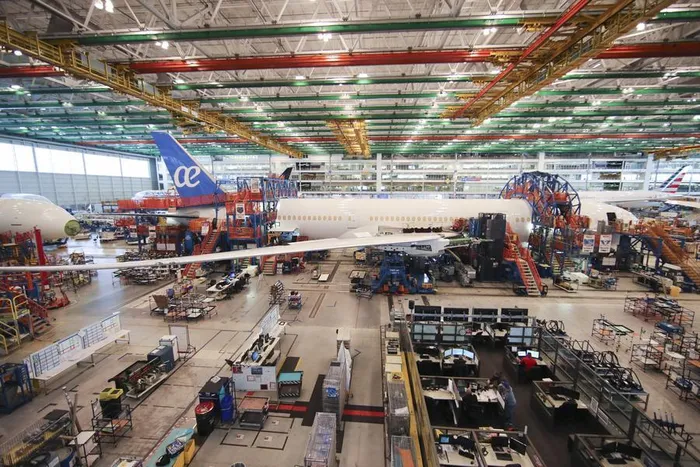
Photo shows interior of the final assembly building in Boeing South Carolina in North Charleston, South Carolina of the United States.
Image: Xinhua
The United States entered October with its manufacturing sector still caught in a prolonged slump, while a parallel global shift is seeing the nations of the Global South step into a far more assertive economic and diplomatic role. The persistence of US industrial weakness; exacerbated by tariff volatility, supply-chain stress, and wavering demand; stands in stark contrast to the rising momentum in emerging economies that are carving out influence in an increasingly multipolar world.
A Factory Sector Under Strain
New data shows that American manufacturers are experiencing their eighth consecutive month of contraction. The Institute for Supply Management’s manufacturing index slipped to 48.7 in October, signalling broad declines across new orders, exports, employment, and production. Any reading below 50 points to shrinking activity, and industry sentiment reflects a climate overshadowed by policy uncertainty and rising import costs.
Firms surveyed describe an environment where tariffs have not delivered the intended boost to domestic manufacturing. Instead, input costs remain elevated, sourcing alternatives are limited, and global customers are pulling back. Producers of machinery, electronics, metals, chemicals, and transportation equipment consistently reported cancelled orders, supply bottlenecks, and cautious buyers. Many note that reshoring is unrealistic because key components simply cannot yet be manufactured at scale within the US.
Even as the Trump administration defends its sweeping duties as necessary for industrial revival, businesses say constant tariff revisions have created a stop-start rhythm that hampers planning. Some agricultural-related manufacturers report further pressure due to China’s reduced purchases of American soybeans, squeezing farmers’ incomes and their ability to invest in equipment. Meanwhile, extended government shutdowns have interrupted access to official economic data, making it harder for companies to anticipate future demand.
Though input prices continued to rise in October, the pace of increases slowed, raising cautious optimism that tariff-linked inflationary pressure could ease. Yet employment remains weak, with many manufacturers holding off on new hires or reducing headcount. Despite promises of massive foreign investment in new US plants, economists note that these facilities will take years to build, offering little immediate relief to the labour market.
In short, US factories find themselves navigating weakening demand, higher production costs, and prolonged policy turbulence, all factors pulling the sector further into stagnation.
A Multipolar Global Landscape Takes Shape
While Western economies confront these internal pressures, the broader world is undergoing a fundamental realignment. The traditional US- and Europe-anchored order is loosening, driven by “America First” trade policies, frictions within long-standing alliances, and efforts by major economies to insulate themselves from geopolitical shocks. Amid this reconfiguration, nations across Asia (excluding China), Africa, the Middle East, and Latin America, the Global South, are stepping forward with a clearer collective voice.
More than 130 nations now fall under this expansive label, representing over three-fifths of the world’s population. What unites them is not geography or political ideology but a shared commitment to economic development, diversified partnerships, and strategic autonomy. Instead of aligning rigidly with the West or China, most Global South states adopt multi-aligned strategies that allow them to engage with all major players without being drawn into exclusive blocs.
This flexibility is becoming a source of power. Global South economies boast young labour forces, abundant natural resources, rapidly expanding consumer markets, and a pivotal role in global supply chains. They are capturing a greater share of global growth and are increasingly forging new trade, technology, and investment arrangements tailored to their national priorities. Whether through regional blocs, South-South partnerships, or multipolar agreements, these countries are reshaping the pathways of global commerce.
Their approach to climate action also reflects pragmatic balance: they pursue sustainability, but not at the expense of growth or developmental needs. These nations recognise their leverage and are using it to negotiate energy, infrastructure, and industrial deals that accelerate development while keeping markets open.
The Global South’s Expanding Influence
The rise of BRICS and other multi-regional groupings highlights how Global South nations are developing new avenues of cooperation that bypass older Western-dominant institutions. As global supply chains evolve, many countries are positioning themselves as essential hubs; offering alternative manufacturing centres, critical minerals, agricultural outputs, and routes for trade diversification.
In a world marked by geopolitical contestation, these states are able to act as “swing players,” providing diplomatic and economic options to both sides of global power divides. With Western economies grappling with slow growth and high political uncertainty, the Global South’s role as a stabilising and opportunity-generating force is becoming more pronounced.
A Diverging Global Outlook
The contrast between the United States’ manufacturing contraction and the Global South’s growing assertiveness captures a broader realignment. While US factories contend with policy shocks, supply-chain disruption, and faltering demand, emerging economies are leveraging demographic strength, strategic resources, and multi-aligned diplomacy to claim a larger place in the global order.
As the world transitions toward a multipolar system, the industrial struggles of advanced economies highlight the urgency of adaptation, while the Global South’s ascent signals where much of the next era of growth and opportunity will originate.
Written By:
Cole Jackson
Lead Associate at BRICS+ Consulting Group
Chinese & South American Specialist
** MORE ARTICLES ON OUR WEBSITE https://bricscg.com/
** Follow https://x.com/brics_daily on X/Twitter for daily BRICS+ updates