

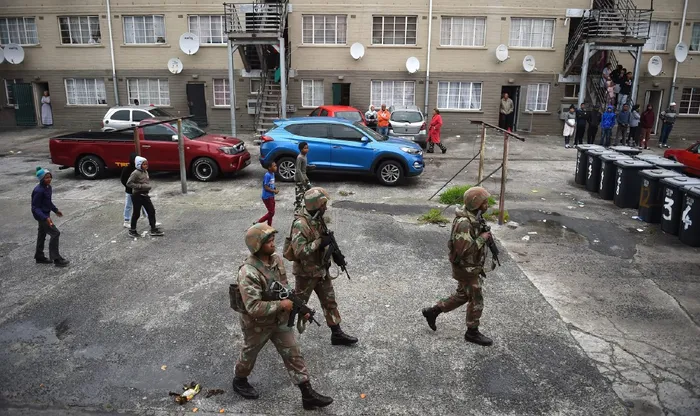
The South African National Defence Force (SANDF) is set to be deployed to combat rising gang violence, sparking debate among civic organisations and government officials.
Image: File
On Friday, 27 March 2026, the South African National Defence Force and the South African Police Service presented a joint briefing to the Joint Standing Committee on Defence and the Portfolio Committee on Police. The session detailed the state of preparedness for the internal deployment of the SANDF in support of the SAPS under Operation Prosper, as announced by President Ramaphosa in his 2026 State of the Nation Address. As an EFF Member of Parliament who participated actively in the proceedings, I left the meeting with a mixture of cautious acknowledgment and profound unease.
While some modest progress has been made in joint planning, the establishment of provincial joint structures, the co-signing of strategic guidelines on 15 March 2026, and the development of a comprehensive 13-module mission-readiness training programme, the briefing left far too many critical questions unanswered. South Africa cannot afford another half-hearted experiment in militarised policing that merely displaces crime rather than eradicating its roots.
The constitutional position is clear and must be restated without equivocation. Section 201(2)(a) of the Constitution permits the President to authorise the employment of the defence force in co-operation with the police service, but this power is designed to be exceptional, temporary, and subject to rigorous parliamentary scrutiny. Internal deployment of the SANDF is not, and must never become, a routine instrument of domestic governance.
Yet the scale and persistence of organised crime — illicit mining networks spanning the country, gangsterism and firearm proliferation in the Western Cape, Eastern Cape and Gauteng, and the corrosive links between crime, illegal migration, corruption and infrastructure sabotage — have rendered such deployment a regrettable necessity. The SAPS has manifestly failed to fulfil its primary constitutional mandate under Section 205(3) to prevent, combat and investigate crime, maintain public order and protect the inhabitants of the Republic. This failure is not accidental; it is symptomatic of deep institutional rot.
During the joint meeting, I directly confronted on behalf of the EFF the Acting Minister of Police, Professor Firoz Cachalia, on the glaring absence of Minister Senzo Mchunu, who remains on enforced leave. That absence is not a mere administrative detail; it is emblematic of the malaise, rot and criminal infiltration that have hollowed out the SAPS. Without a clean, professional and adequately resourced police service, no amount of SANDF “force multiplication” will deliver lasting results. The presentation spoke of “distinct command authority” retained by each entity and coordination through national, provincial and tactical joint operational centres. These structures sound reassuring on paper. In practice, however, they risk repeating the command confusion, procedural friction and human-rights violations that marred the 2021 COVID-19 deployment and the 2019 Western Cape Cape Flats operation. In both previous cases, short-term stabilisation gave way to a rapid resurgence of violence once the soldiers withdrew. The briefing offered no credible evidence that these historical lessons have been systematically learned or that mechanisms exist to prevent their recurrence.
Equally troubling is the vagueness surrounding measurable success. The documents list generic “mission-critical success indicators” — actionable intelligence, coordinated asset deployment, community outreach — but provide no time-bound key performance indicators, baselines or exit criteria. How exactly will Parliament and the public know when the deployment has achieved its purpose? The authorised strength of 2 200 members and the projected expenditure of R823.2 million represent a significant commitment of scarce public resources. Yet the detailed budget breakdown was withheld even from open session, and the presentation contained no performance data from the first Gauteng deployment that began on 31 January 2026 — before formal strategic guidelines were signed. This opacity undermines the very principle of democratic accountability that Section 201(3) of the Constitution seeks to protect.
The EFF expressed deep concern that repeated internal deployments risk eroding the SANDF’s primary constitutional mandate of national defence. Section 200(2) is unambiguous: the defence force exists to defend and protect the Republic in accordance with the Constitution and the principles of international law regulating the use of force. Transforming the SANDF into a permanent high-cost internal stabilisation force while defence readiness declines is a strategic error South Africa cannot afford. The R823.2 million allocated to Operation Prosper must not come at the expense of core combat capability. Nor can we ignore the broader socio-economic context. Organised crime flourishes where poverty, unemployment and inequality are entrenched — consequences of decades of capitalist exploitation that the EFF has consistently warned against. Military deployment may suppress visible symptoms of this crisis, but it cannot address the structural drivers. Stabilisation without radical economic transformation is merely a temporary truce with chaos.
Civilian protection remains another area of legitimate anxiety. The presentation rightly emphasised compliance with the Bill of Rights, the Criminal Procedure Act and a mission-specific Code of Conduct. These safeguards are essential. Yet paper commitments are insufficient. Independent oversight — through real-time involvement of the Independent Police Investigative Directorate, the Military Ombud and, where necessary, parliamentary observers — must be embedded in operational planning. Communities living in the prioritised hotspots (the Cape Flats in the Western Cape, northern Nelson Mandela Bay and Sarah Baartman District in the Eastern Cape, Ekurhuleni, Johannesburg and West Rand in Gauteng, the Platinum Belt and KOSH area in the North West, and the Goldfields in the Free State) deserve more than assurances; they deserve verifiable mechanisms to hold both SANDF and SAPS accountable for any excesses.
The EFF has accepted this deployment with regret, recognising that desperate communities cannot wait indefinitely for a SAPS that has repeatedly failed them. But acceptance is not endorsement of the status quo. We insist that the deployment remain strictly time-bound, legally watertight and subject to structured, regular parliamentary oversight. Problems that arise during implementation must be addressed as a priority, not deferred to closed sessions or post-facto reports. A mandatory periodic review mechanism should be incorporated into the strategic guidelines to prevent mission creep and ensure that the SANDF’s presence does not become normalised.Ultimately, Operation Prosper must serve as a bridge, not a crutch. The operational space created by SANDF support must be used by the SAPS, the Directorate for Priority Crime Investigation and the National Prosecuting Authority to dismantle criminal networks, strengthen detective and intelligence capacity, and rebuild public trust. Anything less would represent a profound betrayal of the communities we are meant to serve.
The EFF remains committed to radical economic transformation that will bring economic freedom in our lifetime and address the deeply ingrained socio-economic consequences of capitalist exploitation and poverty. Until the state is capable of delivering both security and economic justice, deployments such as this will remain necessary — but they must never be allowed to become permanent. Parliament, civil society and the people of South Africa must maintain relentless vigilance. The rule of law and the constitutional order demand nothing less.
*Ambassador Carl Niehaus is an EFF Member of Parliament (MP). He serves as the EFF permanent representative on both the Portfolio Committee on Defence and Military Veterans, and the Joint Standing Committee on Defence.
**The views expressed here do not necessarily represent those of Independent Media or IOL