

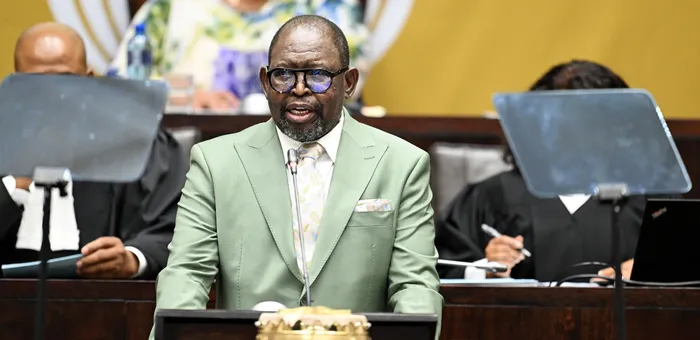
Finance Minister Enoch Godongwana will deliver the 2026 Budget Speech on Wednesday.
Image: Parliament RSA / Supplied
On Budget Day we will be told, once again, that growth is coming. Infrastructure will unlock potential. Investment will restore confidence. Exports will lift revenue. The language is familiar and reassuring.
But budgets are not speeches. They are moral documents. They reveal what a country chooses to build, who it chooses to protect, and how it understands its inheritance.
South Africa’s mineral wealth is constitutionally held in custodianship on behalf of all its people. That principle was meant to signal a break from a past in which extraction enriched a few and excluded the many. It promised that the wealth beneath our soil would serve national development and correct historical injustice.
Two decades later, the question is not whether mining contributes to national revenue. It does. The question is whether the fiscal architecture converts that contribution into visible, durable benefit for our society and especially for the communities that live with devastating impacts extraction every day.
Across South Africa’s mining belts, the costs of extraction are not abstract line items in a fiscal table; they are lived, visible, and cumulative. Land that once supported grazing or small-scale agriculture is opened, stripped and reshaped. Water systems carry the burden of runoff and contamination long after the first blast has faded from memory. Dust settles not only on rooftops but in lungs. Roads buckle under the weight of heavy haulage. Informal settlements expand as job seekers arrive faster than infrastructure can absorb them. Clinics and schools stretch beyond capacity. And when commodity prices fall or a shaft reaches the end of its life, it is not balance sheets that remain behind, but communities whose local tax base contracts just as social need intensifies. The pressures are local, the consequences immediate, and the accumulation of harm generational.
The revenue, by contrast, is national and diffuse. Corporate income tax and mineral royalties flow into the National Revenue Fund. They are pooled, allocated and redistributed through a complex intergovernmental system. That design reflects a commitment to national equity. But it also produces a structural asymmetry: communities that bear concentrated costs have no predictable fiscal claim on the wealth extracted from their land.
The consequences are not theoretical. They are visible in places where formal mining has operated for decades and where unemployment and municipal distress remain stubbornly high. They are visible, too, in the recent gold rush in Springs, where residents dug through soil in search of flecks of value. That scene was not about speculation or nostalgia. It was about survival.
When people risk injury and arrest to recover traces of gold from open ground, they are sending a message. They are saying that the formal economy is not reaching them. They are saying that wealth can leave their communities while opportunity does not arrive. They are saying that custodianship has yet to translate into lived inclusion.
It would be easy to frame this as a story of corporate misconduct or administrative failure. That framing may satisfy anger, but it does not build solutions. The deeper issue is structural fiscal under-capture and redistribution failure. South Africa’s mining tax regime is highly volatile. In boom periods, profits can surge dramatically. In downturns, revenues fall just as sharply. There is no explicit windfall capture mechanism calibrated to extraordinary profitability, and there is no dedicated, rules-based channel linking a portion of mineral revenues to mining-affected municipalities.
The result is a broken development loop. Minerals are extracted and exported. Revenues enter the fiscus. Funds are spent across a wide range of national priorities. But the places that host extraction do not experience a stabilised, predictable flow of investment tied to that activity. When the cycle turns, they are left exposed.
South Africa has an opportunity to undertake a second generation of custodial reform, one that aligns fiscal design with constitutional promise. Three practical steps would begin to close the gap between value extracted and value built.
First, establish a transparent “mining public value account.” Each year, Treasury should publish a consolidated statement of mineral royalties collected, corporate tax paid by the sector, environmental rehabilitation liabilities, closure provisioning status and allocations to mining-affected municipalities. Visibility is the foundation of accountability.
Second, create a Mining Impact Fund, financed by a defined share of mineral royalties and by a calibrated escalator that activates only during periods of extraordinary profitability. This would not be a punitive measure. It would be a stabilisation mechanism. Funds would be allocated to mining-affected municipalities through conditional grants tied to clear development plans, independent audits and public reporting dashboards. In this way, local communities would gain a predictable fiscal claim without sacrificing national equity or oversight.
Third, invest deliberately in economic diversification in mining regions. Revenue linked to extraction should help build what will endure after extraction ends: skills, small enterprises, renewable energy projects, water infrastructure and environmental restoration. A portion of windfall revenues could be saved in a stabilisation reserve to cushion downturns and fund post-mining transitions.
These reforms are not anti-investment. On the contrary, they offer certainty. Investors benefit from clear, rules-based systems that reduce social conflict and regulatory unpredictability. Communities benefit from visible participation in prosperity. The state benefits from reduced instability and a more balanced development trajectory.
South Africa does not lack mineral wealth. It does not lack technical expertise. It does not lack constitutional principle. What it requires is alignment: a fiscal architecture that recognises that when wealth is extracted from a place, a meaningful portion of that wealth must be anchored there in durable form. Not as charity, not as discretionary development projects, but as a structural entitlement tied to the fact of extraction itself. That anchoring must do more than smooth economic decline when mines close; it must also confront, directly and honestly, the environmental damage that extraction leaves behind. The scars on land and water, the degraded air, the destabilised local economies, these are not unfortunate side-effects to be managed at the margins. They are costs incurred in the creation of national wealth.
The Springs gold rush should not be remembered as a symbol of desperation. It can instead serve as a reminder of human ingenuity and aspiration. People dig because they believe something of value lies beneath their feet. A justice-centred budget would honour that instinct, not by leaving individuals to fend for themselves, but by ensuring that the wealth under our soil is systematically converted into schools, clinics, businesses, restored land and resilient municipalities.
If minerals truly belong to the people, then the people must be able to see and feel the benefit. Budgets are moral documents. They show whether we protect balance sheets or communities, whether we consume inheritance or convert it into capacity. The measure of this one will be simple: when the minerals are gone, what remains?
* Christopher Rutledge is a South African human rights activist and the Executive Director of Mining Affected Communities United in Action Advice Office, and part of a national network representing communities impacted by mining.
** The views expressed do not necessarily reflect the views of IOL or Independent Media.