

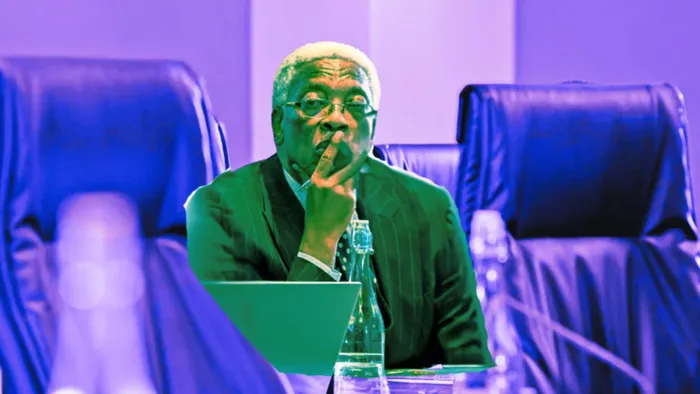
Black African judicial authority has often been subjected to pressures that do not announce themselves as political, yet operate precisely as such, writes Gillian Schutte of the debacle surrounding Eastern Cape Judge President Selby Mbenenge's return to work after being cleared of a gross misconduct claim.
Image: IOL Graphics
There are moments when institutional confusion does not arise organically, but is cultivated. When settled law is re-opened in commentary, when procedural finality is recast as controversy, and when authority already exercised is treated as provisional, one is entitled to ask why. The muddling around Judge President Selby Mbenenge’s return to office has exactly this quality.
This is not unfamiliar terrain. Black African judicial authority has often been subjected to pressures that do not announce themselves as political, yet operate precisely as such. Certain donor-funded civil society actors and aligned media outlets invested heavily in this case as a vehicle for precedent. When the Tribunal did not deliver the outcome some had anticipated, the matter should have ended. Instead, it metastasised into interference.
The Tribunal process concluded. The JSC exercised its statutory authority. The negotiated special leave reached its lawful end. Administrative normality should have followed. It did not. What followed was a concerted effort to keep the matter alive through insinuation, instruction, and overreach. Against that backdrop, the law itself remains unambiguous.
The matter concerning the decision whether or not to suspend JP Mbenenge was dealt with through a statutory process which the JSC had the powers to undertake. In the exercise of such powers, the JSC fully debated whether or not it should advise the President to place JP Mbenenge on suspension. After due deliberation, the JSC resolved not to recommend Mbenenge's suspension.
On December 18, 2023, pursuant to a negotiated agreement between then Chief Justice Zondo and Selby Mbenenge JP, the JP was informed that he had been granted special leave until the Judicial Conduct Tribunal had made known its ruling.
The Tribunal made known its decision last Friday.
On Monday, February 2, there being no justification for Mbenenge to stay at home, which would have meant being remunerated for being idle, Mbenenge resumed duties at the Division's headquarters in Makhanda. Subsequent thereto he visited other centres in the division announcing his return to colleagues.
There can be no basis in law for extending special leave that ceased to exist last Friday. It is trite law that the unilateral grant of special leave is tantamount to a suspension.
Part of that jurisprudence is gleaned from the cases of Heyneke v Umhlatuze Municipality (D908/09) [2010] ZALC 57; (2010) 31 ILJ 2608 (LC) (24 March 2010) and Sibanyoni v Speaker of the City of Mbombela and Others (J 828/2024) [2024] ZALCJHB 309; (2024) 45 ILJ 2808 (LC) (19 August 2024).
In Heyneke, the Labour Court stated:
“[33] Special leave that is imposed on employees is effectively a suspension in the hope of subverting the residual unfair labour practice provisions of the Labour Relations Act No. 66 of 1995 (LRA) and all the time and other constraints that accompany suspensions.”
These sentiments were reiterated in Sibanyoni, where the Court held:
“[26] … it is apparent that the Disciplinary Regulations for Senior Managers under the Systems Act does not make provision for an employer to place an employee on forced special leave. Special leave imposed by an employer is essentially euphemism for a precautionary suspension … It remains a suspension regardless.”
Mbenenge’s resumption of duties therefore had a direct legal consequence. The position of Acting Judge President ceased to exist on 02 February. Section 6(6)(a)(ii) of the Superior Courts Act 10 of 2013 confirms this. The Deputy Judge President exercises the powers of Judge President only in the absence of the Judge President or where the office is vacant. Neither condition applies.
There is, accordingly, no ambiguity as to who holds authority in the Eastern Cape Division.
What has intruded at this point is not misunderstanding but intrusion.
Once Judge President Mbenenge returned to work, the legal configuration was settled. There was no interim status to manage and no authority in abeyance. Any attempt to suggest that he could be instructed to remain at home required a lawful source of power. None has been identified because none exists.
The Minister of Justice does not hold constitutional or statutory competence to direct a sitting Judge President to withdraw from office. The executive is afforded no such role within the architecture governing judicial office. At most, the Minister was notified, as a matter of professional courtesy, that Mbenenge had resumed his duties. Such notification does not invite decision-making, nor does it activate discretion.
As Clyde Ramalaine has pointed out, this sequence mirrors earlier moments where informal pressure was mistaken for authority. He has drawn attention to the episode involving Deputy Judge President Ledwaba, who was requested by the Chief Justice to take special leave after being cited at the Madlanga Commission. Ledwaba refused. The request dissipated. Nothing followed because nothing could follow. The law provided no mechanism to compel compliance.
Ramalaine has also noted the significance of IOL’s reporting in exposing an earlier insistence by the Chief Justice that Judge President Mbenenge could not return to office and should vacate it instead. Once that position entered the public domain, it quietly shifted. What remained was an attempt to preserve influence without the backing of authority.
These are not isolated missteps. They point to a deeper discomfort with finality. Certain actors appear unable to relinquish a case that had been expected to do more work than the law ultimately allowed it to do. When the Tribunal foreclosed that ambition, pressure stepped in where process had ended.
That substitution carries consequences. When institutional actors continue to behave as though outcomes remain negotiable after lawful conclusion, they undermine the very order they claim to protect. Authority does not survive by insisting. It survives by yielding when its mandate expires.
The law has spoken. What persists beyond that point is not governance but insistence. And insistence, untethered from power, marks the moment where authority gives way to interference.
Black African judicial authority has often been subjected to pressures that do not announce themselves as political, yet operate precisely as such, writes Gillian Schutte of the debacle surrounding Eastern Cape Judge President Selby Mbenenge's return to work after being cleared of a gross misconduct claim.
Image: IOL
* Gillian Schutte is a South African writer, filmmaker, poet, and uncompromising social justice activist. Founder of Media for Justice and co-owner of handHeld Films, she is recognised for hard-hitting documentaries and incisive opinion pieces that dismantle whiteness, neoliberal capitalism, and imperial power.
** The views expressed do not necessarily reflect the views of IOL or Independent Media.