

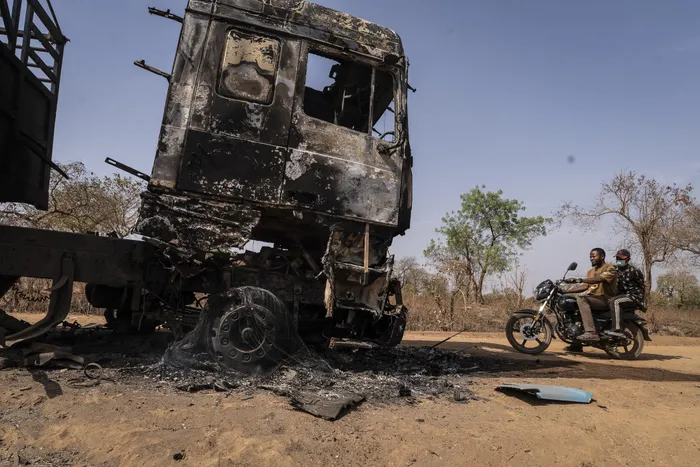
Men ride past a burnt truck following the attack in Woro, Kwara State, on February 5, 2026. Details are still emerging from the attack in Kwara State, but it is one of the country's deadliest in recent months. According to the Red Cross, the death toll stands at 162 people, and the search for bodies is ongoing.
Image: AFP
The reported mass killing in that happened Woro village in Kwara State and President Bola Ahmed Tinubu’s subsequent deployment of an army battalion is not a mere tragic entry in Nigeria’s long list of violent incidents, it is a stark indicator that insecurity in the country has evolved far beyond isolated insurgencies into a layered, adaptive, and structural national crisis. The scale of the attacks, the conflicting casualty figures, and the blurred identity of the perpetrators all point to a deeper governance and security challenge that cannot be solved through troop deployment alone.
While official numbers vary, as they often do in rural attacks where verification is difficult, humanitarian workers, local officials, together with police confirmations, paint a picture of one of the deadliest incidents in recent months. That alone should shift the policy conversation from reaction to strategy.
For more than a decade, Nigeria’s insecurity narrative has been geographically framed: Boko Haram in the northeast, bandits in the northwest, separatist tensions in the southeast, piracy in the Gulf of Guinea, and farmer–herder conflict in the central belt. Kwara State, however, sits in Nigeria’s west-central zone , previously considered more stable than frontline insurgency areas like Borno or Yobe.
This matters. When violence spreads into previously lower-risk regions, it means that armed networks are no longer contained by terrain, ideology, or logistics. Security analysts have increasingly warned, including researchers at regional security institutes and conflict monitoring projects, that militant and criminal groups are becoming more mobile, opportunistic, and interconnected. Reports linking recent attacks happening at the region to jihadist spillover networks such as JNIM (Group for the Support of Islam and Muslims), active across the Sahel, reinforce the concern that Nigeria’s security threats are now transnational in nature.
This mirrors the patterns seen in the wider Sahel corridor, where pressure from military operations in one zone often displaces armed groups into softer neighboring areas. Without cross-border intelligence depth and local governance resilience, military gains simply shift rather than eliminate what is the threat.
Deploying an army battalion is an understandable and necessary response. States have to demonstrate authority after large-scale attacks. Civilian confidence depends on visible protection. However, Nigeria’s experience over the past decade shows that military offensives alone rarely produce lasting security.
Nigeria has launched repeated major operations from anti-Boko Haram campaigns to anti-bandit air offensives, and often reporting high militant casualties and destroyed camps. Yet retaliatory attacks still occur. This cycle is not unique to Nigeria; it resembles counterinsurgency struggles seen in parts of the Middle East and the Sahel, where tactical wins do not automatically produce strategic stability.
The problem lies in asymmetry. Armed groups need only to strike occasionally in order to maintain fear and relevance. Governments, on the other hand, must protect everywhere, all the time. That imbalance means force must be paired with intelligence networks, local trust-building, economic disruption of armed financing, and credible justice systems.
Another concern at hand is attribution certainty. Early blame has been directed at Boko Haram jihadists, while state authorities also reference “terrorist cells,” and security researchers blame possible overlaps with Sahel-based groups. In Nigeria’s conflict environment, categories blur: bandits adopt ideological branding, insurgents engage in criminal financing, and communal conflicts get exploited by armed actors.
Oversimplified labeling has the risk of leading to misaligned responses. Treating every armed assault as purely ideological terrorism risks ignoring the criminal, economic, and governance drivers behind violence. Conversely, dismissing ideological expansion risks underestimating organized militant strategy. Effective response requires granular classification, not political shorthand.
The international dimension can’t be ignored. Recent external political claims alleging religiously targeted mass violence and crimes in Nigeria have been strongly disputed by independent conflict trackers and interfaith monitoring organisations, which consistently show that victims of armed violence include both Christians and Muslims across regions. While identity factors sometimes shape local conflicts, broad religious-genocide narratives distort policy priorities and inflame tensions.
Security policy built on inaccurate narratives is dangerous. It pushes governments toward symbolic responses instead of structural reform and encourages external actors to instrumentalize domestic tragedies.
A durable response must combine layered security reform with governance presence. This means strengthening rural policing capacity, improving early-warning intelligence systems, investing in border surveillance, and supporting community-based conflict mediation structures that many Nigerian states historically relied upon. It also requires addressing the economic ecosystems that sustain armed groups ransom markets, illicit mining, arms trafficking routes, and protection rackets.
Nigeria is not facing a single insurgency. It is confronting a marketplace of violence where ideology, profit, and grievance intersect. That reality demands policy sophistication equal to the threat.
Troop deployment may stabilise Woro in the short term. But unless Nigeria treats these attacks as symptoms of a system-wide security transformation, battalions will keep moving and massacres will keep reappearing on new maps.
Written By:
*Sesona Mdlokovana
Associate at BRICS+ Consulting Group
Africa Specialist
**The Views expressed do not necessarily reflect the views of Independent Media or IOL.
** MORE ARTICLES ON OUR WEBSITE https://bricscg.com/
** Follow @brics_daily on Twitter for daily BRICS+ updates and instagram @brics_daily