

Sherwyn Sean Cupido-Weaich explores how South Africa's constitutional principles shape its foreign policy decisions and the challenges it faces in communicating these values to the international community.
Image: IOL Graphics
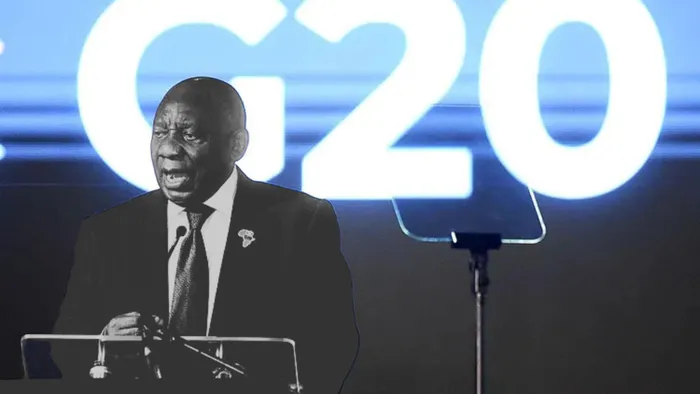
This article forms Part II of a series examining why South Africa’s constitutional order is frequently misread by the United States and its allies. It responds to renewed criticism during Donald Trump’s presidency and recent diplomatic signals, including South Africa’s exclusion from a US-hosted G20 engagement, by situating South Africa’s foreign-policy choices within constitutional and international legal frameworks.
South Africa is often described as a country that sits on the fence.
When it refuses automatic alignment with powerful states, the criticism is familiar: indecision, moral ambiguity, quiet hostility. That accusation sharpened after South Africa condemned United States action in Venezuela and called for an urgent meeting of the United Nations Security Council. In Washington, this was widely interpreted as an unfriendly act.
This article is not a defence of outcomes, but an analysis of constitutional method.
What is often described as neutrality is, in reality, constitutional non-alignment. Yet South Africa has failed to explain this clearly, consistently, and persuasively.
South Africa’s Constitution does not permit foreign policy to operate outside law. External relations are expected to reflect the same values that govern domestic power: dignity, accountability, and restraint. This was a deliberate post-apartheid choice, grounded in the recognition that unchecked power had caused harm both internally and externally.
Klug (2010) asserts that South Africa’s constitutional design deliberately integrates international law into domestic constitutional reasoning. A state that limits power at home cannot exercise it freely abroad.
The Constitutional Court affirmed this approach early on. In S v Makwanyane, it held that international human-rights law is not optional background material but a legitimate interpretive guide to constitutional meaning. Liebenberg (2010) situates this within South Africa’s project of transformative constitutionalism, in which law is intended to reshape how power is exercised rather than merely restrain excess.
That logic was reinforced in Glenister v President of the Republic of South Africa, where the Court held that international anti-corruption obligations shape constitutional duties domestically. As Dugard (2018) explains, the judgment confirms that international commitments cannot be invoked selectively when politically convenient.
The implication is unavoidable. South Africa cannot align reflexively with any power bloc. It must justify its foreign policy choices against constitutional and international legal principle. Non-alignment is not preference. It is obligation.
The United States approaches foreign policy through a different constitutional culture. Executive discretion in external affairs is wide, and courts have historically been reluctant to intervene. As Koh (1990) shows, American constitutional practice has long treated foreign policy as a political domain rather than one governed primarily by legal constraint.
That difference matters.
When South Africa insists on legal process and multilateral engagement, Washington may see obstruction where South Africa sees constitutional compliance. Under Donald Trump’s renewed presidency, foreign policy has again been framed in transactional terms, reinforcing what Posner (2014) identifies as a shift from rule-based to power-based engagement.
South Africa’s refusal to fall into line is therefore read as defiance.
This misreading is real. So too is South Africa’s failure to correct it effectively. Venezuela and the Limits of Silence
The Venezuela episode exposed this weakness.
After reports of unilateral action against Venezuela’s leadership, South Africa condemned the act, cited international legal principles, and called for Security Council engagement. DIRCO explained that questions involving force and sovereignty must be addressed through multilateral institutions rather than unilateral assertion.
This position was legally correct. As Hurd (2017) explains, recourse to multilateral institutions is not about choosing sides but about asserting legitimacy through law.
Yet legality alone did not carry the message. South Africa did not explain repeatedly and publicly why this response flowed from constitutional obligation, nor how it related to earlier crises. Silence was mistaken for selectivity.
The most damaging criticism concerns inconsistency.
South Africa called for UN engagement in response to United States action, but did not pursue equivalent Security Council process after Russia’s invasion of Ukraine. This tension cannot be brushed aside. Both states are permanent members of the Security Council. The explanation cannot rest on veto politics alone.
The distinction lies in legal framing. In Ukraine, South Africa prioritised de-escalation in a conflict already defined by militarisation and bloc confrontation. In Venezuela, the concern was whether unilateral action risked being normalised as lawful enforcement.
As Crawford (2019) explained, international law does not require identical procedural responses to every breach. It requires coherence of reasoning and purpose.
Yet South Africa failed to articulate this distinction clearly and early. As Acharya (2014) warns us that norm-based foreign policy loses authority when principles are asserted without sustained narrative clarity.
Here, the failure was not constitutional. It was communicative.
Non-alignment does not shield South Africa from power.
Retaliation remains possible. Influence is uneven. Alignment can appear safer in the short term. But alignment does not eliminate risk. It relocates it.
As Walt (2018) argues, middle powers often preserve autonomy more effectively through predictable independence than unquestioned loyalty. Automatic alignment trades strategic agency for temporary comfort.
South Africa’s foreign-policy problem is no longer misunderstanding alone. It is institutional failure to persuade.
DIRCO has relied on technically correct but strategically thin explanations. Legal reasoning has been episodic, reactive, and poorly connected across crises. Ambassadors have not been consistently deployed as constitutional communicators. Constitutional reasoning has been treated as self-evident rather than something that must be taught, defended, and repeated.
This must change.
South Africa needs a practice of proactive constitutional diplomacy. Each major foreign policy position should be explicitly anchored to constitutional values and international legal standards, with clear explanation of why similar principles may produce different procedural
choices in different contexts. Norms only gain authority through repetition and institutionalisation. Constitutional foreign policy is no exception.
Therefore, South Africa’s dilemma is not a lack of principle. It is a failure of persuasion.
Non-alignment remains constitutionally sound but, in a world, where power competes with process, law must be communicated as carefully as it is applied. When explanation falters, misunderstanding fills the gap and credibility erodes.
This places responsibility squarely on South Africa itself. Constitutional foreign policy cannot survive on silence, assumption, or episodic defence. It requires clarity, consistency, and institutional discipline.
If South Africa wishes to remain a constitutional state in a multipolar order, it must treat explanation as strategy.
* Sherwyn Sean Cupido-Weaich is a legal and governance professional and researcher with an academic background in law and business. He holds a BA (Hons) in Business and Law (UK) and is completing an Executive MBA in Data Analytics (UK). He has published peer-reviewed research on economic justice and development and is currently engaged in research at the intersection of constitutional governance, data, and public-sector transformation.
** The views expressed do not necessarily reflect the views of IOL or Independent Media.